
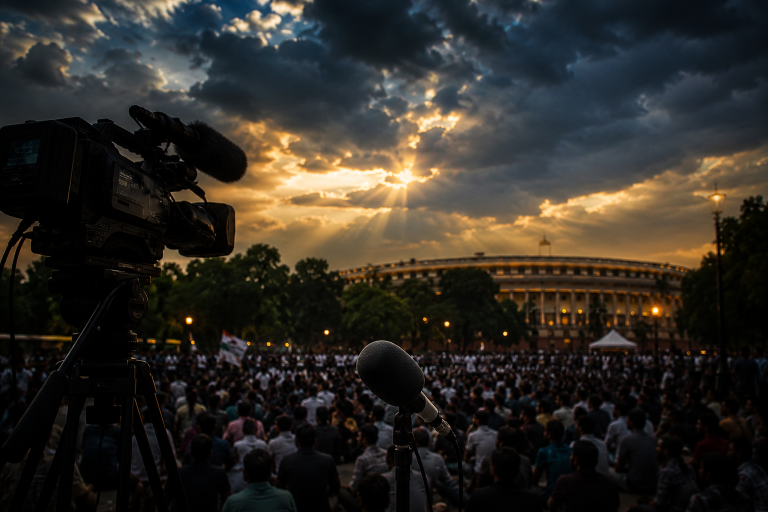
Jantar Mantar Protest: The Narrative War Behind India’s Biggest Political Drama


The Jantar Mantar Spectacle: Protest, Propaganda and the Politics of Narrative
The latest protest drama is being marketed as a spontaneous expression of public anger. Yet to a growing number of Indians, the visible cause appears to be only the front stage of a much larger ideological campaign.
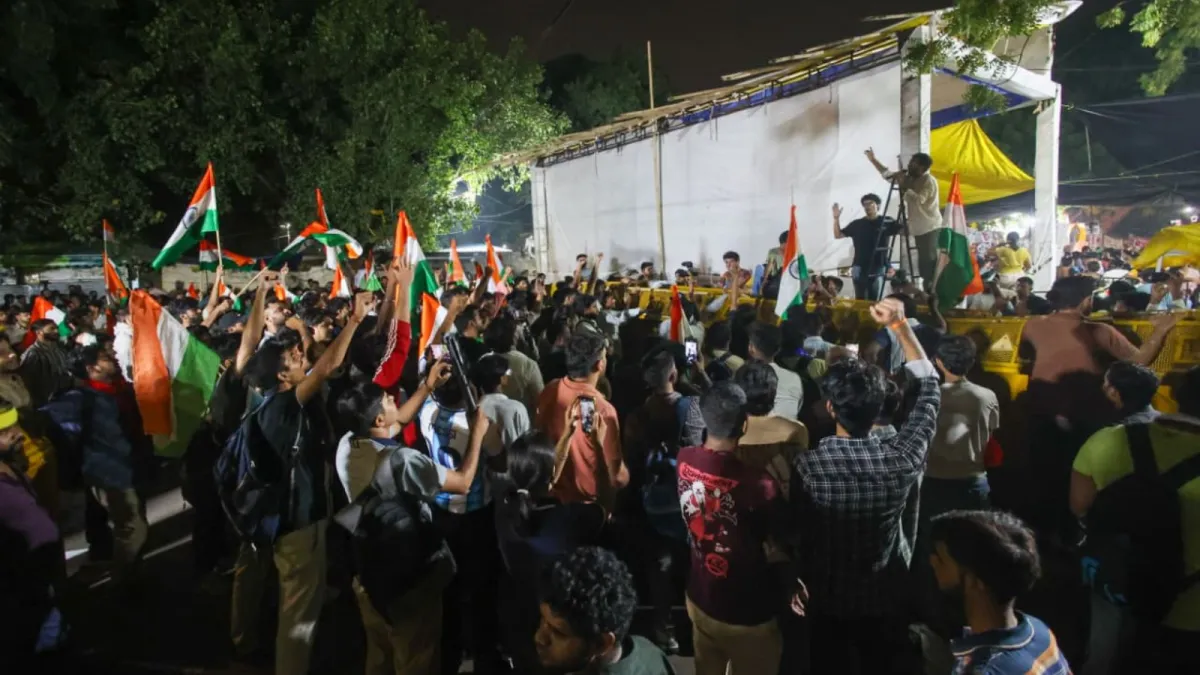
For several days, Jantar Mantar has been turned into the stage for what is being projected as the greatest political drama of the moment. Sonam Wangchuk has been presented as its central hero, surrounded by activists, ideological fellow-travellers, opposition voices and familiar protest networks. But the real story is larger than one man. It concerns the repeated use of public grievance as the visible cover for a wider political and ideological campaign.
The advertised cause may sound genuine, emotional and morally urgent. Yet the growing suspicion among ordinary citizens is that the public demand is merely the set of teeth displayed to the crowd, while the real teeth are used for a different purpose. The old saying, “Hathi ke daant khane ke aur, dikhane ke aur,” describes this political method with remarkable accuracy: what is shown is not necessarily what is intended.
The visible grievance attracts sympathy. The concealed political objective converts that sympathy into narrative power. Central argument
IThe Cause and the Concealed Agenda
Every democracy must allow citizens to raise legitimate grievances. Examination failures, unemployment, administrative lapses and regional demands deserve serious public discussion. But not every gathering that adopts a genuine issue remains genuinely committed to solving it. A protest can begin with one demand and gradually become a platform for an entirely different political programme.
This is precisely what many Indians believe they are witnessing. A specific cause is selected because it can generate public sympathy. Once attention is secured, the vocabulary begins to change. The protest is widened to include the government, the Constitution, federalism, Kashmir, Article 370, minority politics, alleged threats to democracy, attacks on Sanatan traditions and every other theme that fits the preferred ideological script.
The original issue then becomes secondary. It serves mainly as the emotional entry point. The actual battle is fought over legitimacy: whether the elected government can be portrayed as oppressive, whether India can be described as intolerant, and whether domestic unrest can be presented internationally as evidence of democratic collapse.
A movement should be judged not only by the demand printed on its first banner, but also by the political themes it later absorbs, the organisations that surround it, the timing of its escalation and the narrative it ultimately exports to the public.
IISonam Wangchuk Is Not a National Hero
Sonam Wangchuk may be a recognised activist and public personality, but recognition does not automatically make him a national hero. A popular image, awards, media attention or an assumed association with the film 3 Idiots cannot substitute for democratic legitimacy. Familiarity is not the same as nationwide representation.
The attempt to frame him as a lone, selfless moral figure standing against the machinery of power is itself part of the narrative. Modern protest politics requires a face. It needs a protagonist who can be photographed, quoted and turned into a symbol. Wangchuk fulfils that communication requirement exceptionally well. His public image gives the movement instant visibility that an unknown organiser could never achieve.
Yet the central question is not whether he is articulate, educated or personally committed to a cause. The real question is how his name and image are being used. Is he merely pressing a limited demand, or has he become the most marketable face of a larger anti-establishment coalition? Many citizens increasingly believe the latter.
The glamour attached to the supposed 3 Idiots connection has also helped manufacture an aura of unquestionable credibility. Cinema, however, is not biography. A fictional character cannot be used as evidence of a public figure’s political wisdom, moral authority or right to speak for the country.
Criticising the political elevation of a public figure is not the same as denying that person’s right to speak or protest. The issue is the attempt to transform personal visibility into unquestioned national authority.
IIIThe Familiar Ideological Ecosystem
The most revealing feature of such protests is often not the declared demand but the crowd that gathers around it. Again and again, the same ideological formations appear: sections of the communist Left, radical student bodies, professional activists, anti-government commentators, minority-appeasement networks and groups whose political vocabulary remains consistently hostile to Hindu civilisational identity and the idea of a culturally confident India.
These groups do not represent the full social, cultural or political diversity of India. They are a tightly connected ecosystem with its own institutions, media amplifiers, academic supporters, advocacy language and international contacts. Their strength lies not in numerical representation but in coordination, repetition and their ability to make a small mobilisation look like a national uprising.
Their themes are remarkably predictable. Kashmir soon enters the conversation. Article 370 is revived. Minority victimhood is foregrounded. Hindu organisations are portrayed with suspicion. Sanatan traditions are attacked or mocked. The elected government is described not merely as mistaken but as illegitimate, authoritarian or dangerous.
The cause changes, but the ideological cast often remains the same. One month the issue may be agriculture, another month citizenship, unemployment, examinations, federalism or regional autonomy. The slogans differ; the larger narrative remains familiar.
The issue changes. The cast returns. The script expands. The political conclusion is prepared in advance. A recurring pattern
IVFrom Jantar Mantar protest to Narrative Warfare
Contemporary political agitation is no longer limited to gathering people at a physical location. The real battlefield is the information ecosystem. A few hundred people at Jantar Mantar can be transformed, through selective camera angles, emotional captions, celebrity amplification and coordinated online messaging, into the appearance of a nationwide revolt.
This is narrative warfare. It does not always require an outright lie. It can operate through selection, sequencing and emotional framing. One photograph is repeated while another is ignored. One slogan is translated into international language while inconvenient facts disappear. A limited dispute is described as a national crisis. A politically connected activist is presented as the spontaneous voice of ordinary India.
The objective is to control what the public believes the event represents. Once that representation is fixed, the original grievance becomes almost irrelevant. The protest is no longer about resolving a problem; it becomes a weapon for weakening trust in institutions, delegitimising elected authority and creating the perception that the country is permanently on the edge of rebellion.
This method also explains why international commentary often appears so quickly. A domestic issue is translated into the language most attractive to foreign media: human rights, majoritarianism, authoritarianism, minority persecution or democratic backsliding. The internal complexity of the dispute is stripped away, leaving a convenient story of victim and oppressor.
VA Repeated Political Pattern
India has seen earlier versions of the same political playbook. The anti-corruption agitation that elevated Arvind Kejriwal and eventually produced the Aam Aadmi Party demonstrated how street protest, moral symbolism and continuous television coverage could trigger an earthquake in Indian politics. What began as a movement against corruption soon became the foundation of a political organisation.
Later agitations followed their own variations of the model. The anti-CAA campaign used emotional mobilisation and symbolic occupation. The farmers’ protest began with farm laws but soon attracted unrelated ideological groups, foreign celebrities, separatist sympathisers and global media narratives. In each case, a specific grievance became the meeting ground for a much broader political coalition.
This does not prove that every participant was insincere or that no genuine concern existed. It does, however, demonstrate how quickly legitimate grievances can be captured by organised political actors whose objective is larger than the original demand.
What happened in neighbouring countries has made the pattern even more important to examine. Youth-led movements in Nepal and Bangladesh, along with regime-change protests elsewhere, have shown how quickly discontent can be converted into a campaign against the entire state structure. Similar language has periodically been echoed in India, though it has not achieved the same result.
Historical comparison should not be treated as proof of identical planning. It is evidence of a recurring political method: select a grievance, create a symbol, assemble a coalition, escalate the emotional frame and broaden the target from a policy to the legitimacy of the system itself.
VIThe Question of External Support and Vested Interests
Many Indians suspect that large-scale efforts to destabilise the country are not always entirely domestic. Concerns about foreign funding, international advocacy networks, external political influence and the use of civil society organisations for strategic purposes are not imaginary concepts. Democracies across the world regulate foreign influence precisely because money, messaging and institutional support can shape domestic politics.
At the same time, seriousness requires a distinction between suspicion and established proof. Allegations of a “deep state,” foreign sponsorship or externally directed agitation must be tested against financial records, regulatory findings, court proceedings and credible investigations. A responsible editorial should not invent evidence; it should insist that transparency be demanded.
The proper question is therefore not whether every protester is a foreign agent. That would be an absurd and unfair claim. The real question is whether organised networks receive financial, institutional, strategic or media assistance that is hidden from the public while they present themselves as purely spontaneous citizens’ movements.
Transparency should apply equally to all sides. Political parties, activist organisations, NGOs, digital platforms, advocacy groups and media outlets must disclose interests capable of influencing their campaigns. A democracy cannot protect itself if citizens are denied knowledge of who funds the narratives competing for their loyalty.
VIIWhy the Public Is More Sceptical Today
The organisers of such spectacles frequently underestimate the Indian public. The citizen of 2026 is not the citizen of the early television era. People have watched repeated protest cycles. They have seen slogans change overnight, unrelated causes enter the same stage, political leaders arrive for photographs and social-media accounts circulate identical language in coordinated waves.
This experience has produced scepticism. Citizens now ask who benefits. They compare the original demand with the movement’s later messaging. They notice when protests that claim to represent the entire nation repeatedly draw support from the same limited ideological circle. They observe how Indian institutions are condemned abroad before domestic processes have even concluded.
The phrase “Janta sab kuch jaanti hai” is not merely a slogan. It expresses a political reality: voters may remain silent, but silence does not mean ignorance. They absorb events, evaluate motives and ultimately respond through public opinion and elections.
The failure of recent attempts to generate mass mobilisation may indicate that the old formula is losing effectiveness. The loudest online campaign is not necessarily the largest public movement. Repetition cannot indefinitely disguise the absence of broad social support.
A handful of organised voices can dominate a news cycle. They cannot automatically claim to represent 1.4 billion Indians. Public representation versus media visibility
VIIIRights, Duties and Democratic Limits
India’s constitutional order protects freedom of speech and peaceful assembly. These protections are essential, especially when citizens challenge those in power. But constitutional rights do not create a licence to obstruct public life indefinitely, spread hatred, conceal material interests or convert every disagreement into a campaign against the legitimacy of the nation itself.
Protesters have a right to be heard. They do not possess an automatic right to have every demand accepted. Nor does dissent become sacred merely because it is performed through a hunger strike, celebrity endorsement or emotionally powerful imagery.
The state, for its part, must act proportionately and within the law. Heavy-handed action can supply activists with precisely the imagery they need. Democratic governments should therefore respond with transparency, evidence, public communication and lawful restraint.
The constitutional balance requires two forms of accountability: the government must explain its decisions, and protest movements must explain their funding, affiliations, methods and expanding agendas. Scrutiny cannot be reserved for only one side.
IXThe Citizen Is the Final Judge
The Jantar Mantar episode should be understood not simply as a dispute over a particular demand but as a lesson in modern political theatre. The public sees a cause. Behind it stands a communication strategy. Around it gathers an ideological coalition. Beyond it lies a battle to define India for domestic and international audiences.
Sonam Wangchuk should not be granted the status of national hero merely because a section of the media has placed him at the centre of the stage. Nor should a familiar alliance of Left activists, political opponents and professional campaigners be allowed to claim that it represents the whole of Indian society. Visibility is not legitimacy. Noise is not consensus.
At the same time, citizens must resist easy conclusions from every direction. Claims of foreign control, deep-state planning or hidden funding should be investigated and demonstrated, not merely repeated. National interest is strengthened by evidence, transparency and public vigilance—not by careless accusation.
The larger truth is that Indians have become more alert to manufactured outrage. They recognise the recurring cast, the shifting slogans and the way one grievance is used to carry a much larger ideological cargo. The attempt to create unrest through narrative warfare may continue, but the organisers can no longer assume that the public will accept every carefully staged drama at face value.
Democracy depends upon the right to dissent, but national resilience depends upon the ability to distinguish dissent from manipulation. That judgment cannot be outsourced to activists, television studios, governments or foreign commentators. It belongs to the citizen.
Time will reveal whether the Jantar Mantar mobilisation represented a genuine nationwide awakening or merely another political spectacle built by a familiar ideological ecosystem. For now, one fact is increasingly difficult to ignore: the audience is watching the actors—but it is also beginning to understand the script.
Discover more from
Subscribe to get the latest posts sent to your email.







1 COMMENTS