
Beyond Marks: 50+ Students Honoured as Education Excellence Conclave 2026 Redefines What Educational Success Really Means


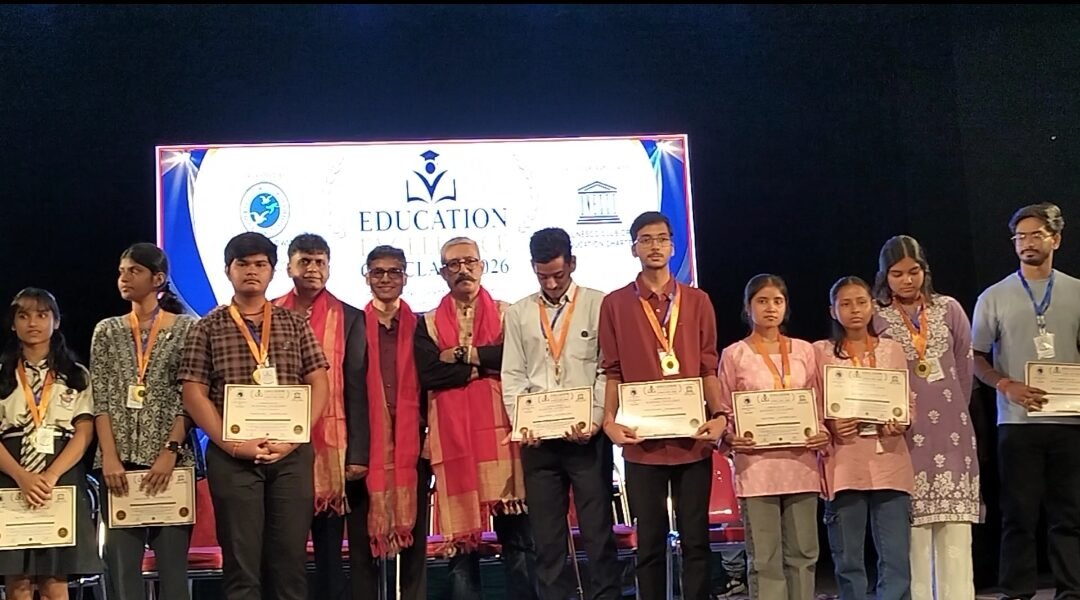
A felicitation ceremony can easily become a sequence of certificates, photographs and applause. But the Education Excellence Conclave 2026, held in Chinsurah, attempted to move beyond that familiar format by asking a more meaningful question: what exactly are we celebrating — the number on a marksheet, or the effort that made that number possible?
That thought became the central spirit of an event that brought together students, parents, educators and institutional leaders from Saraswati World School, South Melior School and Prom High School.
More than 50 students were felicitated for their academic achievements, while over 50 students participated in cultural performances, including dance and songs — turning the Education Excellence Conclave 2026 into a celebration not only of academic success, but also of creativity, confidence and student expression.
Distinguished Guests Join the Celebration
The programme was attended by Shri Subir Nag, MLA, Chinsurah, and Shri Dipanjan Chakraborty, MLA, Uttarpara. Their presence added significance to an occasion devoted to recognising young achievers and encouraging educational excellence.
The chairmen of South Melior School and Prom High School, along with the principals of the participating institutions, attended the programme. The leadership, principal, teachers, students and parents of Saraswati World School also participated enthusiastically.
The programme was presided over by Vikrant Singh, Chairman, CCLP Worldwide , and Vinod Singh, Vice Chairman, CCLP Worldwide.
Beyond Marks: What Are We Really Celebrating?
One of the strongest ideas emerging from the Education Excellence Conclave was that academic achievement deserves recognition — but a marksheet can never tell the complete story of a student’s education.
Marks matter. They demand discipline, focus and consistency. But students were reminded that marks can open a door; they cannot decide what a person does after walking through it.
A marksheet cannot fully answer whether a young person can lead, listen, recover from failure, stand for what is right when doing so becomes difficult, or use knowledge responsibly.
These qualities become increasingly important as students move from examinations into higher education, careers and eventually positions of responsibility.
Bhagavad Gita and the Value of Effort
The keynote address also connected the philosophy of the Education Excellence Conclave with the timeless teaching of the Bhagavad Gita through the verse:
The message was particularly relevant to young achievers: while results matter, students should not allow themselves to become defined only by outcomes. Their greater responsibility lies in sincere effort, discipline, perseverance and right action.
In that sense, the Education Excellence Conclave 2026 was not simply celebrating the phala — the result printed on a marksheet — but also the karma: the effort, discipline and striving that produced it.
The World Is Changing Faster Than the Syllabus
Artificial Intelligence brought another contemporary dimension to the educational discussion.
AI can already write, calculate, translate, analyse and solve increasingly complex problems. Information that once took hours to find can now appear on a screen within seconds.
That raises a fundamental question for schools: if machines can provide information, what should education provide?
The answer presented at the Education Excellence Conclave was clear: education must increasingly teach students how to think, not merely what to remember.
Students need the ability to question responsibly, distinguish reliable information from misinformation, create, collaborate, communicate and make ethical choices.
Three Schools, Three Distinct Educational Recognitions
A special part of the Education Excellence Conclave 2026 was dedicated to recognising the three participating schools for distinctive dimensions of their educational work.
Importantly, the recognitions were not presented as a ranking or comparison between schools. Instead, they acknowledged different educational strengths and approaches that contribute to student development.
Saraswati World School
Saraswati World School was recognised for its continuing commitment to integrating academic learning with experiential education, technology, creativity, communication, student leadership and character development. The recognition celebrated the school’s efforts to prepare learners not only for examinations, but also for the opportunities, responsibilities and challenges of a rapidly changing future.
South Melior School
South Melior School was honoured for its commitment to nurturing confident, responsible and value-driven learners. The recognition highlighted the school’s efforts to empower students through participation, self-expression and responsibility while strengthening values such as integrity, respect, discipline, empathy and character.
Prom High School
Prom High School was recognised for creating an educational environment in which academic learning is strengthened by discipline, responsibility and enduring human values. The honour also acknowledged its emphasis on the intellectual, social, emotional, physical and ethical development of students.
Success Was Celebrated — But Failure Was Discussed Too
Perhaps one of the more unusual aspects of the programme was its willingness to talk about failure on a day devoted to celebrating success.
Young achievers were reminded that, at some point in life, each of them may fail at something — an examination, an interview, a project or even an idea in which they strongly believe.
The important lesson, however, is that failure does not mean that their story has ended.
A Message to Parents: Let Recognition Build Confidence, Not Fear
Parents were also brought into the larger conversation around educational achievement.
Behind many successful students are years of parental encouragement, concern, sacrifice and quiet support. The Education Excellence Conclave acknowledged that when a child’s name is announced on stage, parents too are part of that moment.
At the same time, parents were encouraged not to turn achievement into another burden.
A student who scores 95 per cent should not immediately be made to feel that 98 per cent is the only acceptable next step. Constant escalation of expectations can turn recognition into anxiety.
The Quiet Power of Teachers
Teachers were acknowledged not merely for delivering lessons or preparing students for examinations, but for something much harder to measure — their ability to create belief.
Years later, a student may forget the chapter a teacher taught. They may forget a homework assignment or even the marks they received in a particular subject.
But many remember the teacher who encouraged them at precisely the moment they were losing confidence.
That was described during the programme as the quiet power of teaching — the ability of one sentence of encouragement to travel far beyond the classroom.
UNESCO’s Educational Ideals and the Human Purpose of Learning
An address from the UNESCO Club of Education Charter connected the programme with the broader educational ideals associated with UNESCO — including peace, human dignity, intercultural understanding, responsible citizenship and the transformative role of education.
The address referred to the foundational UNESCO idea:
The message placed education within a wider human context. Education is not simply an instrument for examinations, careers or economic advancement. It also shapes how people understand one another, respond to differences and participate responsibly in society.
The address also referred to the well-known four pillars of learning: learning to know, learning to do, learning to live together and learning to be.
Particular emphasis was placed on “learning to be” — the dimension of education that cannot be reduced to examination scores.
It is reflected instead in how people treat others, handle disagreement, carry success, respond to responsibility and develop as human beings.
Culture, Music and the Other Side of Education

The Education Excellence Conclave was not confined to speeches and felicitation. Dance, songs and cultural presentations by students brought energy and colour to the programme.
More than 50 students participated in the cultural segment, demonstrating another important aspect of education: children’s abilities cannot be understood through examination marks alone.
Art, music, teamwork, stage confidence, creativity and expression are also important dimensions of holistic student development.
Recognition Is Where Responsibility Begins
As the programme moved towards its conclusion, the young awardees were encouraged to enjoy their moment of recognition — but also to understand that the certificate they received represented something larger.
By the following day, the certificate might be placed safely at home. Life, however, would continue.
Students were therefore encouraged not to think of the recognition only as a reward for what they had already done, but as an invitation to what they could become.
Greater opportunity, they were reminded, should bring greater responsibility. If they gain influence in the future, they should use it to lift others. And if they become successful, they should never become so successful that they forget those who helped them reach there.
More Than a Felicitation Ceremony
With students, parents, teachers, principals, school leaders and distinguished guests participating with enthusiasm, Education Excellence Conclave 2026 ultimately became more than an award ceremony.
It became a platform for celebrating achievement while simultaneously asking what educational excellence should mean in a rapidly changing world.
The programme concluded with a Vote of Thanks, bringing together a day of student recognition, institutional honours, keynote reflections, cultural performances and a larger conversation about education, values and the future.
Knowledge will help you move forward.
But character will determine how far that journey is truly worth travelling.”
For the students who walked onto the stage to receive recognition, the applause marked an achievement. But perhaps the more important message of the evening was what happens after the applause ends: the values they carry, the choices they make and the contribution they eventually make to the world around them.
Discover more from
Subscribe to get the latest posts sent to your email.







1 COMMENTS