Future Ready School: Powerful Kolkata Conclave to Redefine Education for Tomorrow


EDUCATION | KOLKATA
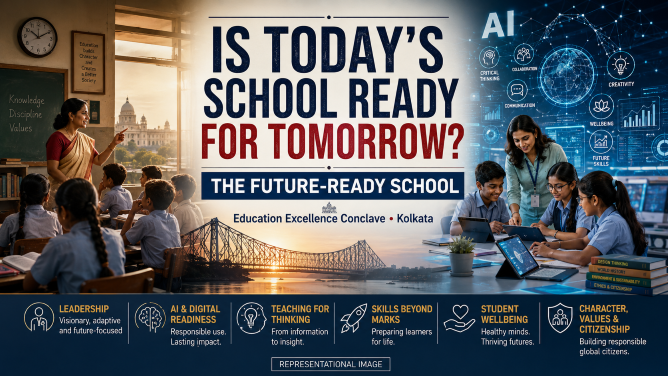
Is Today’s School Ready for Tomorrow? Kolkata Conclave to Explore the Future Ready School
As artificial intelligence transforms learning and work, the forthcoming Education Excellence Conclave — Kolkata seeks to move the conversation beyond technology towards teachers, leadership, critical thinking, wellbeing, values and the changing purpose of schooling.
KOLKATA: For generations, the fundamental structure of schooling has remained remarkably familiar — classrooms, teachers, textbooks, examinations and marks.
But the world outside those classrooms is changing at extraordinary speed.
Artificial Intelligence can now generate text, explain complex concepts, analyse information and support learning within seconds. Digital platforms have transformed access to knowledge. Workplace expectations are evolving, and children are growing up in an environment fundamentally different from the one in which many of their teachers and parents were educated.
This raises what may become one of the defining educational questions of our time:
Is today’s school ready for tomorrow’s world?
That question will form the intellectual foundation of the forthcoming Education Excellence Conclave — Kolkata , being developed around the theme:
THE FUTURE READY SCHOOL
Preparing Schools. Empowering Educators. Reimagining Learning.
The initiative seeks to bring together school leaders, educators, thinkers and education stakeholders for a wider conversation about what schools must preserve, what they must change and what they must begin preparing for.
The Future Ready School Is Not Simply a Digital School
One of the biggest mistakes in discussing the future of education may be to equate “future-ready” simply with having more technology.
Smartboards, digital classrooms, learning applications and Artificial Intelligence can be powerful tools. But technology alone cannot define the quality or future-readiness of a school.
The more important questions are deeper.
- Can students think independently?
- Can they distinguish reliable information from misinformation?
- Can they communicate their ideas effectively?
- Can they solve unfamiliar problems?
- Can they collaborate and adapt?
- Can they use Artificial Intelligence without surrendering their own ability to think?
And perhaps most importantly: can education produce capable human beings with character, empathy, responsibility and judgement?
These questions are becoming increasingly significant as Artificial Intelligence enters education.
UNESCO advocates a human-centred approach to Artificial Intelligence in education. Its work recognises both AI’s potential to support teaching and learning and the risks that can emerge when technological development moves faster than educational policy, ethical frameworks and institutional preparedness.
UNESCO’s AI competency frameworks also emphasise that teachers and students need more than technical familiarity with AI. Human agency, ethical understanding, critical judgement and responsible use remain central to meaningful AI integration in education.
Six Questions That Could Define the Future Ready School
1. Future-Ready Leadership
Transformation cannot begin with technology alone. It begins with leadership.
School leaders increasingly have to make decisions about curriculum, technology, teacher development, student wellbeing, assessment and institutional culture in an environment where change is continuous.
The future-ready principal or school leader may therefore need to be not merely an administrator, but also a learner, strategist and change leader.
2. AI and Digital Readiness
Schools cannot ignore Artificial Intelligence.
But neither can they adopt it without understanding its limitations.
The real challenge is to develop responsible AI literacy among teachers and students — understanding where AI can assist learning and productivity, where human judgement remains essential and where ethical boundaries need to be established.
3. Teaching Students How to Think
Education systems have historically placed enormous importance on the acquisition and reproduction of information.
But when information — and increasingly even answers — can be generated almost instantly, the value of questioning, reasoning, interpretation and judgement becomes greater.
A future-ready classroom cannot merely ask:
“Does the student know the answer?”
It must increasingly ask:
“Can the student understand, question, analyse and apply what he or she knows?”
4. Skills Beyond Marks
Academic achievement will remain important.
But marks alone cannot represent the complete preparation of a child for an uncertain future.
Communication, creativity, collaboration, adaptability, problem-solving and the confidence to continue learning are increasingly important educational outcomes.
The challenge for schools is not to abandon academic excellence, but to expand the meaning of excellence.
5. Student Wellbeing
A high-performing student is not necessarily a flourishing student.
Children today are growing up amid academic expectations, social-media exposure, information overload, competition and rapidly changing social environments.
The future ready school must therefore recognise student wellbeing not as an extracurricular concern, but as an important part of creating the conditions in which meaningful learning can take place.
6. Character, Values and Citizenship
Perhaps one of the greatest paradoxes of the technological age is that the more powerful technology becomes, the more important human judgement may become.
Knowledge without responsibility can be dangerous. Intelligence without empathy can be incomplete. Technological ability without ethics can create consequences far beyond the classroom.
Education must therefore continue to ask an ancient but enduring question:
What kind of human being are we educating?
The Teacher Cannot Become Secondary
The rise of Artificial Intelligence has sometimes produced predictions that technology could eventually replace important parts of the teacher’s role.
But the more meaningful educational debate may point in another direction.
When information becomes abundant, the teacher’s role as mentor, facilitator, interpreter and human connection may become even more significant.
UNESCO’s AI Competency Framework for Teachers identifies 15 competencies across five broad dimensions: a human-centred mindset, ethics of AI, AI foundations and applications, AI pedagogy, and AI for professional learning.
The framework is built around principles including protection of teachers’ rights and enhancement of human agency.
The future-ready teacher, therefore, is unlikely to be the teacher who competes with technology.
From an Event to an Education Conversation
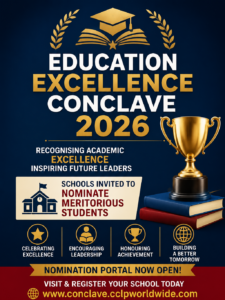
The Education Excellence Conclave has previously provided a platform for recognising educational achievement and bringing schools and education stakeholders together.
The forthcoming Kolkata chapter represents an evolution of that journey.
Under “The Future Ready School”, the emphasis moves towards dialogue, ideas, institutional learning and the challenges that schools themselves are beginning to confront.
Rather than claiming to possess a single formula for the school of tomorrow, the initiative begins with questions.
- What should schools retain from traditional education?
- What needs to change?
- How should teachers be prepared?
- Where should AI be used — and where should it not?
- How should educational success be measured?
- What abilities will children educated today actually require ten or twenty years from now?
These questions cannot be answered by technology companies alone.
They require participation from principals, teachers, education leaders, parents, researchers, policymakers and, ultimately, students themselves.
Why Kolkata?
Kolkata has a deep intellectual and educational tradition.
A city associated with universities, schools, literature, science, social reform and generations of teachers and thinkers provides an important setting for a discussion about the next transformation of education.
But the objective of the conclave is not simply to predict futuristic classrooms.
The more immediate challenge is practical:
What can a school begin doing today to become better prepared for tomorrow?
That may ultimately be the most valuable question behind the Education Excellence Conclave — Kolkata.
Because the future ready school will not be created on the day the future arrives.
It has to be built before it does.
Education Excellence Conclave — Kolkata
Theme: THE FUTURE READY SCHOOL
Proposition: Preparing Schools. Empowering Educators. Reimagining Learning.
Further details regarding the Kolkata edition, participation, programme and associated initiatives will be announced progressively.
Website: www.conclave.cclpworldwide.com
Email: conclave@cclpworldwide.com
Discover more from
Subscribe to get the latest posts sent to your email.