
Vande Mataram Row: Why Should the 1937 Two-Stanza Compromise Continue in 2026?


Vande Mataram: Why Should a 1937 Political Compromise Still Bind India in 2026?
Congress has reaffirmed its decades-old two-stanza practice. Amit Shah calls it appeasement. Parliament has extended legal protection to the National Song. The controversy now raises a question larger than party politics: can a historical compromise never be reconsidered?
Vande Mataram has returned to the centre of Indian political debate, but the controversy is not really about two lines, two parties or even one parliamentary law. At its heart lies a much more difficult question: should a political accommodation made in colonial India in 1937 automatically remain binding on the national imagination of India in 2026?
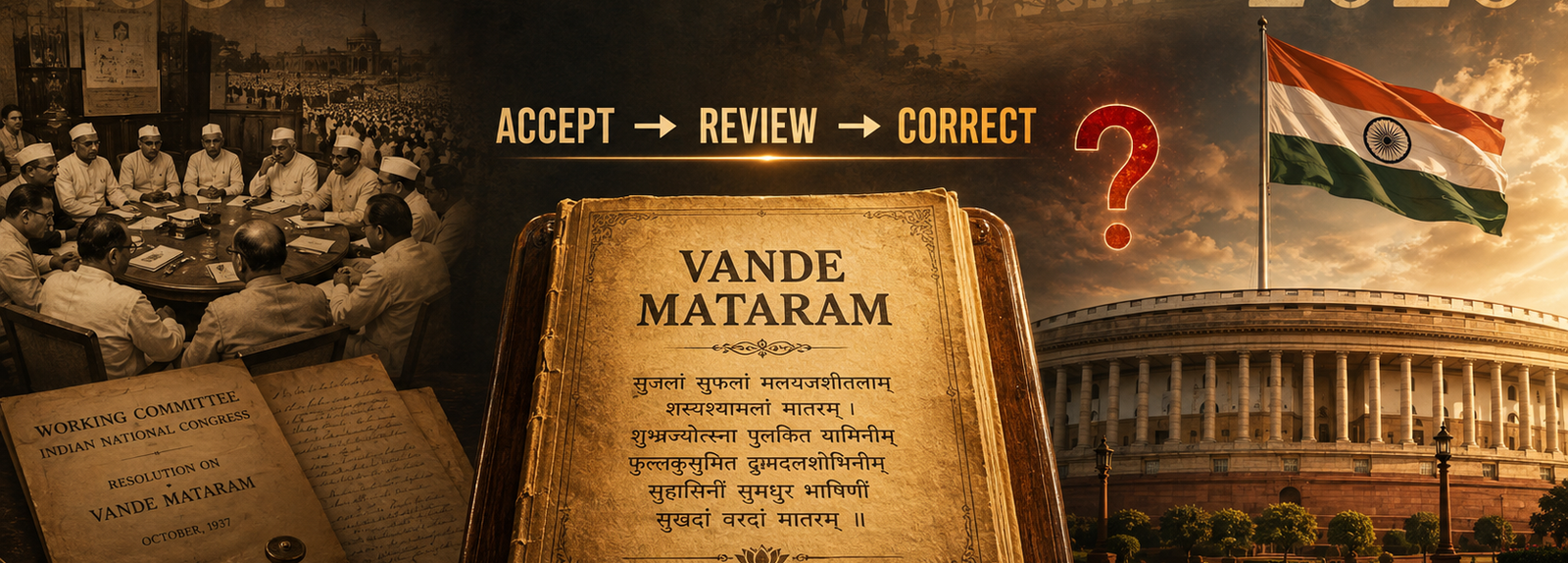
The immediate controversy began after the Congress Working Committee reaffirmed its longstanding practice of singing only the first two stanzas of Vande Mataram at party programmes.
The position traces itself back to the Congress Working Committee’s 1937 decision, adopted amid objections to religious imagery contained in later portions of Bankim Chandra Chattopadhyay’s celebrated composition.
Union Home Minister Amit Shah responded sharply, describing the Congress position as a continuation of appeasement politics.
He has argued that the 1937 decision did more than shorten a song: in his interpretation, it represented a political tendency to concede space to communal pressure, a tendency he links to the environment in which separatist politics subsequently intensified.
Congress rejects that characterisation. Its leaders argue that the first-two-stanza convention has deep historical roots and that the BJP is converting an established practice into a contemporary political controversy.
What Actually Happened in 1937?
Vande Mataram was written by Bankim Chandra Chattopadhyay decades before 1937 and later became inseparable from India’s freedom movement.
During the Swadeshi period, the words became a rallying cry against colonial rule.
The first two stanzas celebrate the motherland through images of water, fertility, greenery, moonlight and beauty.
Later portions employ more explicitly Hindu sacred imagery, including references associated with Durga, Lakshmi and Saraswati.
By the 1930s, objections had emerged from sections of Muslim political opinion.
Congress leaders sought a formula that could retain the song’s place in the national movement without aggravating communal tensions.
Rabindranath Tagore was consulted, and the Congress Working Committee ultimately accepted the first two stanzas for its public political use.
Understanding a Compromise Is Not the Same as Making It Permanent
Historical decisions must be judged within their context.
India in 1937 was not sovereign. British rule continued. Communal mobilisation was intensifying.
Congress was attempting to build and preserve a broad anti-colonial coalition.
Those realities explain why compromise may have appeared necessary.
But explanation is not the same as permanent endorsement.
Laws change. Political conventions change. Public institutions review old practices. Even constitutional arrangements can be amended through lawful democratic processes.
Was 1937 Part of a Larger Politics of Accommodation?
Amit Shah has gone further, arguing that the 1937 decision reflected appeasement and contributed to a political climate in which separatist demands gained strength.
It would be historically simplistic to claim that one decision over Vande Mataram caused the Partition of India.
Partition resulted from a complex interaction of British colonial policy, communal mobilisation, the Muslim League’s politics, the Two-Nation Theory, failures of political negotiation and escalating violence.
Yet that does not make the 1937 decision irrelevant to the debate.
A legitimate historical question remains: was it one manifestation of a broader willingness to adjust national symbols in response to communal political pressure?
The 2026 Law Changes the Context
Parliament has now amended the Prevention of Insults to National Honour Act, 1971 to extend legal protection to Vande Mataram comparable to that already provided to the National Anthem.
WHAT THE 2026 AMENDMENT DOES
It makes it an offence to intentionally prevent the singing of Vande Mataram.
It also covers deliberate disturbance of an assembly engaged in singing the National Song.
The provision should not automatically be read as saying that every occasion must legally include every stanza.
The political debate over the complete song is therefore broader than the criminal offence created by the amendment.
This distinction matters. Respect for national symbols deserves serious discussion, but the law must be represented accurately.
Watch: Why Is the 1937 Compromise Still Being Defended?
1937 Was Colonial India. What Is the Pressure in 2026?
This is where the present controversy becomes more difficult for those defending the old arrangement solely because it is old.
India today is sovereign.
It has its own Constitution, Parliament, courts and elected government.
The political pressures of colonial India cannot simply be reproduced as unquestionable rules for the Republic.
If Congress believes the 1937 compromise remains appropriate, it is entitled to defend that position.
But the stronger question is why the arrangement should be considered immune from reassessment.
Would it not have been possible to say that the decision was taken in a particular historical environment, that the country has since changed, and that national practices can now be reviewed in light of contemporary realities?
We Reject Deliberate Incompleteness Almost Everywhere Else
Consider a simple analogy.
If a book contains ten chapters but readers are permanently told that several chapters cannot be made available because their contents are politically uncomfortable, most people would ask why.
If a university course intentionally removes chapters from study, the student would reasonably want to understand what has been excluded and on whose authority.
If the final portion of a film were permanently withheld not for time constraints but because its ideas offended a political constituency, audiences would distinguish that from an ordinary shortened screening.
Temporary Abridgement
A shorter rendition because of time, ceremony or practical format can be understandable.
Permanent Political Exclusion
Deliberately excluding part of a cultural work indefinitely because of political objection raises a fundamentally different question.
The distinction is important.
The issue is not that every rendition, everywhere, must necessarily be of identical length.
The deeper debate is whether a politically motivated exclusion made generations ago should become a permanent limitation on how the national song itself is understood.
Is Refusing to Review an Old Decision Really Progressive?
Political debate frequently uses the language of progress.
Yet progress normally involves examination, correction and adaptation.
If the circumstances that produced a policy have substantially changed, reviewing that policy is not regression.
It can be the essence of democratic maturity.
The Question of Appeasement Cannot Simply Be Wished Away
Congress can legitimately argue that its current decision represents historical continuity rather than hostility toward Vande Mataram.
But if the reason for refusing reconsideration remains fear that a particular electoral constituency may object to the complete work, then the allegation of vote-bank politics inevitably returns.
Dialogue is possible.
Historical explanation is possible.
Religious disagreement is possible in a plural democracy.
The question is whether disagreement should always be answered by permanently deleting the object of disagreement from public presentation.
Why Should Today’s Citizen Inherit an Unquestioned 1937 Settlement?
A young Indian born decades after Independence had no role in the political calculations of 1937.
If that student reads Vande Mataram today and asks why some sections became politically excluded from routine rendition, the responsible answer should not simply be: “because that is what was decided 89 years ago.”
History deserves something better.
Tell the student what happened.
Explain the objections.
Explain the Congress position.
Explain Tagore’s intervention.
Explain the freedom struggle.
Explain the later political consequences and disagreements.
Then allow a new generation to examine whether yesterday’s political compromise should remain tomorrow’s permanent convention.
The Larger Point
This controversy should not end as another shouting match between BJP and Congress.
No political party owns Vande Mataram.
Its history predates today’s party battles and its place in India’s freedom movement belongs to the country as a whole.
Congress need not erase its 1937 decision.
India need not pretend that the decision never happened.
But acknowledging history does not require society to become its prisoner.
Perhaps the more mature formula is simple: accept the history, understand why the compromise was made, review whether those circumstances still exist, and correct what democratic India believes should no longer remain unchanged.
Editorial note: This article is a News24Media analysis of an ongoing political and historical controversy. Statements attributing appeasement, responsibility for political polarisation or links to Partition represent political or editorial interpretations where indicated and should not be read as establishing a single-cause explanation of Partition. The legal discussion reflects the stated scope of the 2026 amendment concerning intentional prevention or disturbance of the singing of Vande Mataram.
Discover more from
Subscribe to get the latest posts sent to your email.







1 COMMENTS