

EDUCATION | FUTURE-READY SCHOOL | ARTIFICIAL INTELLIGENCE
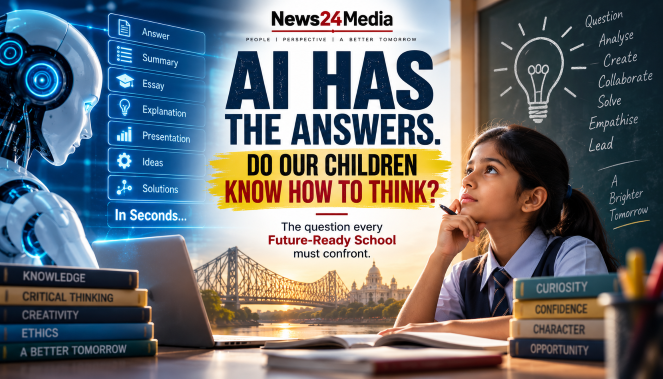
Future Ready School: When AI Can Give Every Answer, What Should We Teach Our Children?
For generations, schools rewarded students for knowing the answer. Artificial Intelligence can now produce answers, essays, explanations and ideas within seconds. Does that make education less important — or does it force us to rethink what real learning actually means?
KOLKATA: Imagine a classroom examination question:
“Explain the causes of climate change.”
A student once had to remember the relevant concepts, organise them, construct sentences and produce an answer.
Today, an Artificial Intelligence tool can generate a polished response almost instantly.
Ask it to simplify the answer for a Class VI student — it can do that.
Ask for ten points — done.
Ask for an essay, a presentation, a debate, a summary or possible examination questions — all within seconds.
And this leads to an uncomfortable but unavoidable question for education:
This is not an argument against Artificial Intelligence.
Nor is it a prediction that teachers, schools or books will suddenly become irrelevant.
In fact, the opposite may be true.
It may make shallow education less valuable.
The Problem Is Not That AI Knows Too Much
The more interesting problem is that education has often rewarded students for doing precisely the kind of work that machines are becoming increasingly capable of doing.
Remember the information.
Reproduce the definition.
Write the expected answer.
Follow the format.
Score the marks.
There is nothing inherently wrong with knowledge or memory. Students cannot think deeply about something they know absolutely nothing about.
But remembering information and understanding information are not the same thing.
And in an age where information is available almost everywhere, education may need to place much greater value on what happens after information is available.
Knowing the answer is useful.
Knowing whether the answer is correct may become even more valuable.
The Student of Tomorrow Needs a New Superpower: Judgement
Generative AI can produce remarkably convincing responses.
But convincing is not the same as correct.
AI systems can produce incomplete information, outdated assumptions, misleading interpretations or confidently stated errors.
This means that students increasingly need something that cannot simply be outsourced to a machine:
judgement.
A student should be able to ask:
- Is this information actually correct?
- What evidence supports it?
- What might be missing?
- Is there another interpretation?
- What assumptions is this answer making?
- Could the source be biased?
- Does the conclusion logically follow from the evidence?
These questions represent something much deeper than digital literacy.
They represent intellectual independence.
UNESCO’s Message Is Important: Students Must Remain Human Agents
The global educational conversation is already moving in this direction.
UNESCO’s AI Competency Framework for Students identifies twelve competencies across four broad dimensions: a human-centred mindset, ethics of AI, AI techniques and applications, and AI system design.
Significantly, the framework does not envision children merely becoming efficient users of Artificial Intelligence.
It emphasises critical judgement of AI solutions, responsible citizenship, human agency and the ability to understand, apply and eventually create with AI.
This distinction matters enormously.
From “What Is the Answer?” to “Why Do You Think So?”
This may require one of the most important changes in classroom culture.
Consider two teachers.
The first teacher asks:
“What is the answer?”
The second asks:
“Why do you believe that is the answer?”
The difference appears small.
Educationally, it is enormous.
The first question tests recall or conclusion.
The second begins to reveal thinking.
And that ability to explain, defend, question and reconsider one’s reasoning could become increasingly important in an AI-enabled world.
What Should a Future-Ready School Teach?
1 Teach Children to Ask Better Questions
Schools have traditionally spent enormous effort teaching students how to answer questions.
The future may demand greater attention to teaching them how to formulate questions.
A vague question produces a shallow investigation.
A thoughtful question opens possibilities.
Curiosity therefore cannot remain an accidental by-product of schooling. It must become an educational outcome.
2 Teach Them to Verify
The internet created an information-rich world.
Artificial Intelligence creates something even more challenging: a world in which information can be generated specifically for the person asking for it.
Students therefore need habits of verification.
Check the source.
Compare claims.
Look for evidence.
Separate fact from interpretation.
Recognise uncertainty.
And perhaps most importantly:
learn that a confident answer is not automatically a correct answer.
3 Teach Them to Disagree Intelligently
Real critical thinking is not simply criticising everything.
It means being able to consider competing ideas, evaluate evidence and change one’s conclusion when better evidence appears.
A future-ready classroom should therefore create space for debate, discussion and respectful disagreement.
Students should learn to say:
“I disagree, and here is why.”
That sentence may be more educationally valuable than simply reproducing the teacher’s preferred conclusion.
4 Teach Application, Not Only Reproduction
A student may memorise a mathematical formula.
But can the student recognise where it should be applied?
A student may know the definition of pollution.
But can the student examine the neighbourhood and identify an environmental problem?
A student may describe entrepreneurship.
But can the student identify a problem and design a possible solution?
The future-ready school must increasingly connect knowledge with application.
5 Teach Creativity — Including Creativity With AI
Trying to keep Artificial Intelligence completely outside education may eventually prove as unrealistic as trying to keep calculators, computers or the internet outside it.
The better question is how students should use these tools.
AI can help generate possibilities.
It can provide feedback.
It can simulate conversations.
It can help students explore different perspectives.
It can assist research and creation.
But using AI to expand one’s thinking is fundamentally different from using AI to avoid thinking.
It should increasingly become: “What thinking did the student contribute?”
6 Teach Ethics Before Capability
A child may learn how to generate an image.
But should every image be generated?
A student may know how to imitate someone’s voice.
But should it be done without consent?
AI increases capability.
And every increase in capability creates a corresponding need for responsibility.
This is why ethics, empathy, privacy, intellectual honesty and digital citizenship cannot be treated as optional additions to future-ready education.
What Happens to Homework?
This may be one of the most immediate practical challenges facing schools.
If a conventional homework question can be completed perfectly by AI in thirty seconds, teachers face a difficult choice.
They can spend enormous energy trying to police technology.
Or they can begin redesigning some assignments so that simply obtaining an answer is no longer sufficient.
For example, instead of:
“Write 500 words on water conservation.”
a student might be asked to:
- Identify one water-related problem in the local community.
- Photograph or document evidence.
- Interview two people.
- Use AI to suggest possible solutions.
- Evaluate which suggestions are realistic.
- Present a personal recommendation.
- Explain where AI helped and where human judgement was necessary.
Now AI can participate in the assignment.
But it cannot easily replace the learning.
Examinations May Also Have to Ask Better Questions
The challenge extends beyond homework.
If education values critical thinking, creativity and application, assessment eventually has to recognise those qualities.
An education system cannot repeatedly tell children:
“Think creatively.”
and then reward them primarily for reproducing predetermined answers.
This does not mean traditional examinations must disappear.
Foundational knowledge remains essential.
But assessment can progressively include more interpretation, problem-solving, oral explanation, projects, application and evidence of reasoning.
Does This Make the Teacher Less Important?
At first glance, AI appears to challenge the teacher.
If a machine can explain photosynthesis, solve an equation, translate a paragraph and generate practice questions, what remains for the teacher?
Quite possibly, the most important parts of teaching.
A machine can provide an explanation.
A teacher observes whether the child actually understood it.
A machine can generate ten solutions.
A teacher helps a student evaluate which solution makes sense.
A machine can answer at midnight.
A teacher can inspire, challenge, encourage, notice hesitation, build confidence and understand the human being sitting in the classroom.
UNESCO’s teacher competency framework itself describes the emerging environment as a teacher-AI-student dynamic and stresses the need to enhance human agency rather than diminish it.
The teacher of the future therefore may not compete with AI on the quantity of information available.
The future-ready teacher becomes the person who helps students turn information into understanding, understanding into judgement, and judgement into wisdom.
And What About Parents?
Parents face a similar transition.
A perfect homework submission may no longer tell us very much about what a child actually knows.
Instead of asking only:
“Have you finished your homework?”
parents may increasingly need to ask:
“Explain to me what you learned.”
Or:
“What part did you find difficult?”
Or even:
“Did you use AI? What did it help you understand?”
These conversations shift attention away from completion and towards learning.
The Most Dangerous Future Is Not Children Using AI
Fear can easily dominate conversations about new technology.
Children will cheat.
Students will stop writing.
They will become dependent.
Some of these risks are real.
UNESCO’s guidance on generative AI has similarly warned that over-reliance on generated or second-hand information could reduce opportunities for students to construct knowledge through direct experience, experimentation, trial and error and collaborative learning.
But the greater danger may not be children using Artificial Intelligence.
A student who accepts everything AI produces without questioning it is vulnerable.
A student who can interrogate the output, verify it, improve it, challenge it and combine it with human experience possesses something much more valuable.
That is not resistance to technology.
That is readiness for technology.
The Future-Ready School Must Protect the Right to Think
For centuries, technological progress has repeatedly changed what human beings need to remember and what tools can do for us.
Calculators did not eliminate mathematics.
Search engines did not eliminate knowledge.
Spell-check did not eliminate language.
Artificial Intelligence will not eliminate education.
But it may force education to confront a question it has sometimes avoided:
Are we educating children to produce answers — or educating them to understand the world?
In the future, a good student may increasingly be the child who knows what question to ask next.
From Knowing to Thinking
The Future-Ready School should therefore not become a place where children simply learn how to operate the newest technology.
It must remain a place where human capacities are strengthened.
Curiosity.
Reasoning.
Creativity.
Communication.
Empathy.
Character.
Judgement.
And the courage to question even an answer delivered confidently by a machine.
It may be knowing what to do with them.
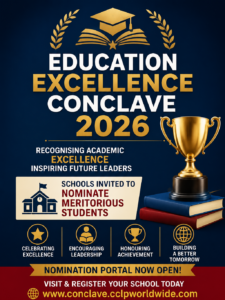
EDUCATION EXCELLENCE CONCLAVE — KOLKATA
THE FUTURE-READY SCHOOL
Preparing Schools. Empowering Educators. Reimagining Learning.
The relationship between Artificial Intelligence, teaching, critical thinking and human judgement forms part of the wider conversation being developed around the forthcoming Education Excellence Conclave — Kolkata.
The initiative seeks to bring school leaders, principals, educators and education stakeholders together to explore what schools can begin doing today to prepare learners for a rapidly changing tomorrow.
Kolkata | Coming Soon
Website: Conclave Kolkata
Email: conclave@cclpworldwide.com
UNESCO, AI Competency Framework for Students (2024); UNESCO, AI Competency Framework for Teachers (2024); UNESCO, Guidance for Generative AI in Education and Research.
Discover more from
Subscribe to get the latest posts sent to your email.