
Jantar Mantar Protest Editorial: How Peaceful Dissent Risks Being Weaponised into Street Anarchy


The Toolkit of Anarchy: How Peaceful Dissent Is Being Weaponised at Jantar Mantar protest site
Examination fraud gave India’s young people a legitimate reason to demand accountability. But when misinformation, political amplification and street confrontation overtake reform, the students’ original cause becomes the first casualty.
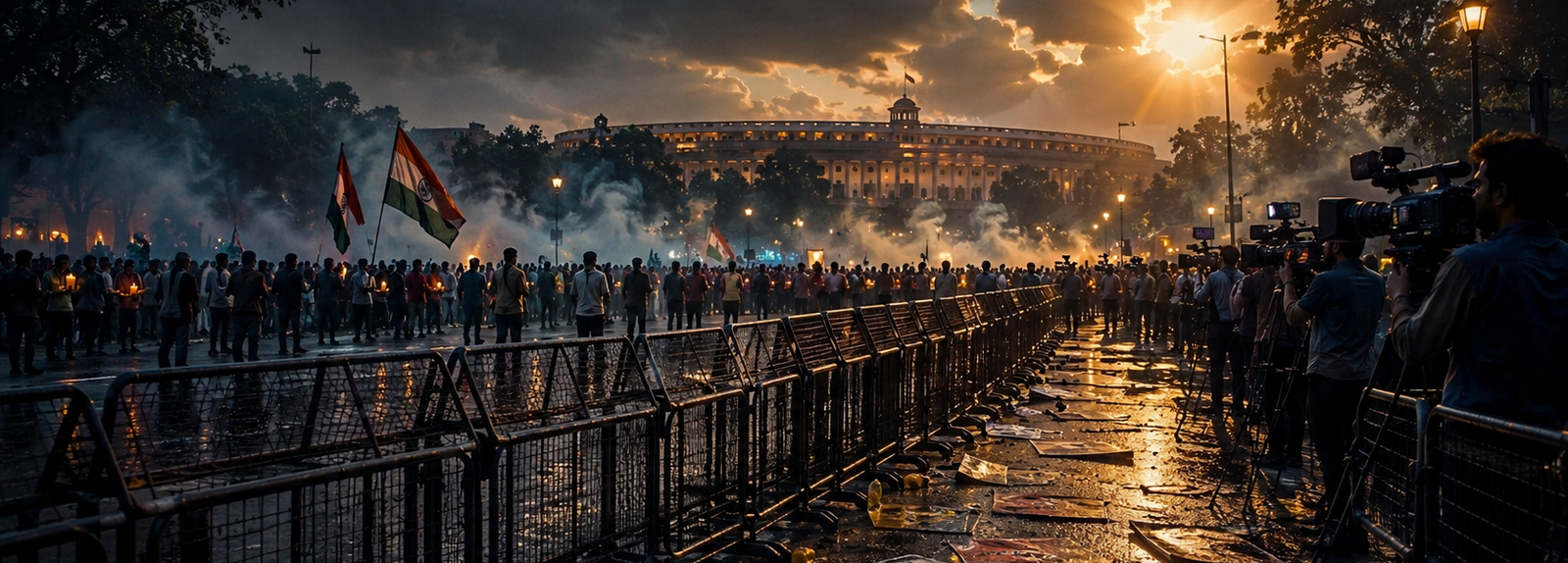
Tear gas hung over central Delhi as young demonstrators pressed against police barricades. A movement that had begun with satire and student anger now stood opposite security lines, its placards, slogans and mobile-phone cameras recording every confused minute. Sonam Wangchuk’s prolonged hunger strike had already drawn national attention to Jantar Mantar protest. The attempted march towards Parliament, however, changed the image of the agitation. The national conversation was no longer confined to leaked examination papers or demands for ministerial accountability. It had become a story of confrontation.
That transformation should concern every Indian, regardless of political preference. A democracy must protect the right to dissent, particularly when students believe that the integrity of examinations—and therefore their futures— has been compromised. But democracy cannot remain indifferent when a legitimate cause begins to lose direction amid viral misinformation, political appropriation and the growing temptation to treat disruption as an achievement in itself.
The grievance was real
Verified factual contextThe Cockroach Janta Party, founded by digital strategist Abhijeet Dipke as a satirical youth movement in May 2026, drew support from young citizens and student organisations. Its central demand was the resignation of Union Education Minister Dharmendra Pradhan over the NEET examination controversy and reported irregularities affecting the examination system.
These grievances cannot simply be dismissed as partisan theatre. Competitive examinations are among the most consequential public institutions in India. Families invest years of savings, labour and emotional energy in preparing their children for them. For many candidates, an examination is not merely a test; it is the narrow bridge between limited opportunity and a professional future.
When allegations of paper leaks, administrative failures or evaluation irregularities arise, the state has a duty to respond transparently and rapidly. Delayed explanations create a vacuum. In that vacuum, distrust expands, rumours acquire credibility and every official silence begins to appear deliberate.
Students demanding a fair examination system are not enemies of the state. Their demand for accountability is a demand for the credibility of the state.
This is why the original protest deserved to be heard. It raised an issue touching millions of students and questioned whether merit can survive when the machinery created to measure it is itself under suspicion.
How the movement changed
Documented sequenceThe agitation gathered momentum in phases. An early demonstration at Jantar Mantar was followed by a sustained sit-in. Wangchuk, who had previously expressed support for the protesters, began an indefinite hunger strike on 28 June. His participation brought greater visibility, emotional force and public footfall to the site.
As the movement expanded, so did its political and organisational complexity. Protesters attempted to march towards Parliament, leading to clashes in which police used baton charges and tear gas. Reports indicated injuries and allegations of excesses, while authorities defended restrictions imposed on an unauthorised march through a sensitive part of the capital.
The movement’s internal strains also entered the public domain. CJP spokesperson Vijeta Dahiya was removed after a video showing him eating during the protest march triggered criticism and accusations of insensitivity. Dahiya subsequently said that he had been made a scapegoat. The episode was not evidence of a conspiracy, but it did reveal the pressure confronting a rapidly assembled movement trying to maintain discipline, symbolism and message control under national scrutiny.
A satirical online campaign can mobilise anger quickly. Running a sustained democratic movement, however, requires organisational accountability, coherent leadership and the ability to prevent fringe behaviour from defining the whole. CJP’s challenge was no longer merely to attract attention. It was to prove that it could preserve the legitimacy of its cause while managing a large and emotionally charged mobilisation.
From reform to destabilisation
Editorial analysisAnalysts studying recent youth-led upheavals in South Asia have pointed to a familiar sequence: an authentic grievance draws young citizens into the streets; dramatic images increase public sympathy; state action produces anger; political actors enter the arena; and the original demand gradually expands into a broader confrontation with the government.
Versions of this progression have been discussed in relation to major protests in Kathmandu and Dhaka. The comparison must be treated cautiously. Similarity does not establish coordination, and no regional example can be mechanically imposed upon India’s political conditions.
The pattern is a warning—not proof of a blueprint
News24Media is not asserting that the Jantar Mantar protest was designed or directed according to a foreign plan. The warning lies in the structure of modern mobilisation itself: a peaceful protest can be transformed rapidly when competing groups, viral narratives and confrontational tactics begin operating faster than the movement’s own leadership can control them.
A democratic society should therefore resist two simplistic conclusions. The first is that every protester is an anarchist. The second is that every act carried out under the banner of a protest deserves constitutional protection. Peaceful dissent and violent coercion are not the same act merely because they occur in the same crowd.
The new toolkit is a mobile screen
Structural media analysisThe most dangerous toolkit of the present age may not be a secret document, foreign instruction manual or centrally controlled organisation. It may simply be a flood of videos, edited clips, false captions and emotionally charged posts travelling through millions of mobile phones before anyone can establish what actually occurred.
Delhi Police recently had to deny a fabricated newspaper clipping falsely claiming that CJP founder Abhijeet Dipke had died. The clipping was presented in the visual form of news precisely because such fabrication borrows credibility from familiar media design. By the time an official denial appears, the original falsehood may already have been downloaded, forwarded and converted into public anger.
Genuine recordings of police action must not be dismissed merely because fake material also circulates. Allegations of excessive force deserve independent examination. But the existence of real grievances makes verification more—not less—important. A fabricated image inserted among authentic evidence can discredit victims, mislead crowds and prevent a truthful assessment of state conduct.
The speed of social media has altered the relationship between rumour and violence. Previously, organisers, journalists or authorities had at least some time to challenge a false account. Today, a misleading twenty-second clip can reach a crowd while an event is still unfolding. It can manufacture certainty from confusion and turn speculation into a call for immediate retaliation.
This paper’s assessment is that India needs a rapid, credible and politically independent mechanism for verifying protest-related content. Government fact-checking alone will not command trust when the government is itself a party to the dispute. Newsrooms, digital platforms, civil-society organisations and independent investigators must cooperate to identify manipulated material without suppressing genuine documentation.
When politicians enter the street
Fact and interpretationAs the agitation grew, opposition parties visibly aligned themselves with it. Congress, AAP and Left parties supported the protests, while Rahul Gandhi and Priyanka Gandhi joined a demonstration outside Prime Minister Narendra Modi’s residence following the clashes in Delhi. Gandhi also publicly attacked the government’s handling of the paper-leak controversy and the police action.
Opposition participation is neither illegal nor unexpected. Holding the government accountable is an opposition’s constitutional responsibility. Nevertheless, once established parties enter a youth movement, its political meaning inevitably changes. Cameras begin following national leaders rather than anonymous students. Speeches become sharper, demands broaden and the contest moves from examination reform to government survival.
The question is not whether opposition leaders had a right to participate. They did. The question is whether their intervention helped preserve the students’ demand for institutional reform or encouraged the movement to become another stage for a familiar struggle for political power.
Motive cannot be established merely from participation. Yet citizens are entitled to examine the timing, language and consequences of political involvement. A responsible opposition should amplify a legitimate grievance without allowing that grievance to become expendable material in a larger campaign.
PM Shri @narendramodi thanked India’s youth for the response and suggestions following his video and expressed his gratitude for the overwhelming support.
— BJP (@BJP4India) July 24, 2026
Watch ⬇️ pic.twitter.com/Y2q35aRNdP
Peaceful protest and violent incitement
News24Media positionThe government has sought to distinguish peaceful students from individuals accused of participating in violence. It has given assurances concerning peaceful protesters while maintaining that those responsible for unlawful acts may face prosecution. That distinction is constitutionally necessary—but it must be applied honestly, individually and transparently.
No peaceful student should be punished merely for raising a slogan, attending a demonstration or demanding a minister’s resignation. Equally, no person should receive immunity for assault, arson, deliberate incitement or destruction merely by standing inside a protest crowd.
Our editorial position
Peaceful dissent is not anarchy. But violence cannot be sanitised as dissent. India must reject the false choice between listening to students and maintaining public order. A confident government should be capable of doing both.
Do not lose the student behind the slogan
The gravest danger is that the people who began this debate may now disappear from it. The NEET aspirant studying late at night, the parent who borrowed money for coaching, and the student waiting for a fair evaluation receive little benefit from a cycle of baton charges, incendiary videos and political marches.
Once the national story becomes exclusively about police barricades and competing political speeches, examination reform recedes into the background. Officials discuss law and order. Opposition parties discuss government legitimacy. Television panels discuss who won the day’s confrontation. The student is left with the same uncertainty that brought the protest into existence.
The Centre must therefore move beyond general assurances. It should publish a time-bound account of the examination failures, establish responsibility wherever evidence warrants it, strengthen digital and physical security for question papers, create transparent candidate-grievance systems and communicate corrective measures directly to students.
Protest organisers, for their part, must enforce non-violence, distance themselves from fabricated content, disclose decision-making processes and prevent political platforms from swallowing the original educational demands.
India does not need silence at Jantar Mantar. It needs truth at Jantar Mantar protest: truth about examination failures, truth about police action, truth about viral videos and truth about those seeking to redirect student anguish towards a wider confrontation.
Accountability must operate in both directions. Those responsible for corrupting or compromising examinations must face consequences. Those proven to have incited violence, manufactured dangerous misinformation or attacked citizens and security personnel must also face the law.
The Republic is strong enough to hear dissent and firm enough to resist anarchy. It must demonstrate both qualities now—before the legitimate anger of India’s students is buried beneath the smoke of somebody else’s political battle.
Discover more from
Subscribe to get the latest posts sent to your email.









1 COMMENTS