
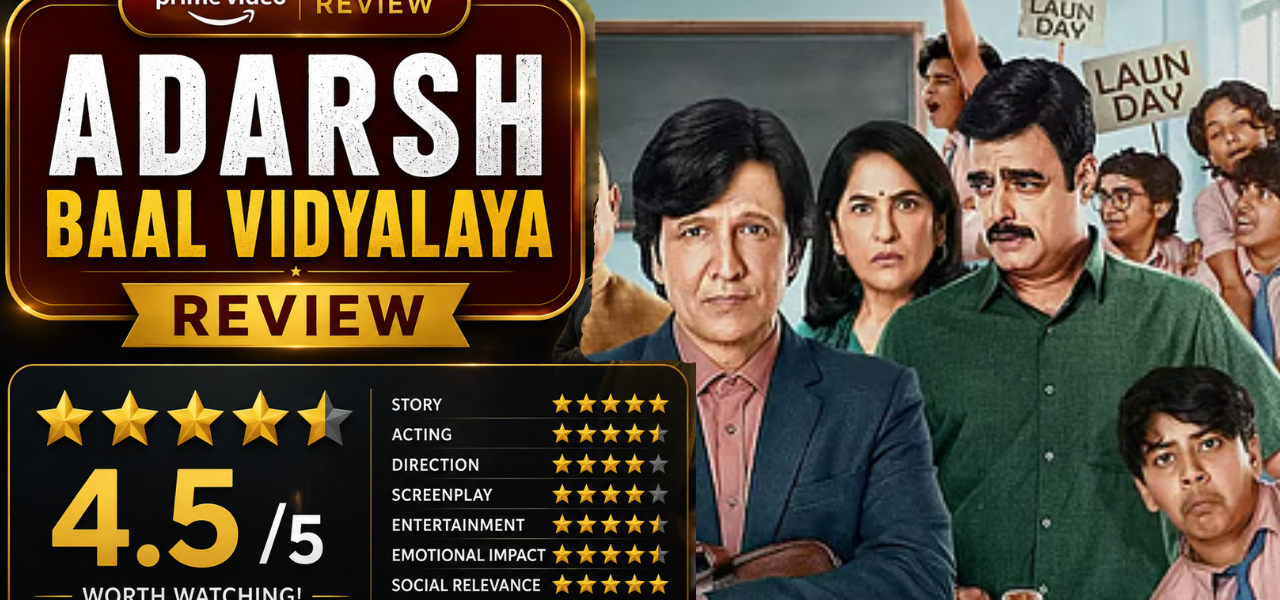
Adarsh Baal Vidyalaya Review: A Powerful, Heartwarming Drama—Is It Really Worth Watching?


Web Series Review · OTT · Education Drama
Adarsh Baal Vidyalaya Review: Kay Kay Menon Turns a Broken Blackboard Into Prime Video’s Most Honest Classroom Yet
Introduction
Adarsh Baal Vidyalaya Prime Video review season has arrived, and it lands at an unusually charged moment for Indian education discourse. Premiering on Prime Video on July 24, 2026 , this seven-episode Hindi comedy-drama is directed by Himank Gaur and created and executive-produced by Biswapati Sarkar and Sameer Saxena under their Posham Pa Pictures banner — the studio behind some of Indian streaming’s most grounded, slice-of-life hits. The writing room includes Sarkar himself alongside Akshay Asthana, Nupur Pai, Tatsat Pandey and Meghna Srivastava.
The premise is deceptively simple: a burnt-out government school headmaster wants one thing — a fully funded training trip to Cambridge — and the only way to get it is to drag his failing institution into the top ten in Delhi’s board exam rankings. That single, self-interested goal becomes the spark for a much larger story about what it actually takes to fix a broken system, and whether good intentions can survive contact with real bureaucracy, real poverty and real children. It’s a premise that immediately invites comparison to Panchayat and Maamla Legal Hai — shows that mined bureaucratic dysfunction for both comedy and quiet heartbreak — and this Adarsh Baal Vidyalaya cast, led by Kay Kay Menon, is more than equipped to attempt the same.
Story Without Major Spoilers
The series is set in Tinki Toli, a fictional locality on the outskirts of Delhi that the show itself jokes can only be reached by “taking the left from the gutter.” At its centre is Adarsh Baal Vidyalaya, a government school that is struggling to live up to its own name — chipped walls, unmotivated students, resigned teachers and a headmaster, Gyaneshwar Tripathi (Kay Kay Menon), who has spent years perfecting the art of doing just enough to get by.
The central conflict is set in motion when an education department official dangles an incentive: transform the school into one of Delhi’s top ten performers in the Class 10 board results, and Gyaneshwar gets his ticket to a UK training programme — with his long-suffering wife Sushma in tow. What follows is not a triumphant, single-minded crusade but a messy, funny, occasionally heartbreaking attempt to assemble a team out of teachers who each have their own baggage, ideology and reasons for having given up. The social environment around the school — parents who see little value in board exams that don’t guarantee jobs, a neighbourhood short on resources, and a system that rewards paperwork over outcomes — is sketched with enough specificity that it never feels generic. Without giving away how far Gyaneshwar’s transformation goes, the show earns its tension by constantly asking whether he’s doing this for the children or for himself.
Does the Series Reflect India’s Education Reality?
This is where Adarsh Baal Vidyalaya distinguishes itself from a standard feel-good school drama. The series doesn’t flinch from depicting the specific, unglamorous mechanics of government education in India: underpaid and demoralised teachers, a curriculum that feels disconnected from students’ daily realities, decaying infrastructure, and an examination system that matters enormously to institutions and bureaucrats but barely registers with working-class families trying to survive.
The show’s satire is sharpest when it targets the incentive structures around education rather than the students or teachers themselves — an episode built around the quality of a mid-day meal component works as a stand-in for the entire machinery of underfunded welfare schemes, and a subplot involving a student who wants his personal history folded into the curriculum lands as pointed commentary on how curricula get shaped by power rather than pedagogy. Political interference, parental apathy born of economic necessity, and the quiet contempt with which government schools are viewed in public perception are all present, and treated as structural problems rather than individual failings.
Where the series simplifies reality is in its resolution arc: transformation, when it comes, tends to arrive through the charisma and persistence of individuals rather than through systemic change — a common and understandable narrative shortcut for a seven-episode comedy-drama, but one that means viewers looking for a genuine policy critique will find the show stronger on diagnosis than on prescription. Its arrival amid ongoing student protest movements across the country has also given it an unplanned topicality that sharpens its relevance.
Kay Kay Menon’s Performance
Kay Kay Menon, an actor whose range has spanned everything from menacing antagonists to weary everymen, brings a specific kind of restraint to Gyaneshwar Tripathi. His screen presence here isn’t built on volume or intensity — it’s built on a laid-back, almost recumbent energy that makes every small shift into seriousness land harder. His comic timing is unforced, his line delivery underplayed rather than performed, and the character’s arc from self-interested opportunist to something closer to a reluctant leader is handled with enough ambiguity that the audience is never quite sure how much to trust him. It’s another reminder of why Menon remains one of Indian screen acting’s most reliable craftsmen — his work here sits comfortably alongside standout performances in Farzi and The Railway Men, without repeating either.
Supporting Cast
The ensemble around Menon earns its place rather than filling space. Abhimanyu Singh, cast against his usual tough-guy type, plays Hansraj, a chaste-Hindi-speaking teacher whose devotion to grammar and old-school discipline makes him both the show’s funniest figure and, gradually, one of its more sympathetic ones. Prasanna Bisht plays Kanchan, a new recruit determined to shake up the institution from within, and her idealism gives the show a useful counterweight to Gyaneshwar’s cynicism. Archana Puran Singh and Naveen Kasturia round out the staff room with performances that use comic instinct without tipping into caricature, while Deven Bhojani and Prachee Shah, as Gyaneshwar’s wife Sushma, add texture to the domestic and institutional pressures surrounding the central character. Almost every teacher gets a backstory substantial enough to justify their screen time — a rarity in ensemble workplace comedies, where side characters often exist purely as punchlines.
Child Actors
The students of Adarsh Baal Vidyalaya are not reduced to background noise. Their unruliness feels lived-in rather than performed for laughs, and their interactions with the teaching staff carry real emotional stakes — particularly in storylines involving students whose home circumstances shape their behaviour in the classroom. The child performers hold their own in scenes opposite seasoned adult actors, contributing both to the show’s humour and to its more sobering moments, without ever feeling like they’re simply there to support the grown-up narrative.
Writing & Screenplay
The five-writer room gives the show a script “ripe with potential” — nearly every character arrives with a defined backstory, and the series is genuinely unpredictable about which relationships it chooses to deepen. Episode-to-episode pacing, however, is where critical opinion has genuinely split: several reviewers found the show’s opening stretch sluggish, with some going as far as calling early episodes “painfully slow” and criticising the show for trying to juggle too many threads at once. Others found that after a tentative start, the series “kicks into high gear” and sustains its momentum. The truth likely sits between these positions — the show asks for patience in its first two episodes before its ensemble and satire fully click into place.
Direction
Himank Gaur’s direction favours a grounded, observational visual language over stylised comedy staging, letting the chaos of an under-resourced classroom feel authentic rather than choreographed. The balance between comedy, drama and social commentary is mostly well-managed, though a few scene transitions in the show’s slower middle episodes feel more functional than inspired.
Humour
The comedy here is situational and character-driven rather than gag-based, and it largely avoids the crass or predictable routes such premises often take. The best jokes are the ones rooted in the specific absurdities of Indian educational bureaucracy — an argument over a school meal, a student’s demand for personal glorification in the syllabus, a teacher’s fixation on linguistic purity — where the humour and the social critique are the same joke told twice.
Emotional Impact
Beneath its comic surface, the series does land genuine emotional beats — the resilience of teachers who keep showing up despite low pay and low morale, and the quiet dignity afforded to students the system has effectively written off, give the show real heart. It resists easy redemption arcs for its adult characters, which makes the moments of hope that do arrive feel earned rather than manufactured.
Technical Review
Production design is one of the show’s clear strengths — the school itself feels gritty, chipped and genuinely under-resourced rather than art-directed poverty. Cinematography stays unobtrusive and naturalistic, costume and sound design support the working-class setting without overstatement, and editing is generally tight, barring a few episodes in the middle stretch that could have been trimmed.
Social Message
The show’s themes — equality of opportunity, the gap between merit and access, and the resilience of community in the absence of institutional support — mostly emerge organically through character and incident rather than didactic speechifying. It is, at its core, a “deeply political series that refuses to shout,” preferring observation over sermon, which is precisely why its social commentary tends to land rather than alienate.
Strengths
- Kay Kay Menon’s central performance — understated, funny and quietly moving in equal measure.
- A gritty, lived-in school setting that never feels like a set.
- An ensemble with real backstories, avoiding the trap of disposable side characters.
- Satire that’s rooted in specific, recognisable Indian bureaucratic and social realities rather than generic jokes about “the system.”
- Restraint in its social messaging, letting scenes carry the point rather than dialogue.
Weaknesses
- Uneven pacing, particularly in the opening episodes, which some viewers may find slow to reward their patience.
- Occasionally cliched characterisation among secondary figures, especially where backstories lean on familiar tropes.
- A resolution arc that favours individual charisma over systemic critique, which slightly undercuts the show’s own diagnosis of structural dysfunction.
- A middle stretch that, for some critics, feels like it’s “trying too hard” to cover every education-system talking point at once.
Who Should Watch It?
Recommended for families looking for a comedy-drama with genuine substance, for teachers and education professionals who will recognise the systemic frustrations depicted on screen, for parents and students interested in stories about Indian public schooling, for longtime Kay Kay Menon fans, and for anyone who enjoyed the workplace-comedy rhythms of Panchayat or Maamla Legal Hai.
Final Verdict
Adarsh Baal Vidyalaya is not a flawless series, but it is a sincere and frequently funny one — a show willing to sit with the contradictions of Indian government education rather than resolve them too neatly. It brings something genuinely fresh to Prime Video India’s slate of originals by refusing to romanticise institutional reform, and its unplanned timing alongside real student protest movements gives it an extra layer of relevance. Whether it’s one of the platform’s stronger releases this year will depend on individual patience with its slower opening stretch — but for viewers willing to stay with it, the show pays off with a rare thing in Indian OTT storytelling: comedy that critiques without cynicism, and hope that doesn’t feel manufactured.
Ratings
| Category | Score |
|---|---|
| Story | ★★★★☆ 4/5 |
| Acting | ★★★★★ 4.5/5 |
| Screenplay | ★★★☆☆ 3.5/5 |
| Direction | ★★★★☆ 4/5 |
| Entertainment Value | ★★★★☆ 4/5 |
| Emotional Impact | ★★★★☆ 4/5 |
| Social Relevance | ★★★★★ 4.5/5 |
| Overall Rating | ★★★★☆ 4/5 |
Have you watched Adarsh Baal Vidyalaya yet? Do you think Kay Kay Menon’s Gyaneshwar Tripathi deserves a place among Indian OTT’s best-written protagonists — and does the show’s take on government education ring true to you? Share your thoughts in the comments below.
Discover more from
Subscribe to get the latest posts sent to your email.








1 COMMENTS