

SBI Funds Management IPO: What the Gap Between ₹900 and ₹574 Actually Teaches Investors
India’s biggest AMC listing became the year’s most-watched test of unlisted-market pricing. The real lesson isn’t that pre-IPO investors were cheated — it’s that “unlisted price” and “IPO price” were never measuring the same thing.
On July 21, 2026, shares of SBI Funds Management Limited — India’s largest asset management company and the investment manager of SBI Mutual Fund — listed on the NSE and BSE at ₹613, a 6.85% premium to its IPO price of ₹574. By the close of trading, the stock had slipped slightly to settle at ₹610.15. For an issue that had been oversubscribed more than 41 times and carried a grey-market premium (GMP) indicating a 17% pop, the debut was, by most trade press accounts, muted rather than spectacular.
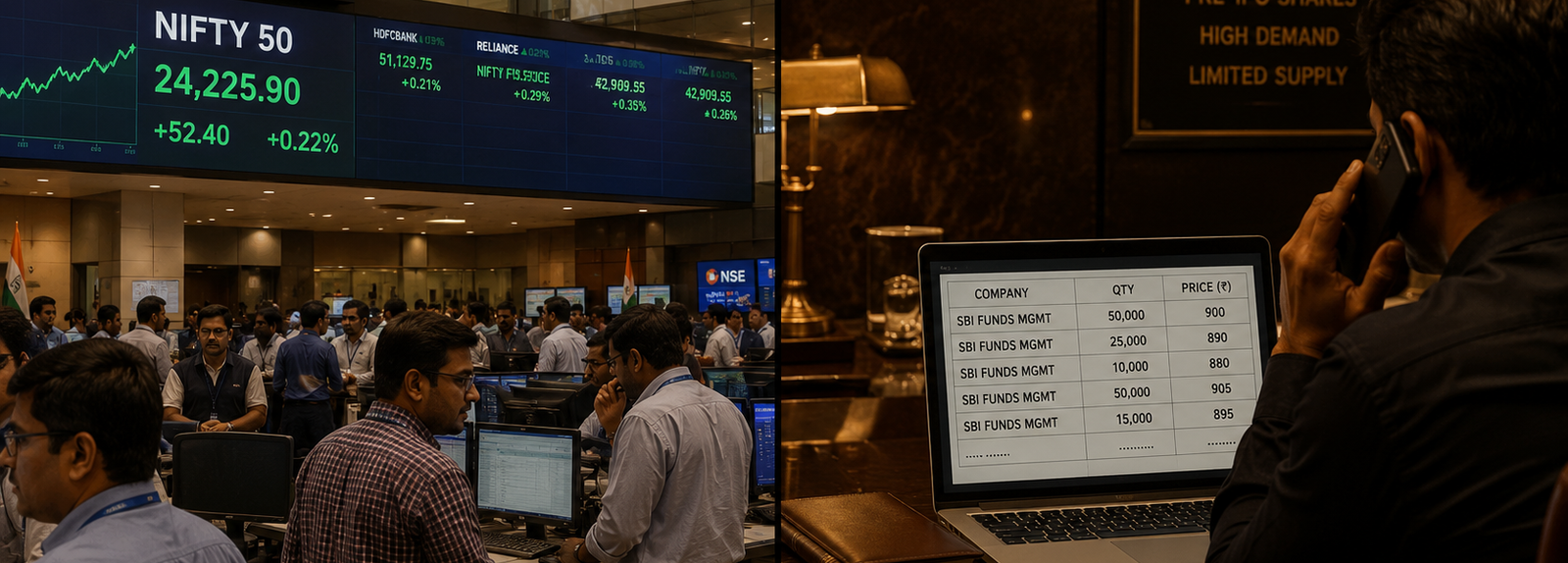
But the more interesting story for ordinary investors sits one step earlier — in the unlisted, or “pre-IPO,” market, where SBI Funds Management shares had reportedly traded as high as the ₹800–900 range in 2023 and touched figures north of ₹2,800 by late 2024 and 2025, before a bonus issue reset the arithmetic just ahead of listing. Anyone who bought into the unlisted-share narrative expecting the IPO to simply confirm or exceed those dealer-quoted prices needs to understand exactly why it didn’t — and why that gap is not evidence of wrongdoing, but a textbook illustration of how private-market pricing and public-market price discovery are fundamentally different processes.
What this article is — and isn’t. This is an investor-education case study built on verified IPO filings, exchange disclosures and multiple published unlisted-market data points. It does not allege misconduct by SBI Funds Management, SBI, Amundi, or any dealer platform. Where unlisted-market prices are cited, they come from private dealer platforms that are not SEBI-recognised exchanges, and are presented as indicative, not verified transaction data.
1. The Company: India’s Largest Asset Manager, By a Wide Margin
SBI Funds Management is a joint venture between State Bank of India (holding roughly 61.9%) and France’s Amundi Group (roughly 36.4%), originally incorporated in 1992. It manages the SBI Mutual Fund schemes, alongside Portfolio Management Services (PMS) and Alternative Investment Funds (AIFs), and has held the number-one mutual fund market position by quarterly average AUM (QAAUM) since March 2021 — a market share of roughly 15.3–15.4%.
As of March 2026, its total QAAUM across mutual funds, PMS and AIFs stood at approximately ₹29.5 lakh crore (about $395 billion), serving over 16 million investors through 270-plus branches. For FY26, the company reported net profit of roughly ₹3,067 crore, up from about ₹2,540 crore in FY25 — growth of nearly 21%, on the back of rising SIP flows and India’s broader shift of household savings into financial assets.
This is, by every conventional yardstick, a high-quality, zero-debt, cash-generative business. That is precisely why it became one of the most actively traded names in India’s unlisted-shares market well before its IPO was even confirmed.
2. The Unlisted Market Story: Real Gains, Real Confusion
Private dealer platforms that broker unlisted shares — not stock exchanges, and not SEBI-regulated trading venues — reported the following indicative price trajectory for SBI Funds Management shares over roughly three years:
| Period | Indicative Unlisted Price (per platform data) |
|---|---|
| Early 2023 | ≈ ₹800 – ₹900 |
| December 2023 | ≈ ₹1,245 |
| October 2024 | ≈ ₹2,835 |
| November 2025 | ≈ ₹2,650 – ₹2,888 |
| Just before listing (post-bonus adjustment), July 2026 | ≈ ₹847 – ₹858 |
Sources: multiple unlisted-share dealer platforms (Planify, UnlistedZone, Unlisted Ventures, Altius Investech, Sharescart). These are dealer-quoted indicative prices, not exchange-verified transaction records, and figures vary meaningfully between platforms for the same dates — itself a useful lesson in how opaque this market is.
The single most important fact buried in that table is easy to miss: at some point in the run-up to the IPO, SBI Funds Management carried out a 3:1 bonus issue — every one share held became four. That mechanically resets the per-share price even though total investor wealth is unchanged. An investor who bought one share at ₹900 in early 2023 held four shares after the bonus; if those four shares were worth ₹858 each just before listing, that investor’s original ₹900 had grown to roughly ₹3,432 — a return of close to 3.8x in about three years, comfortably ahead of most listed alternatives.
That is a genuine, verifiable success story for early unlisted investors. The confusion — and the risk — starts with anyone who bought after the bonus adjustment, closer to the IPO, at the reset price of roughly ₹847–858 per share.
3. The IPO: Numbers That Actually Cleared the Market
SBI Funds Management filed its Draft Red Herring Prospectus with SEBI on March 19, 2026. The final structure:
- Price band: ₹545 – ₹574 per share
- Structure: 100% offer-for-sale (OFS) by promoters SBI and Amundi — no fresh capital raised by the company itself
- Issue size: originally estimated near ₹11,693 crore, reduced to approximately ₹9,813 crore after a pre-IPO placement of ₹1,880 crore trimmed the number of shares offered publicly
- Subscription window: July 14–16, 2026
- Anchor book: ₹2,662.96 crore raised from anchor investors on July 13, 2026
- Overall subscription: roughly 41.7 times, driven overwhelmingly by qualified institutional buyers (QIB portion subscribed about 140x; retail closer to 3.6x)
- Listing: July 21, 2026, on BSE and NSE, at ₹613 — a 6.85% premium to the ₹574 upper band, easing to ₹610.15 by the close
SBI is estimated to have received about ₹7,366 crore and Amundi about ₹4,327 crore from the stake sale. At listing, SBI Funds Management’s market capitalisation stood at roughly ₹1.24–1.27 lakh crore — meaningfully below the ₹1.3–1.8 lakh crore market-cap estimates that had circulated based on unlisted-market pricing at various points over the preceding two years.
4. The Valuation Gap, Properly Adjusted
Once the bonus issue is accounted for, the real comparison an investor should have made in the weeks before listing was not “₹900 vs ₹574” but roughly “₹850 (post-bonus unlisted) vs ₹574 (IPO upper band)” — still a gap of about 48%, and even against the day-one closing price of ₹610.15, a premium of nearly 39%.
Why would sophisticated-seeming unlisted buyers pay that much more than the price institutional QIBs — with access to the same DRHP, the same financials, and considerably more valuation expertise — were willing to pay just weeks earlier? A few structural reasons, none of which require assuming bad faith by any party:
- Illiquidity should command a discount, not a premium. Unlisted shares cannot be freely bought or sold on an exchange, carry six-month lock-ins for many investor categories, and settle through manual, dealer-brokered transfers. Financial theory says illiquid assets should trade cheaper than their liquid equivalent, all else equal — yet in India’s pre-IPO market, scarcity and hype routinely push prices the other way.
- Merchant bankers price for clearance, not sentiment. IPO pricing is set through a formal book-building process involving lead managers (in this case Kotak Mahindra Capital, Axis Capital, BofA Securities India and HSBC, among others) who test institutional demand directly. Unlisted-market prices are set by a comparatively thin network of dealers and retail-facing platforms with no equivalent price-discovery mechanism.
- Limited float, concentrated dealer networks. A small number of platforms controlling supply of an unlisted stock can sustain elevated quotes for long stretches simply because genuine two-way, transparent trading doesn’t exist to correct them.
- The GMP itself proved unreliable. Even the grey-market premium — a more IPO-specific, shorter-duration indicator than the unlisted share price — pointed to a 17% listing pop. The actual outcome was 6.85%. If GMP, updated daily and tracking the live subscription book, still overshot by more than half, the case for treating a slower-moving, less liquid unlisted quote as a reliable IPO-price predictor weakens further.
5. Did Investors Actually Lose Money? Three Scenarios
The honest answer is: it depends entirely on when someone entered. These illustrative scenarios use round lot sizes and the published price points above; they are for educational purposes only and are not a recommendation.
Scenario A — Early unlisted buyer (2023)
100 shares bought at ₹900 in early 2023 = ₹90,000 invested. After the 3:1 bonus, this becomes 400 shares. Valued at the day-one closing price of ₹610.15, the holding is worth approximately ₹2,44,060 — a gain of roughly +171% over about three years, even after a listing that “disappointed” GMP expectations.
Scenario B — Late unlisted buyer (just before listing, post-bonus)
100 shares bought at ₹858 in the weeks before the IPO = ₹85,800 invested. Valued at the day-one closing price of ₹610.15, the holding is worth approximately ₹61,015 — a loss of roughly ₹24,785, or -28.9%, before even accounting for the lock-in period that would have prevented an early exit even if the investor wanted one.
Scenario C — IPO retail applicant
One lot of 26 shares allotted at the IPO price of ₹574 = ₹14,924 invested. Valued at the day-one closing price of ₹610.15, the holding is worth approximately ₹15,864 — a gain of roughly +6.3%, fully liquid from day one, no lock-in.
The pattern is clear and unsurprising: entry price, not the company’s quality, determined the outcome. SBI Funds Management’s business fundamentals were essentially the same for all three investors. What differed was what each one paid to access those fundamentals.
6. Was Anyone Misled?
There is no evidence that SBI, Amundi, SBI Funds Management, or its merchant bankers made any representation about unlisted-market pricing — their formal disclosures relate to the IPO price band and audited financials, both of which were accurate as filed. The more useful question is whether buyers misunderstood what they were buying into, and several well-documented behavioural patterns plausibly played a role:
- Fear of missing out (FOMO): a stock that quadrupled its per-share price (pre-bonus) between 2023 and 2024 generates its own momentum-chasing demand, independent of valuation.
- Herd mentality: the more a name is discussed on dealer platforms and social channels as a “sure-shot IPO winner,” the more new buyers assume the crowd has already done the valuation work.
- Confirmation bias: once an investor has bought in, dealer commentary reinforcing “IPO valuation could be ₹1 trillion-plus” (a figure that did circulate in market reports through 2025) is more readily believed than caution.
- A specific, common misconception: that IPO price will always be at or above the prevailing unlisted price. There is no rule that guarantees this, and the SBI Funds Management case is a clear counter-example for anyone who bought unlisted shares in the final months before listing.
7. This Isn’t a One-Off: The HDB Financial Comparison
SBI Funds Management is not the first large Indian pre-IPO name where unlisted pricing ran ahead of the eventual issue price. HDB Financial Services — HDFC Bank’s NBFC arm — saw its unlisted shares quoted as high as ₹1,000–1,300 through parts of 2025, against an eventual IPO price band of ₹700–740 fixed in June 2025. HDB Financial still delivered a respectable listing (around 12.8% premium on July 2, 2025), but investors who had bought unlisted shares at the top of that range were sitting on notional losses relative to their entry price even on a strong listing day — a milder version of the same dynamic now visible in SBI Funds Management.
8. The Moral of the Case Study
Buying unlisted shares ahead of an IPO is not automatically a superior strategy to waiting for the IPO itself. There is no guarantee that:
- the eventual IPO price will exceed what you paid in the unlisted market;
- listing-day gains will materialise at all, let alone match GMP expectations;
- merchant bankers conducting formal price discovery will validate dealer-quoted private valuations;
- demand will stay elevated between your purchase and the listing date; or
- you will be able to exit on your own schedule, given lock-in periods that can run six months or longer.
The SBI Funds Management story genuinely rewarded patient, early entrants. It just as genuinely penalised late entrants who treated a dealer-quoted price as a floor rather than what it actually was: an unregulated, thinly traded, sentiment-driven number.
Reader Checklist: Before You Buy Unlisted Shares
- What is the company’s intrinsic valuation, based on earnings and comparable listed peers — not the dealer’s quote?
- Is the current unlisted premium justified by fundamentals, or by scarcity and hype?
- Who is actually selling these shares, and why? (Employee ESOPs, early investors, or the promoters themselves?)
- Has a DRHP even been filed? If not, there is no confirmed IPO timeline at all.
- Is there any guarantee of listing — or could the IPO be delayed, downsized, or shelved entirely?
- Could the IPO price legitimately come in below today’s unlisted quote?
- What is the lock-in period on your specific investor category, and can you actually afford to be illiquid that long?
- Are you comparing today’s unlisted price to a pre-bonus or pre-split price without adjusting for it?
- Would you still buy this business at this price if there were no IPO on the horizon at all?
Practical Takeaways
- Never buy solely because “an IPO is coming.” An IPO is a liquidity event for existing shareholders, not a valuation guarantee for new ones.
- Don’t confuse scarcity with value. A thin, dealer-controlled market can sustain elevated prices for a long time without those prices being fundamentally justified.
- Read the DRHP/RHP yourself — the financials, promoter shareholding, and use-of-proceeds sections tell you more than any dealer pitch.
- Always ask whether a bonus issue, stock split, or rights issue has occurred before comparing historical unlisted prices to current ones.
- Treat GMP and unlisted prices as sentiment indicators, not price targets — in this case, even the GMP overshot the actual listing gain by more than double.
- Diversify instead of concentrating capital in a single pre-IPO story, however strong the underlying business appears to be.
- Evaluate the business, not the narrative. SBI Funds Management is a genuinely strong company at the right price — the lesson here is entirely about price, not quality.
Reporting: News24Media.org Investigative Desk. Data as of July 22, 2026, compiled from SEBI/exchange disclosures, IPO registrar and lead-manager filings, and multiple financial news wires and unlisted-share dealer platforms as cited inline. News24Media.org | Kolkata
Discover more from
Subscribe to get the latest posts sent to your email.