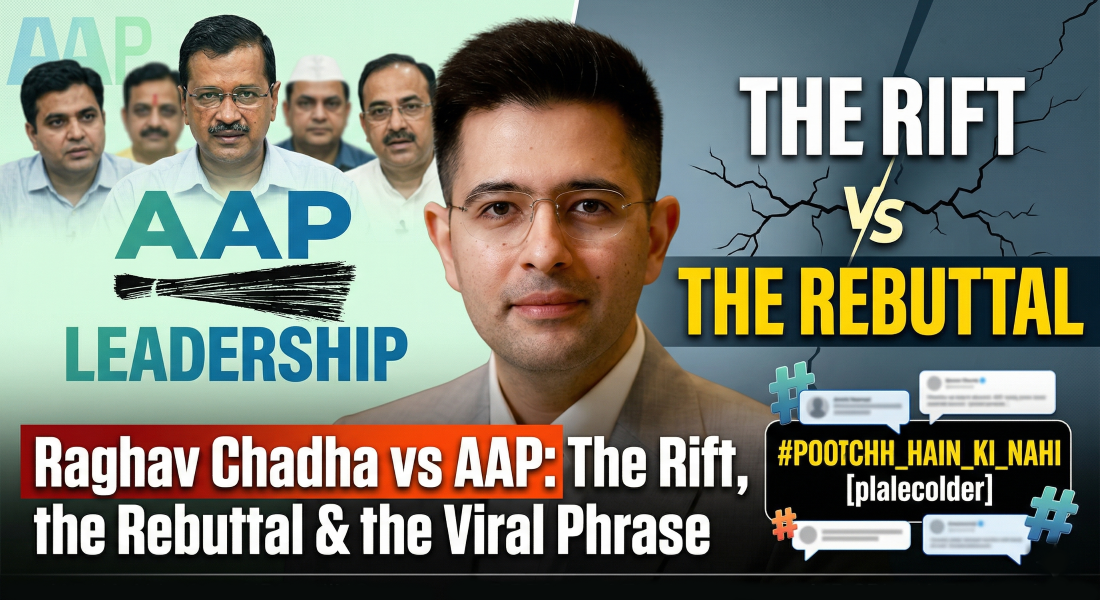
Raghav Chadha vs AAP: The Rift, the Rebuttal & the Viral Phrase


“Ghayal Hoon, Isiliye Ghatak Hoon” — Raghav Chadha’s Battle Against His Own Party
Three allegations, a forensic rebuttal, a viral phrase borrowed from cinema — and a young politician who just rewrote the rules of how to fight back.
Indian politics has witnessed many intra-party rebellions — but few have been executed with such surgical precision and such cinematic flair as the one now unfolding around Rajya Sabha MP Raghav Chadha. In a single week spanning April 2–5, 2026, a party that once celebrated him as its most polished parliamentary voice stripped him of his deputy leader role, formally wrote to the Rajya Sabha Secretariat asking that he not be allotted speaking time, publicly called him “compromised,” hinted he was drifting toward the BJP — and then watched as the man they expected to crumble responded with a rebuttal that the nation is still discussing.
The Backstory: A Rise Unlike Any Other
To understand the weight of this rupture, one must first understand the scale of what Raghav Chadha built. Born in 1988, a product of Modern School New Delhi and a trained Chartered Accountant who worked with Deloitte and Grant Thornton, Raghav Chadha entered politics through the Anna Hazare anti-corruption movement in 2012 — when Arvind Kejriwal first asked him to help draft the Delhi Lokpal Bill. From that moment, his ascent was extraordinary: national spokesman at a remarkably young age, youngest national treasurer, Delhi MLA from Rajinder Nagar in 2020 with 57% of the vote, Vice-Chairman of the Delhi Jal Board, and finally, the youngest Rajya Sabha MP from Punjab in 2022.
His role in AAP’s Punjab miracle was not peripheral. He was the campaign strategist and co-incharge when AAP swept 92 of 117 seats in 2022 — one of the most decisive election victories in modern Indian political history. He subsequently became adviser to Chief Minister Bhagwant Mann. And in May 2023, CM Mann offered Kapurthala House — his own official Delhi residence — as the venue for Raghav Chadha’s engagement with Bollywood actress Parineeti Chopra. That gesture alone tells you everything about where Raghav Chadha stood in the hierarchy three years ago.
“The only other time Kapurthala House was opened for a private ceremony was for the wedding of Kejriwal’s own daughter. That is the measure of the trust that once existed.”— News24Media Political Analysis
The Unravelling: How Trust Turned to Distance
The fracture did not happen overnight. It accumulated through a series of silences — moments when the party expected Chadha to speak, and he did not. When Arvind Kejriwal was arrested in the Delhi excise policy case in 2024, Chadha was in London undergoing a vitrectomy surgery, and his explanation was medical. But his voice was conspicuously absent even after he returned. He did not publicly react when Kejriwal was discharged last month. He skipped the celebratory rally and press conference. He was absent from a Jantar Mantar public meeting.
Meanwhile, his parliamentary focus had shifted decisively toward what he himself would call “impact over ruckus” — pushing for affordable food at airports (11 UDAN Yatri cafes subsequently opened, offering tea at Rs 10), advocating for gig workers’ rights, paternity leave legislation, menstrual health policy, data privacy, and telecom consumer protection. These were issues that earned him national applause and genuine policy outcomes — but not the kind of fire-breathing anti-BJP confrontation that AAP’s internal culture demands. A quiet verdict formed inside the party: Raghav Chadha was treating himself as bigger than the organisation. He was asked to vacate the plush official residence in Chandigarh that had once been his. The house fell under CM quota. It was a quiet but unmistakable demotion.
The Trigger: The Formal Removal
On April 2, 2026, AAP made the internal conflict external. The party formally replaced Raghav Chadha as its Deputy Leader in the Rajya Sabha, appointing Ashok Mittal — founder and chancellor of Lovely Professional University — in his place. The communication sent to the Rajya Sabha Secretariat went further: it formally requested that Raghav Chadha not be allotted speaking time from AAP’s parliamentary quota. This was not a routine administrative adjustment. This was a public parliamentary silencing of one of India’s most articulate young legislators.
AAP formally communicated to Parliament that Raghav Chadha should not be granted time to speak in the House from the party’s quota — a step that goes beyond internal discipline and enters the domain of stripping an elected MP of his functional parliamentary identity. Raghav Chadha called it “a ban on my voice.”
AAP’s Three Allegations: The Charge Sheet
Senior AAP leaders went public with three specific charges against Raghav Chadha, which they offered as justification for his demotion. Punjab CM Bhagwant Mann was the most damaging voice, calling Chadha “compromised.” Atishi Marlena suggested he may be on the verge of defecting to the BJP. Saurabh Bharadwaj accused him of “not raising serious issues.” Here is the complete charge sheet, followed by Raghav Chadha’s point-by-point destruction of each count:
The Phrase That Stopped India: Why “Ghayal Hoon, Isiliye Ghatak Hoon” Went Viral
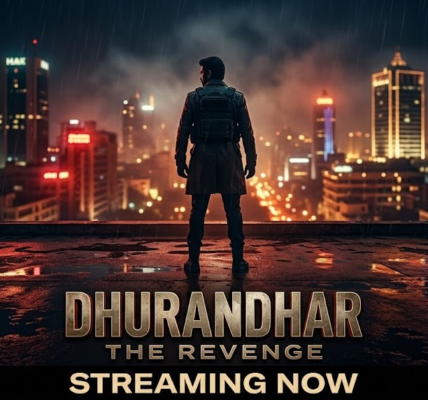
In a political culture saturated with slogans, press conferences, and performative outrage, Raghav Chadha did something genuinely rare: he ended a rebuttal video with a line so perfectly calibrated — emotionally, culturally, and strategically — that it crossed over from politics into the national conversation. The phrase was borrowed from the Bollywood film Dhurandhar, and its genius operates on four simultaneous levels.
The cinematic resonance: By drawing from a contemporary film, Chadha guaranteed the phrase would travel far beyond the usual political media audience. It gave the clip instant cultural currency — shareable, meme-able, quotable across demographics that would never normally engage with Rajya Sabha proceedings.
The poetic paradox: The phrase inverts the ordinary logic of weakness. Most politicians, when publicly attacked by their own party, either deflect with anger or shrink in self-pity. Chadha did neither. He transformed his injury into a source of power — declaring that the wound itself had made him more dangerous. It is almost Shakespearean in construction: the wronged man who becomes formidable precisely because of what was done to him.
The political warning: To those inside AAP who believed they had neutralised him by stripping his platform, the message was crystalline: you have not weakened me. You have freed me. A politician with nothing left to protect is the most unpredictable force in any room. The phrase was simultaneously a statement of defiance and a barely-veiled threat.
The brand declaration: For a 37-year-old politician whose career arc extends far beyond his current party affiliation, the image this moment created — unbroken, composed, fighting with intelligence rather than fury — is invaluable. Parineeti Chopra amplified it further with a cryptic Instagram post about “standing up for oneself.” She had earlier shared content calling him “Prime Minister material.” The Bollywood-politics axis ensured the story detonated across every media category simultaneously.
The Deeper Pattern: AAP’s Recurring Purge Cycle
Political observers watching this episode have noted that it is not without precedent within AAP’s internal history. The party that began as a movement against establishment politics has, over its 14-year existence, shown a recurring tendency to produce brilliant young talent — and then eventually find itself in conflict with that same talent when it develops an independent identity. Yogendra Yadav and Prashant Bhushan were expelled in the early years. Kumar Vishwas, one of AAP’s most charismatic founding voices, had a public and bitter fallout. Swati Maliwal’s clash with the party leadership became a national story.
Chadha’s situation mirrors this pattern with one significant difference: he has chosen to fight back in public, on the record, with evidence — rather than through leaks and backroom manoeuvring. This approach is both riskier and more respectful of his own political intelligence.
The Road Ahead: A Rollercoaster Without a Fixed Destination
The Punjab Factor — His Greatest Asset and Biggest Risk
Punjab is where Chadha’s political equity is deepest. He was the architect of AAP’s 2022 landslide there. With Punjab Assembly elections due in 2027, any repositioning by Chadha — whether inside AAP, aligned with another party, or as a compelling independent voice — will have enormous consequences for Punjab’s political landscape. The AAP leadership’s anxiety about his proximity to the BJP is, at its core, anxiety about Punjab.
The BJP Speculation — Real, or Manufactured Pressure?
Both BJP and Congress condemned his removal as “highly objectionable” — which is unusual behaviour for opposition parties intervening in another party’s internal matter. This could represent a genuine courtship. Or it could be a tactical move to further destabilise AAP by keeping the speculation alive. Either way, Chadha has not addressed it directly — a silence that is itself a form of leverage.
The Rajya Sabha Term Clock — His Constitutional Shield
Chadha’s six-year Rajya Sabha term runs until 2028. Regardless of what AAP does internally, he remains a sitting Member of Parliament. He can continue to speak — under his own steam if not AAP’s quota — and continue building his legislative record. The party can muzzle his quota time, but it cannot remove him from Parliament itself.
The Parineeti Dimension — Politics Meets Celebrity
The Chadha-Chopra marriage has permanently changed the media calculus around him. Their son Neer, born in October 2025, adds a personal dimension that makes any dramatic political move more complicated. But it also means that every political development around Chadha is guaranteed national coverage across entertainment, celebrity, and news media simultaneously — an asset that most politicians cannot dream of.
His Parliamentary Record — The Foundation No One Can Take
Whatever party label he eventually carries, the record stands: UDAN cafes opened, gig workers’ rights championed, data privacy raised, paternity leave advocated. These are not talking points. They are documented legislative interventions with measurable outcomes. In a political landscape where most MPs measure their tenure in slogans, this record makes Chadha attractive to any political home — and gives him the credibility to eventually build his own.
Raghav Chadha has never been a stranger to controversy — from Rajya Sabha privileges disputes to Punjab drug-money allegations to the quiet whisper campaigns that followed his marriage and his eye surgery abroad. But this chapter is qualitatively different. For the first time, the conflict is existential and internal — with the very organisation that gave him his platform and shaped his political identity.
What makes this moment significant is not the controversy itself but the manner in which he has chosen to meet it. He did not leak information anonymously. He did not seek backroom deals. He appeared on camera, named three allegations, demolished each with evidence and logic, and closed with a line borrowed from cinema that the entire nation is now repeating. That is not the behaviour of a politician in retreat.
He is wounded. And therefore, lethal. A new chapter — and quite possibly the most important one of his career — has just begun.
Discover more from
Subscribe to get the latest posts sent to your email.