
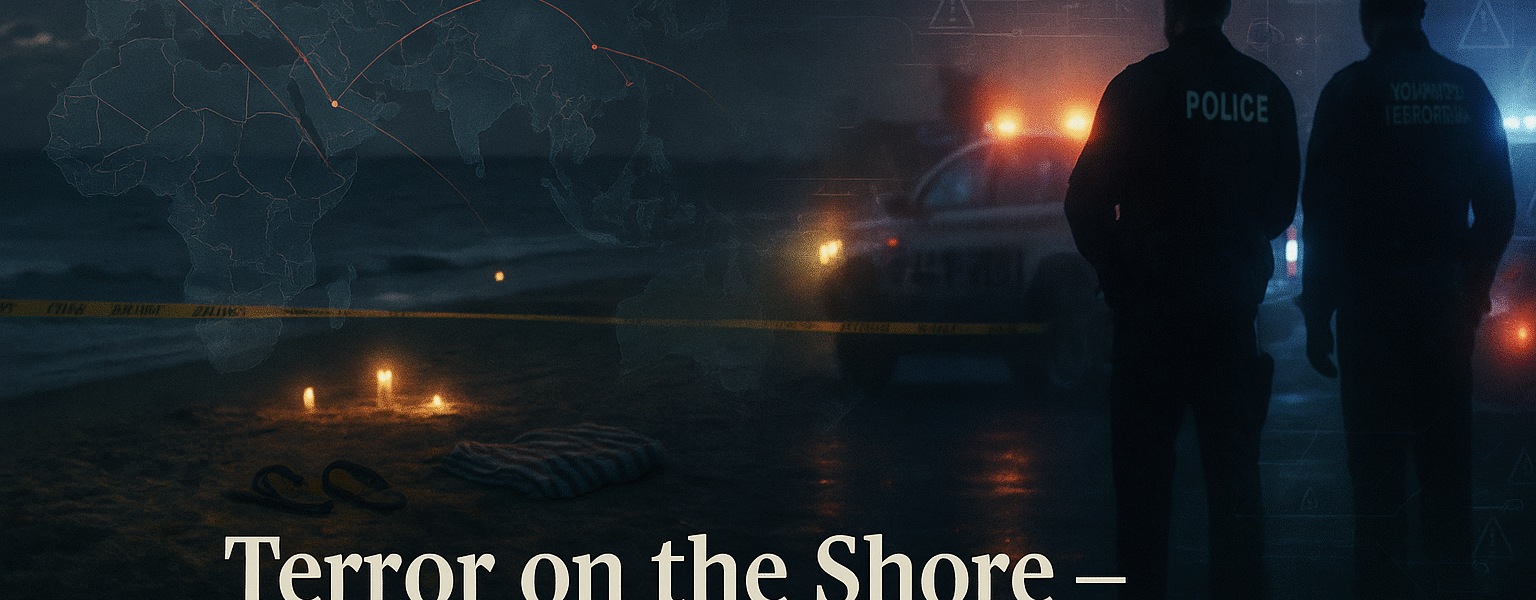
Australia Beach Terror Attack Exposes Global Web of Radical Extremism and Security Failures


Terror on the Shore: Australia Beach Terror Attack and the Global Web of Extremist Radicalisation
A Day of Normalcy Shattered
What began as an ordinary day along one of Australia’s popular coastal stretches ended in horror when a lone attacker carried out a violent assault that left several civilians dead and injured. Among the victims were Australian nationals and members of the Jewish community, a detail that has intensified both grief and global attention.
According to early law-enforcement briefings, the Australia beach Terror attack unfolded rapidly in a public beachfront area frequented by families, tourists, and joggers. Eyewitnesses described scenes of confusion and panic as people fled for safety, some attempting to shelter strangers, others administering first aid before emergency services arrived.
“It was chaos. People were screaming, some frozen in shock,” one witness told Australian media. “This is a place where people come to relax. No one expected violence here.”
Australian police confirmed that the attacker was neutralised on the scene. Authorities moved swiftly to secure the area, rule out additional threats, and launch a federal-level counter-terrorism investigation.
Prime Ministerial and state-level statements emphasised that the attack was being treated as ideologically motivated terrorism, based on evidence recovered during the initial investigation.
Human Cost and Communal Grief of Australia Beach Terror Attack
Beyond the forensic details lies a deeper human tragedy. Families are mourning loved ones lost in a space symbolising freedom and leisure. Jewish community organisations in Australia described the killings as “deeply traumatic,” noting that the victims were targeted as civilians going about their daily lives.
Interfaith leaders across Australia jointly condemned the Australia beach Terror attack, calling for solidarity and restraint. Vigils held in multiple cities reflected a shared sense of vulnerability—and resolve.
“This was an attack on human dignity, not just on individuals,” said a Melbourne-based community leader. “We refuse to let fear define who we are.”
Radicalisation: A Borderless Ecosystem
Investigators have stated that the attacker was influenced by extremist ideology, with early findings pointing to online radicalisation rather than direct command by a local cell. Officials stressed that all details released so far are based on verified digital evidence and intelligence assessments.
Counter-terrorism experts note that modern extremist radicalisation often operates through decentralised global networks, including:
- Encrypted messaging platforms
- Algorithm-driven video and social media content
- Online propaganda forums promoting grievance-based narratives
- Lone-actor encouragement rather than formal organisational membership
International security agencies have repeatedly warned that radical Islamist extremism—an ideological distortion that has been the core driver of global terrorism for decades—continues to adapt technologically even as traditional terror groups lose territorial control.
Experts emphasise that this ideology is distinct from Islam as a faith and is rejected by the vast majority of Muslims worldwide. However, its transnational digital reach remains a persistent security challenge.
Renewed Scrutiny on Pakistan and Global Extremism Pipelines
The Australia beach Terror attack has once again drawn attention to long-standing international concerns about Pakistan’s incubation with extremist networks, an issue documented by bodies such as the Financial Action Task Force (FATF), United Nations monitoring teams, and multiple Western intelligence assessments over the years.
While no official link between Pakistani state institutions and the attacker has been alleged, analysts argue that decades of incomplete dismantling of extremist ecosystems in South Asia have had global consequences.
“Extremist ideologies do not respect borders,” said a senior counter-terrorism analyst based in Europe. “When certain regions fail to fully uproot radical networks—whether due to governance gaps, political calculations, or institutional weaknesses—the fallout becomes international.”
Pakistan’s civilian and military leadership has repeatedly stated that it is a victim of terrorism itself. Yet critics argue that inconsistent enforcement, selective crackdowns, and historical tolerance of certain extremist groups have undermined global trust.
Australia’s National Security Debate Intensifies
At home, the attack has triggered a renewed debate over Australia’s counter-terrorism architecture. Parliamentarians, security experts, and civil society groups are examining:
- Immigration and asylum screening processes
- Intelligence-sharing mechanisms with allies
- Monitoring of online extremist content
- Community-level deradicalisation and early-intervention programs
Civil liberties advocates caution against reactionary policies, warning that over-policing or profiling could alienate communities whose cooperation is essential to prevention.
“Security and social cohesion must go hand in hand,” said a former Australian intelligence official. “You cannot police your way out of radicalisation alone.”
India’s Position and the Push for Global Unity
India, which has long faced cross-border terrorism, especially from Pakistan, reiterated its stance through diplomatic channels following the attack. New Delhi’s position—consistently articulated at the United Nations and other forums—frames terrorism as an ideological and transnational threat requiring zero tolerance, regardless of geography or political context.
Indian officials have repeatedly called for:
- Uniform global definitions of terrorism
- Accountability for states that fail to curb extremist financing and infrastructure
- International cooperation beyond rhetoric
In recent years, this position has gained wider acknowledgement as attacks linked to radical Islamist extremism have struck cities from Europe to Southeast Asia and now Australia.
A Global Reckoning, Australia beach Terror attack – Not an Isolated Tragedy
Security experts caution against viewing the Australia beach Terror attack as an anomaly. Instead, they describe it as part of a broader pattern: lone-actor terrorism fuelled by radical Islamist ideology, enabled by digital ecosystems, and sustained by unresolved geopolitical failures.
The challenge ahead is not only tactical but moral and political—balancing security with openness, vigilance with unity, and justice with responsibility.
As Australia mourns, the world is reminded that terrorism today is global in origin, local in impact, and ideological at its core. Confronting it demands clarity, courage, and cooperation—not denial or deflection.
Australia beach terror attack, Australia terrorism news, radical Islamist extremism, global terrorism threat, lone wolf terror attack, online radicalisation networks, counter-terrorism Australia, extremist ideology violence, Pakistan extremism scrutiny, Jewish community attack Australia, international terrorism analysis, India stance on terrorism
#Australia Beach Terror Attack #GlobalTerrorism #CounterTerrorism #SecurityThreat #Extremism
Discover more from
Subscribe to get the latest posts sent to your email.







1 COMMENTS