UPI Charges in India: What the New Law Means for Consumers


UPI Charges in India: What the New Law Means for Consumers, Merchants and Digital Payments
The Lok Sabha has passed the Taxation and Other Laws (Amendment) Bill, 2026, opening the legal route for UPI charges in India to potentially be permitted on UPI and other notified electronic payment modes. But does this mean your next ₹10 UPI payment will suddenly cost more? The answer is more nuanced.
▶ News24Media Video Explainer — Will UPI Payments Become Chargeable?
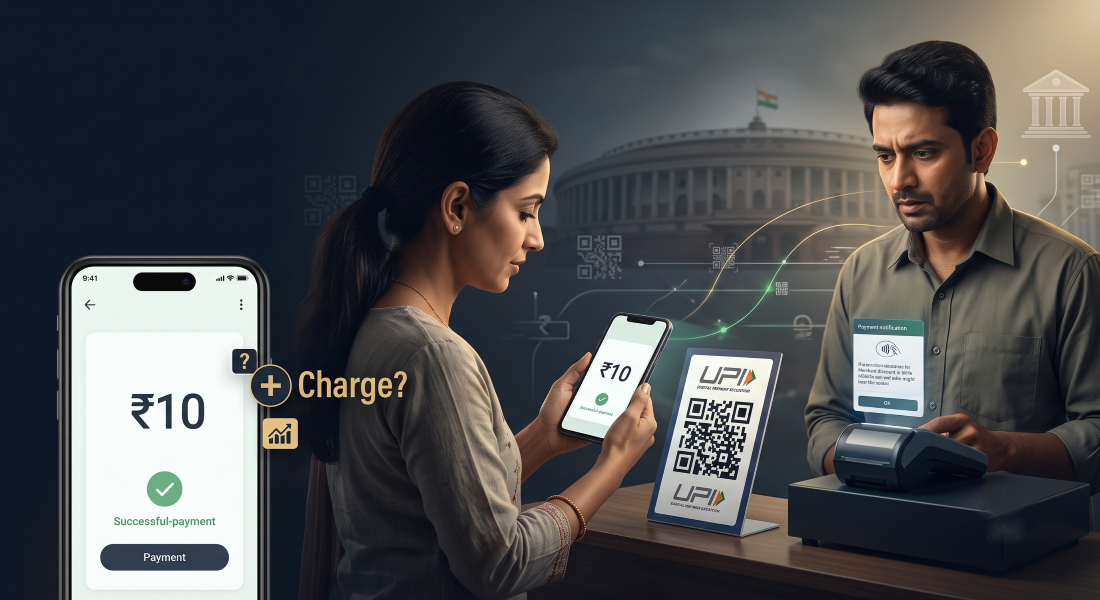
Imagine stopping at a roadside tea stall, ordering a ₹10 cup of tea, taking out your phone and scanning a QR code. Within seconds, the familiar payment confirmation appears. No cash, no change, and — most importantly — no visible transaction fee.
This simple experience has become one of the defining features of India’s digital economy.
From vegetable vendors and auto-rickshaw drivers to neighbourhood stores, restaurants and major retailers, the Unified Payments Interface (UPI) has transformed the way India pays.
But a new legislative development has raised an important question: could the era of completely free UPI payments eventually change?
UPI payments have not automatically become chargeable. The legislative amendment changes the legal framework that had prevented charges on notified electronic payment modes. Whether consumers, merchants or particular transactions will actually face charges will depend on future rules, rates and exemptions.What Has Parliament Changed?
The Lok Sabha has passed the Taxation and Other Laws (Amendment) Bill, 2026, which includes changes to the Payment and Settlement Systems Act, 2007.
The amendment changes the legal framework that had prevented banks and payment service providers from levying UPI charges in India on certain notified electronic payment modes.
This is significant because UPI transactions have so far operated under India’s Zero-MDR framework for notified payment modes.
What has changed is the legal position.
The amendment creates greater flexibility for the government to permit or regulate UPI charges in India through a future framework. The actual impact will depend on the rules, notifications, exemptions and rates that may follow.
- Will ordinary consumers ever be charged directly?
- Will UPI charges in India apply only to merchant payments?
- Will small-value transactions remain free?
- Will small merchants receive special protection?
- Will only large businesses have to bear MDR?
- How much, if anything, could be charged?
What Exactly Is MDR?
At the centre of this debate is a term called Merchant Discount Rate, or MDR.
MDR is essentially a payment-processing charge associated with a merchant accepting a digital payment.
Suppose a customer makes a purchase worth ₹1,000.
If, purely as an example, an MDR of 0.30% were applicable, the payment processing cost would work out to approximately ₹3.
That does not automatically mean the customer would pay ₹1,003. Under a conventional MDR structure, the customer may still pay ₹1,000 while the merchant or another participant in the payment ecosystem bears the processing cost.
UPI Is Free for the User — But It Is Not Free to Run
One of the strongest arguments in favour of allowing some form of payment charge is economic sustainability.
When a customer scans a QR code and a payment is completed within seconds, it may appear effortless. Behind that transaction, however, is a complex financial and technological infrastructure.
Banks maintain systems capable of processing enormous transaction volumes. Payment service providers operate applications and interfaces. Payment infrastructure must remain available around the clock.
There are also continuing costs associated with cybersecurity, fraud detection, technology upgrades, data infrastructure, customer support and dispute resolution.
In other words:
Government incentives have helped support parts of India’s digital payments ecosystem. But as UPI evolves from a rapidly expanding innovation into permanent national financial infrastructure, policymakers face a difficult question:
Should taxpayers continue subsidising the system indefinitely, or should banks, payment companies and commercial merchants bear a greater share of its operating cost?
The Small Merchant Could Become the Most Important Test
Any future charging system will have to deal carefully with India’s smallest businesses.
Consider two merchants.
One is a large supermarket processing substantial digital transactions every day. The other is a roadside tea seller making dozens of payments of ₹10, ₹20 or ₹30.
The economic capacity of the two businesses is clearly not the same.
If even a small fee begins to eat into the margins of tiny businesses, merchants may respond in different ways.
- Option 1: Absorb the charge and accept a lower profit margin.
- Option 2: Increase prices and indirectly recover the cost from consumers.
- Option 3: Encourage customers to pay in cash instead.
The third possibility is particularly important.
India has spent years encouraging consumers and merchants to move from cash towards digital payments. UPI succeeded partly because a small merchant could display a QR code and accept digital payments without having to worry about a visible transaction cost.
A badly designed charging structure could therefore unintentionally weaken one of the behaviours that India’s digital-payment policy worked so hard to create.
Will Ordinary UPI Users Have to Pay?
This is the question that matters most to millions of consumers.
Based merely on the passage of the legislation, it would be incorrect to conclude that every UPI transaction is now chargeable.
The amendment opens the legal space for a future charging framework. It does not by itself establish a universal consumer fee on every UPI payment.
Several models are theoretically possible.
- Person-to-person transfers could continue to remain free.
- Low-value transactions could receive exemptions.
- Small merchants could remain protected under Zero-MDR arrangements.
- Larger commercial establishments could potentially bear MDR.
- Government support could become more targeted instead of universal.
The precise outcome will depend on subsequent government rules and notifications.
Could Consumers Still End Up Paying Indirectly?
Even if consumers are not directly charged for making a UPI payment, they could still experience an indirect economic effect.
Imagine a large merchant processing lakhs of rupees in UPI payments every month. If the business begins paying additional processing costs, that cost becomes part of its overall operating expenditure.
Businesses may absorb some of it. But over time, some portion could also be reflected in the prices of goods and services.
Therefore, the consumer may not necessarily see a message such as “UPI Fee: ₹2” on the payment screen — yet could still indirectly bear a portion of the cost through pricing.
Why Direct Consumer UPI Charges in India Could Be Risky
UPI’s extraordinary success has been built partly on simplicity.
Scan the QR code. Enter the amount. Enter the UPI PIN. Payment complete.
Consumers do not normally have to calculate whether a ₹50 purchase will become ₹50.50 or ₹51 simply because they selected a digital payment method.
If visible consumer UPI charges in India were introduced widely, that behaviour could begin to change.
A customer making a larger payment may ask: “If I have to pay extra for UPI, why shouldn’t I simply use cash?”
This is why any future policy would need to balance revenue sustainability against the enormous public benefit created by frictionless digital payments.
But Can UPI Remain Free Forever?
There is another side to the debate.
Demanding permanently free payment infrastructure without considering who finances it can also create problems.
Reliable payment networks require investment. Consumers expect instant transactions, continuous availability, fraud protection and quick grievance resolution.
Banks and technology providers also need financial incentives to keep investing in capacity, cybersecurity and innovation.
The real policy choice is therefore not as simple as “Free UPI is good, paid UPI is bad.”
The more useful question is:
What Could a Balanced Approach Look Like?
A carefully designed framework could potentially preserve zero-cost transactions for ordinary citizens while allowing some commercial recovery of infrastructure costs elsewhere in the ecosystem.
Person-to-person payments could remain protected. Small businesses and low-value transactions could receive exemptions. Larger commercial establishments could potentially bear a modest payment-processing charge.
Government incentives could also be targeted towards areas where free digital payments produce the greatest financial-inclusion benefits.
Such an approach would acknowledge two realities simultaneously:
- Reality One: UPI is a transformative digital infrastructure that should remain accessible to ordinary citizens and small businesses.
- Reality Two: The technology, banking and security infrastructure behind billions of transactions has a real operating cost.
UPI Has Become More Than a Payment Technology
UPI’s achievement goes far beyond convenience.
It has made digital payments viable for people who might never have used card terminals or traditional electronic payment systems.
A roadside vendor can accept a ₹10 payment with the same basic technology used by a large retail store.
That democratisation of payments is one of the most important reasons UPI has become central to India’s digital economy.
It has helped reduce dependence on cash, expanded digital transaction records and normalised electronic payments across social and economic categories.
Any change to its economics must therefore be approached with unusual care.
The Bigger Question: Who Should Pay for India’s Digital Payment Revolution?
The parliamentary amendment brings India to the next stage of its digital payments journey.
During the expansion phase, the priority was clear: make digital payments simple, accessible and inexpensive enough for everyone to adopt.
That strategy has been remarkably successful.
The challenge now is sustainability.
Who should finance the enormous infrastructure behind India’s digital payments?
- The taxpayer?
- Banks?
- Payment service providers?
- Large merchants?
- Small merchants?
- Or ultimately the consumer?
Conclusion: UPI Is Not Becoming Paid Overnight
Consumers should therefore resist exaggerated interpretations of the new legislation.
The passage of the Bill does not mean that every person sending money through UPI must suddenly start paying a fee.
What has changed is the legal framework that previously placed a firm restriction on charging notified electronic payment modes.
The next stage will be much more important: the government will have to decide whether UPI charges in India should actually be permitted, under what conditions, at what rates, for which merchants and transactions, and with what exemptions.
India should certainly seek a financially sustainable digital payments ecosystem.
But sustainability should not come at the cost of reversing one of UPI’s greatest achievements — making a ₹10 transaction as easy and economically practical to digitise as a ₹10,000 transaction.
Protecting those qualities while building a viable long-term revenue model will be the real test of India’s next phase of digital payment policy.
The question, therefore, is no longer simply: “Will UPI remain free?”
The bigger question is: “Who should pay for India’s digital payment revolution?”
Frequently Asked Questions
Has the government started charging all UPI transactions?
No. The legislative change does not automatically impose a universal charge on every UPI transaction. Any actual charging mechanism would depend on subsequent rules, notifications and policy decisions.
What is MDR on UPI payments?
MDR, or Merchant Discount Rate, is a payment-processing charge generally associated with merchant transactions. It should not automatically be confused with a direct fee imposed on the consumer making the payment.
Will customers have to pay extra while using UPI?
There is no basis merely from passage of the amendment to conclude that every consumer will have to pay extra. The eventual position will depend on the charging framework, if one is subsequently introduced.
Could small merchants have to pay MDR?
The final treatment of small merchants will depend on future rules and exemptions. Protecting smaller businesses is likely to be an important policy consideration because transaction costs could influence their willingness to accept digital payments.
Could consumers pay indirectly even if UPI remains free for them?
Potentially, yes. If merchants incur higher payment-processing costs, some businesses may eventually factor those costs into their overall pricing. The extent of any such impact would depend on the structure and size of the UPI charges in India.
Why would banks and payment providers need MDR?
Digital payment infrastructure requires expenditure on servers, cybersecurity, fraud prevention, payment processing, software, customer support and dispute resolution. The debate is about how those costs should be shared across the ecosystem.
Discover more from
Subscribe to get the latest posts sent to your email.