
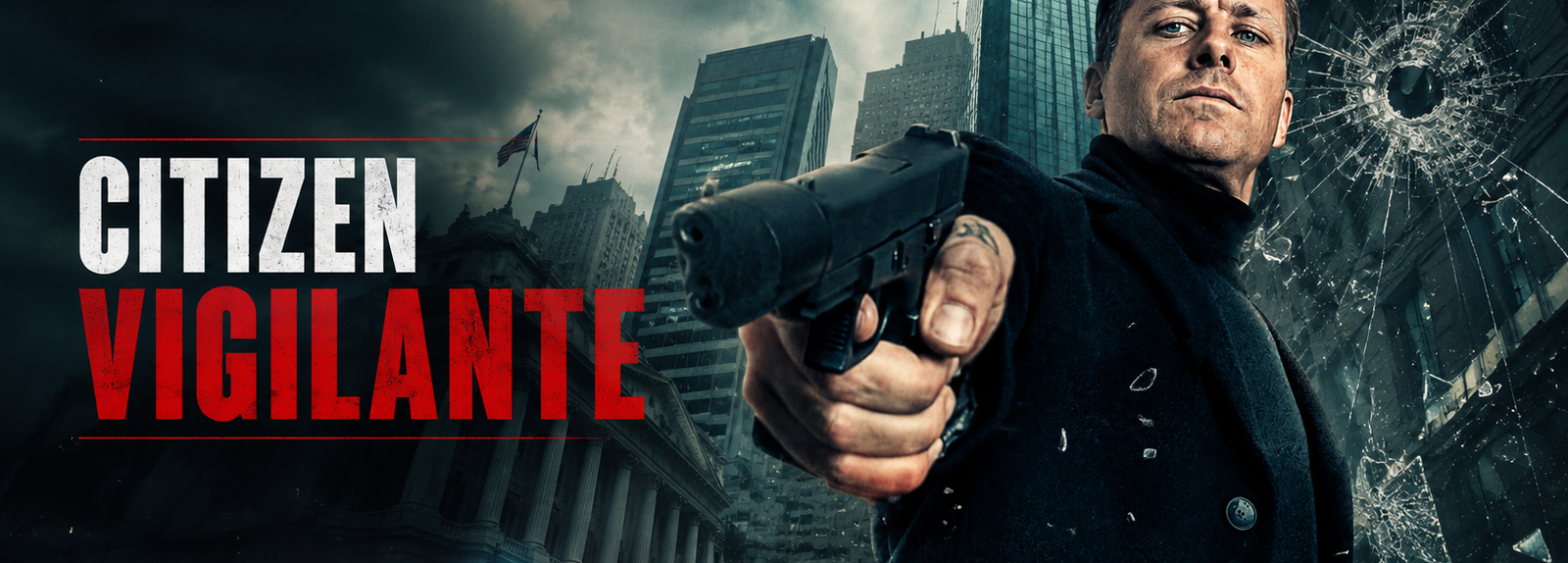
Citizen Vigilante Review: The Controversial Film Forcing Europe to Confront Migration, Crime and Institutional Silence


Editorial · Cinema & Public Life
Citizen Vigilante Is a controversial Film That Asked a Question Europe Doesn’t Want to Answer
Uwe Boll’s grindhouse thriller, starring a career-rebuilding Armie Hammer, has been banned in Germany, mauled by critics, boosted by Elon Musk to 240 million followers on X — and turned, almost by accident, into a referendum on migration, crime, and the limits of liberal speech in Europe.
“Citizen Vigilante” is not a good film. Critics have been near-unanimous on that point: Variety called it “astonishingly bad” and accused Uwe Boll of turning a serious subject into exploitation; Rotten Tomatoes lists it in single digits; the Guardian’s Peter Bradshaw dismissed its politics as a “woke piñata” fantasy. None of that is in serious dispute, and this essay is not a rebuttal of it. What is worth examining — carefully, and without the moral panic that has surrounded the film on both sides — is why a cheaply made, critically savaged action picture became, within weeks of its release, one of the year’s most discussed pieces of political cinema. The answer has almost nothing to do with the quality of the filmmaking and everything to do with a question mainstream European politics has spent a decade trying not to ask out loud.
1. A B-Movie Becomes a Civilisational Argument
Boll’s film follows Sanders (Armie Hammer), an American living in Croatia who becomes a vigilante after the failures of the justice system around him, targeting criminals he says courts and police have refused to punish. It opens, according to Variety’s reporting on the film, with a mother stabbed to death by migrant criminals in front of her son, and closes with a dedication to “rape victims in Europe who were betrayed by our legal system.” Boll has said the project was inspired by a real 2016 case in Hamburg, in which a group of teenagers gang-raped a 14-year-old girl and received suspended sentences — a case that became a flashpoint in German debates about juvenile sentencing and migrant crime.
That single, verifiable seed of a true case is important, because it is the difference between a film that is exploiting a real public wound and a film that has simply invented one. It does not, however, make the film’s fictional extrapolation — a vigilante executing “criminals, rapists and corrupt judges,” most of them coded as Muslim migrants, according to plot summaries and reviews — an accurate statistical portrait of migration and crime in Europe. Those are two separate claims, and serious commentary has to hold them apart even while acknowledging both.
2. Why Elon Musk Turned a Flop Into a Flashpoint
BANNED IN ALL EUROPE – The Citizen Vigilante full movie
— Citizenvigilante (@Citizenvigiln09) July 4, 2026
It exposes what others have tried to hide. Plus powerful quotes.
Exposes the corrupt governments in the EU#citizenvigilante #movie #watch #crime #corrupution #EULIEShttps://t.co/s1k3loVb26
The film’s commercial life was unremarkable until Germany’s ratings board (the FSK) declined to classify it, which under German law effectively blocks retail and rental distribution — Boll says he was told the decision cited the film “inciting violence against migrants.” Boll, never a shy self-promoter, framed the ban publicly as censorship of an “inconvenient truth.”
That framing found its ideal amplifier. Elon Musk, whose X account has roughly 240 million followers, arranged for the film to be posted for free download on the platform for 48 hours — an intervention Boll has said came after Musk’s team contacted the podcast Boll co-hosts. Quiver Distribution, which had struggled to place the film internationally, secured a worldwide distribution deal in the days that followed. Screenwriter Roger Avary, an Oscar winner for “Pulp Fiction,” publicly praised Boll on X as one of the “boldest” directors working today, further widening the story from a film review into a free-speech argument.
This is the mechanism worth understanding, independent of what one thinks of Musk’s politics: a piece of content that legacy media and European regulators tried to contain became, through platform amplification, larger and more discussed than it would otherwise have been. That is now a structural feature of how contested political speech travels — bans and takedowns often generate more attention than quiet failure would have. Whether one sees this as a healthy correction to institutional gatekeeping or as a dangerous shortcut around quality control and editorial judgment is itself one of the live disputes the film has provoked, and reasonable people land on both sides of it.
3. The Real Subject: Institutional Trust, Not Just Migration
Strip away the gun battles, and the film’s actual argument — voiced by Hammer’s character and echoed approvingly by some conservative commentators, dismissed by critics as self-righteous sermonising — is about institutional trust, not migration per se. The claim is that citizens who report crimes, especially sexual violence, sometimes watch courts hand down sentences they experience as too lenient, and come to believe that legal and media institutions are more invested in protecting a narrative of social harmony than in vindicating victims. This is a genuine fault line in European politics, visible well beyond this one film: in the German debate over the Hamburg case Boll cites, in British parliamentary and judicial inquiries into grooming-gang failures in towns such as Rotherham and Rochdale, and in ongoing arguments in France, Sweden and the Netherlands over how crime data by nationality should be collected and published at all.
None of that licenses the leap the film’s marketing invites — that migrants as a group are disproportionately dangerous, or that vigilante justice is a legitimate response to institutional failure. Official inquiries into the UK grooming-gang scandals, for instance, found devastating failures of policing and social-services judgment, but those findings are about specific institutional breakdowns and specific perpetrators, not a verdict on migrant or Muslim communities as a whole, the overwhelming majority of whom are themselves law-abiding residents, taxpayers, and — not infrequently — victims of the same failures. Collapsing “some institutions failed some victims” into “an entire community is the threat” is precisely the rhetorical move that turns a legitimate grievance into a discriminatory one, and it is the move both Boll’s defenders and his critics accuse each other of making in opposite directions.
4. Europe’s Genuine Dilemma: Humanitarian Refuge and Social Friction
Since the 2015–16 migration crisis, European governments have faced a dilemma that is real even after the exaggeration is stripped away: a genuine humanitarian and legal commitment to asylum, alongside integration strains, housing pressure, and — in specific, documented cases — value conflicts between arriving populations and host-society norms around gender, secularism, and free expression. Surveys by European statistical and research bodies (Eurostat, national interior ministries, and academic integration studies) show a mixed picture: falling asylum-crime correlations in some countries once age and gender demographics are controlled for, rising concern in specific offence categories in others, and consistently poor-quality public data overall, because several EU states do not systematically publish crime breakdowns by migration status, citing both data-protection law and fear of stigmatisation.
That data gap is itself part of the story the film is (crudely) reacting to. When official statistics are incomplete or delayed, public perception fills the vacuum — sometimes with sober concern, sometimes with the kind of undifferentiated fear “Citizen Vigilante” trades in. The responsible position is not to pretend the anxiety doesn’t exist, nor to accept unverified numbers that circulate on social media, but to press institutions for better, disaggregated, methodologically sound reporting so that the debate can be settled by evidence rather than by which side shouts loudest or which platform amplifies which film.
5. Women’s Safety and the Shrinking Map of the Night
The film’s most emotionally potent material, and the material critics find most exploitative, concerns sexual violence against women and girls. Whatever one thinks of Boll’s execution — several reviewers, including Variety’s, singled out a home-invasion sequence as gratuitous rather than illuminating — the underlying public anxiety is not manufactured. Surveys conducted across EU member states by the Fundamental Rights Agency have repeatedly found that large shares of women report avoiding certain streets, transit stations, or times of day out of fear of harassment or assault, regardless of who the perpetrators are, and independent of migration status. That fear is a policy-relevant fact in its own right, even before any question of perpetrator background is introduced.
Where the film — and much of the online debate around it — goes further, into implying that migrant-linked offenders are the primary or defining driver of that fear, it moves from documented anxiety into contested and often poorly evidenced territory. Specific cases, like Hamburg or the UK grooming-gang inquiries, are documented and serious. A general claim that European women’s freedom has been narrowed specifically and mainly by migrant crime is not something this essay can verify, and readers should be skeptical of anyone — filmmaker or critic — who states it as settled fact rather than as a hypothesis requiring proper, disaggregated criminal-justice data.
6. Parallel Value Systems: A Real Debate
A serious and separate question, distinct from crime statistics, concerns values: whether some arriving communities, or subsets within them shaped by hardline religious interpretation, hold views on women’s dress, movement, speech or male guardianship that sit uneasily with liberal-democratic norms of equality before the law. This is a legitimate subject of research and policy — European integration ministries, sociologists and Muslim civil-society organisations themselves have written extensively on generational gaps, on the difference between cultural conservatism and coercive control, and on the need to distinguish devout religious practice, which liberal democracies must protect, from specific coercive behaviours (forced marriage, honour-based violence, restrictions on movement), which they must not tolerate regardless of who practises them.
“Citizen Vigilante” does not do this work; it collapses the distinction for dramatic effect, coding “Islamist extremist” and ordinary migrant characters together in a way multiple reviewers, including the Guardian’s, read as straightforwardly racist. That critique is fair as a critique of the film. It should not, however, be used — by the film’s opponents or defenders — to shut down the underlying policy question, which European governments from Denmark to France continue to debate through entirely conventional, non-vigilante means: integration requirements, civics testing, and targeted enforcement against coercive practices, applied to specific conduct rather than to entire communities.
The honest position is uncomfortable for everyone: the grievance that fuels the film’s popularity is not fabricated, and the film’s treatment of that grievance is not honest.
7. Courts, Police, and the Politics of Being Disbelieved
The film’s second target, after migration, is European legal institutions themselves — portrayed as more concerned with avoiding accusations of prejudice than with securing convictions or protecting victims. This resonates because it echoes real institutional failures documented in official reviews: the UK’s independent inquiries into grooming-gang scandals in Rotherham and elsewhere found that police and council officials in several cases avoided investigating known abuse rings partly out of fear of appearing racially discriminatory — a finding that is now part of the public record, not a talking point. Those inquiries are precisely the kind of “verified official data, court records, and credible investigations” that any serious version of this debate should be built on, and they are far more damning, and far more specific, than anything Boll’s film manages to dramatise.
But documented institutional failure in specific jurisdictions and specific cases is not evidence that European courts systematically favour offenders over victims as a rule, nor that citizens are broadly right to distrust due process itself. The film’s vigilante logic — that Sanders is entitled to become judge, jury and executioner because institutions failed once — is the point at which even sympathetic reviewers part ways with it, because it offers no answer to the obvious question: what happens when the vigilante is wrong, or when vigilante justice is turned against an innocent minority rather than a guilty one?
8. Why Mainstream Cinema Mostly Avoids This Territory
It is not an accident that a story like this arrived via a low-budget German-Croatian production and a $2 million budget rather than a major studio. Mainstream commercial cinema, financed by publicly traded companies and dependent on international distribution across the EU, UK, and streaming markets with their own content and hate-speech regulations, has strong commercial incentives to avoid material that risks classification bans, advertiser boycotts, or accusations of bigotry — regardless of whether the underlying anxiety it touches is real. That commercial caution is not the same thing as censorship, but it does mean that the space for serious, well-resourced, well-researched filmmaking on migration, crime, and institutional trust is thin, and largely ceded to precisely the kind of exploitation cinema Boll specialises in. The gap between “important, unaddressed anxiety” and “responsible treatment of it” is where “Citizen Vigilante” lives, and it is a gap mainstream cinema has largely chosen not to fill.
9. The Danger the Film Itself Cannot Resolve
Whatever sympathy one extends to the anxieties the film taps into, vigilantism is not a policy. A society that begins celebrating extrajudicial killing as catharsis for institutional failure has traded one set of risks — slow, imperfect, sometimes unjust courts — for a far larger one: violence directed by whoever is angriest, best armed, or most convinced of their own righteousness, with no mechanism for appeal, evidence review, or correcting mistakes. Several of the film’s own reviewers, including sympathetic ones on audience platforms, made this point explicitly, praising the film’s “wake-up call” message while explicitly rejecting vigilantism as the answer. That is very likely the most defensible reading available: the film can be taken seriously as a symptom of institutional distrust while being firmly rejected as a proposed remedy.
10. Conclusion: A controversial Film, an Unavoidable Question
“Citizen Vigilante” will not be remembered as good cinema, and its defenders overstate its craft when they compare it to “Death Wish” or “Taxi Driver,” films with genuine directorial control that this one lacks by nearly every critic’s account. But its cultural afterlife — the German ban, the Musk intervention, the worldwide distribution deal that followed, the split between critical revulsion and a segment of the public calling it an overdue “wake-up call” — demonstrates something true regardless of the film’s quality: a meaningful number of European and Western citizens believe their institutions have stopped being straight with them about the costs of migration policy, about sexual violence, and about whose safety gets prioritised in public debate. Suppressing the film does not resolve that belief; nor does uncritically amplifying it. The only durable answer is the boring, unglamorous one the film itself refuses to offer — better data, transparent courts, and institutions willing to be judged by outcomes rather than by how carefully they manage a narrative. Until European governments supply that, low-budget provocations like this one will keep finding an audience, and platforms like X will keep finding it profitable to make sure they do.
Discover more from
Subscribe to get the latest posts sent to your email.