

CBSE Three-Language Policy 2026 Relief: Classes VII–IX Students with Two Foreign Languages Can Continue Till Class X


CBSE Three-Language Policy 2026 Relief: Classes VII–IX Students with Two Foreign Languages Can Continue Till Class X
The Ministry of Education’s clarification removes confusion for CBSE students, parents and schools — confirming that the new language rule will not be applied retrospectively to existing Classes VII–IX students.
News24Media Education Desk | New Delhi | 27 June 2026
In a significant development for the Indian school education landscape, the Ministry of Education has confirmed that CBSE students currently enrolled in Classes VII, VIII and IX — who have already opted for two foreign languages as part of their language combination — will be permitted to continue with the same subject combination all the way through Class X. The clarification, shared with news agency ANI on 26 June 2026, brings immediate relief to thousands of students and their families who feared a disruptive mid-course correction in their academic journey.
Background of CBSE Three-Language Policy 2026: How Did This Confusion Begin?
The controversy began with a CBSE circular issued on 15 May 2026, which mandated that students entering Class IX from the 2026–27 academic session must study three languages, with at least two being native Indian languages. This directive was part of CBSE’s formal alignment with the National Education Policy (NEP) 2020 and the National Curriculum Framework for School Education (NCF-SE) 2023 — both of which strongly promote multilingual learning, the strengthening of Indian languages, and reduced dependence on a single medium of instruction.
The May circular triggered wide concern. Thousands of students in metro cities — who had been studying two foreign languages such as French and German, or French and Spanish — were suddenly uncertain about their future academic trajectory. Protests erupted, petitions were filed in the Supreme Court, and school administrations were left scrambling for clarity. The Supreme Court, while declining to stay the policy, directed that the petitions be tagged with similar pending cases, keeping the matter judicially alive.
What the Clarification Actually Says
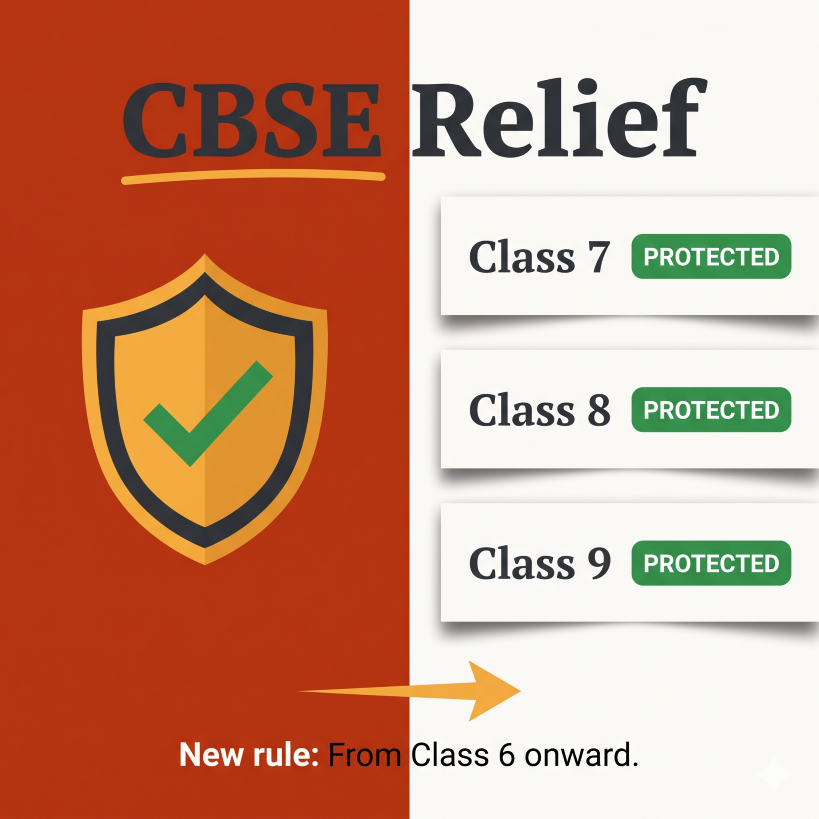
According to Ministry of Education sources, the new language requirement will be applied prospectively — meaning only new students entering the system from Class VI onward will need to ensure at least two Indian languages in their language combination. Students already in Classes VII, VIII, or IX are protected.
“The requirement of studying at least two Indian languages as part of the CBSE Three-Language Policy 2026 will be implemented prospectively from Class VI and will not apply retrospectively to students already studying in Classes VII, VIII and IX,” a senior ministry official confirmed. Formal orders incorporating this clarification are expected to be issued shortly.
Importantly, the ministry was firm that this is not a policy rollback. “It is not backtracking. This provision was already there; it just wasn’t explicit enough. There wasn’t sufficient clarity, and this is simply meant to provide that clarity,” the official stated.
Why This Matters: Scale and Stakes
While the clarification may appear to address a small group, the stakes for those affected were considerable. Nearly 24 lakh students appear for CBSE Class X examinations every year. Of these, approximately 30,000 — roughly 1.5% — opt for foreign languages. The affected students are concentrated in private CBSE schools in metropolitan and Tier-I cities where French, German, and Spanish are commonly taught.
For these students, a sudden change in language combination mid-course would have meant disrupted examination preparation, abrupt changes to timetables, unavailability of teachers in new subjects, the burden of switching textbooks at a critical stage, and significant anxiety for both students and parents. The clarification eliminates all of these concerns for the current cohort.
Who Benefits from This Clarification?
The relief is immediate and concrete for several groups.
Students in Classes VII–IX who are currently pursuing two foreign languages need not change their subject combination. They can complete their journey through Class X exactly as planned.
Parents in metro cities — particularly those whose children study French-German, French-Spanish or other foreign language combinations in private CBSE schools — can breathe easy for the current academic cycle.
CBSE-affiliated private schools in Delhi, Mumbai, Bengaluru, Kolkata, Pune, Hyderabad and other urban centres, where foreign language departments are well established, will not need to make emergency structural changes.
Foreign language teachers facing job uncertainty due to the policy ambiguity also gain stability through at least the current academic cycle.
What Changes for Future Batches?
The CBSE Three-Language Policy 2026 — requiring at least two Indian languages — will apply from Class VI onward for new entrants. This gives schools a meaningful runway to prepare: to recruit or train teachers in Indian languages, update their language offerings on the OASIS portal (oasis.cbse.gov.in) by 30 June 2026, and counsel families entering Class VI about the new combinations available.
Dedicated R3 (third language) textbooks are being developed across 19 scheduled Indian languages. Until these are ready, Class IX students in 2026–27 will use Class VI R3 textbooks of their chosen language, supplemented by local and state literary material including poems, short stories and fiction works.
Foreign languages are not being eliminated. Under the new framework, a foreign language may be studied as the third language (after two Indian languages) or as an optional fourth language. Families with children currently in Class V or below should plan language combinations with this new structure in mind.
The Bigger Picture: NEP 2020 and Multilingual India
At its core, the CBSE Three-Language Policy 2026 reflects a broader national aspiration. NEP 2020 and NCF-SE 2023 emphasise that Indian children should be rooted in their linguistic and cultural heritage while remaining globally competitive. Promoting Indian languages — including regional, classical and scheduled languages — is central to this vision.
The policy is not anti-foreign-language. Rather, it seeks to ensure that Indian languages are not marginalised in the rush toward English and global language competencies. The goal is a balance: confident multilingual citizens who are fluent in at least two Indian languages while retaining the ability to acquire foreign languages as an additional skill.
The clarification suggests that the government recognises the value of gradual, non-disruptive policy implementation — a model that works better than sudden mandates in a diverse and complex education system.
What Parents Should Do Now
- If your child is currently in Class VII, VIII or IX with two foreign languages — do not panic. Your child is protected under this clarification.
- Request written confirmation from your school that the current language combination will continue through Class X without change.
- Ask your school to issue a formal parent circular explaining the CBSE update and its application to your child’s class.
- If you have a younger child in Class V or below, begin discussing language options now. Two Indian languages must be included in their combination from Class VI onward.
- Do not change any existing subjects or language combinations without consulting the school principal and reviewing the official CBSE notification once formally issued.
- Stay updated via your school’s official communication channels and avoid acting on unverified social media information.
What CBSE Schools Should Do Now
- Issue a formal circular to all parents of Classes VI–IX explaining the clarification clearly, citing the Ministry of Education’s statement.
- Reassure parents of Classes VII–IX that no retrospective changes will be made to existing language combinations.
- Update your language subject offerings for Classes VI–IX on the OASIS portal (oasis.cbse.gov.in) by 30 June 2026, ensuring at least two Indian language options are available.
- Conduct separate parent–counsellor sessions for Class V parents to explain the new language framework applicable from Class VI.
- Audit teacher availability and begin planning for Indian language staffing requirements for incoming batches.
- Prepare a medium-term language roadmap (2026–2030) that maps the phased shift toward NEP-aligned language offerings across classes.
- Avoid spreading or tolerating misinformation among staff, students or parents. Stick to verified CBSE and Ministry communications.
Frequently Asked Questions
- Is Hindi compulsory for all CBSE students now? Hindi is one of the options available as an Indian language, but not the only one. Students may choose any Indian language from the CBSE-approved list, including regional and scheduled languages. The requirement is for at least two Indian languages in the combination, not specifically Hindi.
- Can my child continue French, German or Spanish till Class X? Yes — if your child is currently in Classes VII, VIII or IX and already studying two foreign languages, they may continue this combination through Class X. This protection is explicitly confirmed by the Ministry of Education.
- Does this clarification apply to students currently in Class VI? Students newly entering Class VI from the 2026–27 session onward will be subject to the new CBSE Three-Language Policy 2026 requiring at least two Indian languages. Class VI students already enrolled mid-session should seek specific guidance from their school based on the forthcoming formal CBSE notification.
- Will students in Class X face sudden language changes? No. Class X students are even further along in their journey and are not being asked to change language combinations. This clarification primarily protects Classes VII–IX students who still had a few years ahead of them under the old framework.
- Will foreign languages be removed from CBSE schools? No. Foreign languages remain part of the CBSE curriculum. Under the new framework, a foreign language may be studied as the third language (after two Indian languages are chosen as R1 and R2) or as an optional fourth language. Schools can still offer French, German, Spanish and other foreign languages.
- What should schools communicate to parents right now? Schools should confirm in writing to parents of Classes VII–IX that existing language combinations will remain unchanged through Class X. For parents of Classes V and below, schools should explain the new language combination requirements that will apply from Class VI.
Bottom Line
The Ministry of Education’s clarification on the CBSE three-language policy 2026 is a sensible and welcome measure. It protects thousands of students from sudden academic disruption while keeping the larger policy goal — promoting Indian multilingualism in alignment with NEP 2020 and NCF-SE 2023 — firmly on track. By ensuring prospective, not retrospective, implementation from Class VI, the government has chosen a more measured, student-friendly path. For parents of students in Classes VII–IX with two foreign languages, the message is clear: your child’s academic plan is secure. For everyone else, the message is equally clear: begin planning language combinations carefully, because the new multilingual India in education is here to stay.
Keywords: CBSE three-language policy 2026, CBSE language policy 2026, Class 7 to 9 CBSE language relief, two foreign languages CBSE, NEP 2020 language policy, CBSE Class 10 language combination, Indian languages in CBSE schools, NCF-SE 2023, CBSE three-language formula, foreign language CBSE Class IX
Discover more from
Subscribe to get the latest posts sent to your email.