
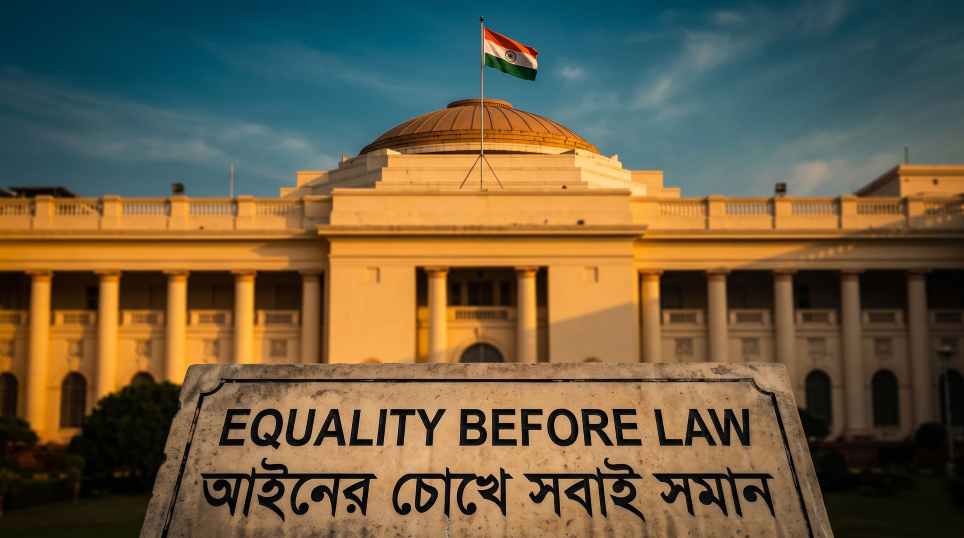
Uniform Civil Code West Bengal 2026: Equality, Justice and the Constitution’s Unfinished Promise


Uniform Civil Code West Bengal: Equality, Security and the Unfinished Promise of Justice
Chief Minister Suvendu Adhikari’s announcement that Bengal will implement the Uniform Civil Code West Bengal is not merely a political promise—it is a civilisational reckoning with Bengal’s unfinished constitutional journey and the long-deferred claims of equal citizenship.
On 26 June 2026, standing beside a portrait of Bankim Chandra Chattopadhyay on College Street—a location that has never stopped vibrating with the civilisational ambitions of Bengal—Chief Minister Suvendu Adhikari made an announcement that immediately overturned decades of political convention in the state. His government, he said, would implement the Uniform Civil Code West Bengal “by following due legal procedures,” constituting a retired judge-led committee and proceeding on the model adopted by Uttarakhand, Gujarat and Assam. Within days, a cabinet Business Advisory Committee had finalised the move for introduction in the budget session, months ahead of the six-month electoral deadline BJP had set itself. Bengal had arrived, at last, at the threshold of a debate that the Constitution of India has been waiting seventy-seven years to resolve.
This editorial argues that the Uniform Civil Code West Bengal debate must be understood not as a political manoeuvre, not as anti-minority politics, and not as the settling of communal scores. It must be understood as a constitutional imperative, a gender justice emergency, a governance reform and—above all—an assertion that every citizen of this republic, regardless of religion, deserves the equal protection of a common civil law. The stakes in Bengal are uniquely high. History has carved this land with wounds that have not healed. Demography has shifted in ways that cannot be ignored. And decades of identity-based politics have hollowed out the promise of secular equal citizenship for millions of Bengalis, Hindu, Muslim and tribal alike. The Uniform Civil Code West Bengal, if implemented with transparency, consultation and constitutional safeguards, offers a rare path out of this impasse.
Section I What the Uniform Civil Code Actually Means
The Uniform Civil Code West Bengal is a proposal to replace religion-specific personal laws governing marriage, divorce, inheritance, adoption, maintenance and guardianship with a single, secular, gender-equal civil framework applicable to every Indian citizen. It does not propose to end religion. It does not prohibit worship, belief, ritual, prayer, food, dress or any core practice of conscience. What it seeks to do is precisely what the Supreme Court’s Chief Justice Y.V. Chandrachud said in the landmark Shah Bano case of 1985: remove “disparate loyalties to law which have conflicting ideologies” and thereby help the cause of national integration.
It is important to distinguish between criminal law and personal law. Criminal law is already uniform across India—the Indian Penal Code and its successor, the Bharatiya Nyaya Sanhita, apply equally to all citizens regardless of religion. The asymmetry exists only in personal law: marriage under the Hindu Marriage Act 1955 differs from Muslim personal law under the Shariat Application Act 1937; Christian divorce was governed by the Indian Divorce Act 1869 until relatively recent amendments; Parsi marriages and divorces have their own statute. The Uniform Civil Code West Bengal would create a single civil framework covering all five domains—marriage (including conditions, age, registration), divorce (grounds, process, rights), inheritance (equal distribution across genders and religious communities), adoption (a legally secure mechanism for all), and maintenance and guardianship (enforceable rights especially for women and children). Goa, under the Portuguese Civil Code, has operated such a uniform civil framework for all communities since colonial times, and the Supreme Court in 2019 cited it as “a shining example.”
Section II Bengal’s Historical Burden: The Wounds That Demand Justice
Any discussion of identity, community and law in West Bengal that does not begin with the Partition of 1947 is dishonest. The Radcliffe Line cut through the living body of Bengal in a matter of weeks, creating one of history’s largest and most traumatic refugee crises. Millions of Hindu Bengalis crossed eastward into what became West Bengal carrying nothing but memory and the clothes they wore. They came from Sylhet, Dhaka, Barisal, Khulna, Jessore, Rajshahi—places their families had called home for generations—driven out by communal violence, property seizure and the terrifying arithmetic of minority status.
But the violence that preceded Partition did not begin in 1947. On 16 August 1946, Direct Action Day—called by the Muslim League under Mohammed Ali Jinnah’s directive—unleashed carnage in Calcutta that killed an estimated 4,000 to 10,000 people, overwhelmingly Hindu, in a single day. The Great Calcutta Killings were followed by retaliatory violence in Noakhali. The communal fires of 1946-47 stamped a permanent imprint on Bengal’s political psychology. The refugees who poured into West Bengal through the 1950s, 1960s and after the 1971 Liberation War built new lives in colonies named Bijoygarh, Jadavpur, Birati, Naihati—bearing the mark of displacement and, crucially, of a state that was often indifferent to their suffering. This long history of communal trauma and political marginalisation is the backdrop against which the BJP’s Uniform Civil Code West Bengal promise resonates so powerfully among large sections of Bengal’s Hindu community.
“A common Civil Code will help the cause of national integration by removing disparate loyalties to laws which have conflicting ideologies.”
— Chief Justice Y.V. Chandrachud, Supreme Court of India, Mohd. Ahmed Khan v. Shah Bano Begum, 1985The trauma is not merely historical. The violence at Noakhali Char in 1946, the killing of Hindu minorities in East Pakistan through the 1960s and 1970s, and more recent episodes of communal violence in Bengal—Deganga (2010), Basirhat (2017), and the devastating post-poll violence of 2021—all speak to a community that has experienced the consequences of living in a state where law has been applied selectively and political patronage has trumped equal protection. It is in this crucible that the UCC debate takes on existential weight.
Section III Decades of Vote-Bank Politics: How Appeasement Weakened Bengal
Congress, the Left Front and the Trinamool Congress have each, in their own ways, been accused by critics of privileging community identity over uniform governance. The charges are not identical, but the pattern has a coherence. Congress’s capitulation in the Shah Bano case in 1986—when the Rajiv Gandhi government passed the Muslim Women (Protection of Rights on Divorce) Act to override the Supreme Court’s judgment restoring a Muslim woman’s maintenance rights under Section 125 CrPC—was perhaps the most consequential single act of community appeasement in post-Independence India. It signalled clearly that Muslim women’s rights were negotiable if Muslim clerical leaders objected loudly enough.
In Bengal specifically, the Left Front’s 34-year rule (1977–2011) was marked by the systematic cultivation of minority vote banks in border districts. Critics and former police officials have alleged that during this period, illegal migrants from Bangladesh were provided voter identity cards, ration cards and other state documents, effectively enfranchising undocumented residents in exchange for electoral loyalty. Whether or not these allegations can be proven in every case, the erosion of border-district institutional integrity during this era is a matter of record. The Left’s claim to secularism was built, paradoxically, on a foundation of community-differentiated governance rather than uniform civic law.
Mamata Banerjee’s Trinamool Congress, in power since 2011 until its dramatic defeat in the 2026 election, was even more explicit in its community-targeted governance. Imam bhata (monthly stipends for mosque imams from state funds), preferential access to minority development boards, opposition to the National Register of Citizens, and consistent resistance to any discussion of illegal migration or demographic change became defining features of TMC governance. In electoral terms, the strategy was rational: in approximately 85 to 100 of Bengal’s 294 assembly seats, Muslim voters hold decisive influence, and TMC won around 75 of these in 2021. But in governance terms, the strategy corroded the idea of the neutral state obligated to every citizen equally. When the state speaks differently to different communities on matters of civil law, it is no longer a state governed by the rule of law—it is a marketplace of identities.
Section IV Demography, Border Security and the Anxiety That Cannot Be Dismissed
Bengal’s demographic transformation since Partition is real and documented. Census data shows that Hindus constituted approximately 78.45% of West Bengal’s population in 1951, while Muslims were 19.85%. By 2011, the Hindu share had declined to 70.54% and the Muslim share had risen to 27.01%—over 24.6 million people in a state of 91 million. The drivers of this change are multiple and contested. Higher fertility rates among Muslim communities explain a portion of the differential growth. Historical Muslim settlement patterns in deltaic and riverine eastern Bengal, which predates the modern state by centuries, accounts for the high Muslim share in districts like Murshidabad (historically 66%+ Muslim) and Malda. Internal migration from rural to urban centres has also played a role.
But illegal cross-border migration from Bangladesh—through a 4,096-km Indo-Bangladesh border that is substantially porous, riverine and unfenced—is also a documented phenomenon. The Ministry of Home Affairs, early probes into the April 2025 violence in Murshidabad, suggested involvement of Bangladeshi nationals. BSF records, court cases and investigative journalism have all documented organised migration networks that have operated since the 1980s. This is not a question of anti-Muslim prejudice—the majority of Bengal’s Muslim residents are multi-generational Indian citizens with as much legal claim to this land as any other community. The distinction must be drawn clearly and persistently: between Indian Muslim citizens who deserve all rights equally, and undocumented migrants who entered through a porous border without legal status. The failure to maintain this distinction—whether by prejudiced nationalists who tar all Muslims with the same brush, or by appeasement politicians who refuse to enforce border law for fear of losing votes—has been catastrophic for governance, social trust and communal harmony alike.
It is in this context that the Uniform Civil Code West Bengal carries significance beyond its immediate personal-law reforms. A uniform civil law creates a clear framework for legal citizenship—marriages registered under a common law, inheritance documented through a common code, family status adjudicated through common courts. For border regions where document fraud has allegedly been systematic, a UCC with mandatory registration requirements creates a new baseline of legal accountability.
Section V The UCC as Gender Justice: Placing Women at the Centre
Whatever political argument one makes for or against the UCC, the moral heart of the case rests with women. Across India’s religious communities, women have been systematically disadvantaged by personal law systems that were codified, or left uncodified, in ways that served male religious authority rather than female dignity. Muslim women in particular have suffered the arbitrary cruelty of triple talaq—struck down as unconstitutional by the Supreme Court in the Shayara Bano case of 2017, yet still practiced informally in large parts of Bengal. Nikah halala—which requires a divorced woman to marry another man, consummate that marriage and be divorced again before she can remarry her first husband—is a practice the Uttarakhand UCC explicitly criminalises, and which any humane civil code must prohibit. Polygamy, permitted under Muslim personal law subject to conditions that are rarely enforced, leaves co-wives without secure maintenance, inheritance or legal status.
Hindu women, meanwhile, have benefited from the codification of Hindu personal law through the Hindu Marriage Act 1955, the Hindu Succession Act 1956 and their amendments—particularly the 2005 amendment that gave daughters equal coparcenary rights in ancestral property. But discriminatory customary practices persist even within reformed Hindu law, particularly in rural areas and among communities where daughters are still pressured to waive inheritance rights.
A properly drafted Uniform Civil Code West Bengal would establish: a uniform minimum marriage age (18 for women, 21 for men, as in the Uttarakhand model); mandatory registration of marriages for all communities; equal inheritance rights for sons and daughters across all religions; a common maintenance framework enforceable through civil courts; and secular adoption rights that allow Hindu, Muslim, Christian and tribal families to adopt children without navigating a maze of conflicting personal laws. These are not Hindu values or Western values—they are the values enshrined in Articles 14 and 15 of the Constitution, which guarantee equality before law and prohibition of discrimination on grounds of religion, race, caste, sex or place of birth.
Section VI Renewal of Dignity: Why Many Bengalis See UCC as a Moment of Reckoning
It would be intellectually dishonest to pretend that the Uniform Civil Code West Bengal debate in Bengal is purely about abstract legal reform. For millions of Hindus in Bengal—including the descendants of Partition refugees, residents of border districts who have experienced the erosion of their social and cultural presence, survivors of post-poll violence who received inadequate state protection, and communities that felt invisible to a political establishment that valued their votes but not their rights—the UCC announcement carries an emotional and civilisational charge that goes beyond personal law. It is, for many, the first signal from the state in decades that they are equal citizens deserving of equal law.
This sentiment must be understood with care. The demand for equal law is constitutionally legitimate and morally compelling. The danger lies in allowing that legitimate demand to be weaponised against ordinary Muslim citizens—residents, voters, taxpayers—who have nothing to do with illegal migration, who practice their faith privately and peaceably, and who are as entitled to the protection of a uniform civil code as anyone else. The UCC, correctly framed, is not a law aimed at any community. It is a law aimed at a system that has made different communities unequal. Muslim women are among its primary beneficiaries. Muslim families that have been disadvantaged by disputed inheritance claims under personal law can benefit equally from a transparent, secular succession framework. The framing of Uniform Civil Code West Bengal as an assertion of equal citizenship—rather than as an instrument of majority cultural assertion—is not merely a political nicety. It is the constitutional obligation of any government that implements it.
Section VII Risks, Objections and the Safeguards a Mature State Must Provide
The objections to UCC are not all bad faith. They deserve serious engagement. Religious bodies—the All India Muslim Personal Law Board, various Christian denominational councils, Scheduled Tribe organisations—raise genuine concerns about the potential overreach of a uniform state into the domain of community life and faith. The Uttarakhand UCC’s mandatory registration of live-in relationships, carrying potential criminal penalties, was widely and rightly criticised as an intrusion into personal liberty that went far beyond the UCC’s legitimate purpose. The exemption of Scheduled Tribes from the Uttarakhand Act, while practically pragmatic, also opened the Act to the criticism—voiced by AIMIM’s Asaduddin Owaisi—that a code claiming universality cannot simultaneously exempt large communities.
Uniform Civil Code West Bengal must learn from these lessons. The West Bengal Committee should be charged with drafting a code that is strictly limited to civil matters—marriage, divorce, maintenance, inheritance, adoption and guardianship—and does not venture into regulating private life, consensual relationships or religious observance. The tribal communities of Bengal’s Jungle Mahal, Darjeeling hills and Dooars—Santals, Mundas, Oraons, Lepchas and others—have customary law systems governing land use, marriage and community governance that are protected under the Fifth and Sixth Schedules of the Constitution and Part XXI provisions. Any Uniform Civil Code West Bengal must explicitly and carefully carve out these protections, as the Uttarakhand model did for STs, while engaging tribal communities directly in consultations.
The charge that Uniform Civil Code West Bengal imposes a “Hindu code” on all citizens is politically motivated but must be answered clearly. The Hindu Undivided Family (HUF) tax exemption, which gives Hindu families a tax advantage not available to Muslims or Christians, should be part of the reform conversation. A genuinely uniform code must remove privileges, not merely impose obligations, across communities. If Uniform Civil Code West Bengal drafters are serious about equal citizenship, they will address this asymmetry head-on.
The concern about religious freedom under Articles 25 and 26 is also addressable. As Justice Kuldip Singh noted in Sarla Mudgal, “Article 25 guarantees religious freedom whereas Article 44 seeks to divest religion from social relations and personal law. Marriage, succession and like matters of a secular character cannot be brought within the guarantee enshrined under Articles 25, 26 and 27.” The key constitutional principle is that while the state cannot interfere with religious belief, doctrine or ritual practice, it can—and must—regulate the secular aspects of social relations that happen to be administered through religious institutions. Registering a marriage is a civil act. Inheriting property is a civil act. These are not matters of faith; they are matters of civil law that have been left, by default, in the hands of religious authorities.
Section VIII A Bengal-Specific UCC Roadmap: The Path That Must Be Taken
Chief Minister Adhikari has stated that a committee under a retired judge will be constituted, following the Uttarakhand and Gujarat models. This is the right procedural instinct, but Bengal’s complexity demands a more expansive and inclusive process than any state has yet attempted. We propose the following roadmap.
- White Paper and Scope Definition (Month 1–2): The government should publish a white paper clearly defining the scope of the proposed UCC—restricted to marriage, divorce, inheritance, adoption, maintenance and guardianship—and explicitly stating what is excluded: religious belief, ritual, worship, community practices, dietary customs and tribal customary law under constitutional protections.
- Expert Committee (Month 2): Constitute a committee of seven to nine members: a former Supreme Court or High Court judge (chairperson), a constitutional scholar, a women’s rights expert, a legal sociologist, a tribal rights specialist, a representative of minority communities, a demographer and a public health specialist who can speak to child and family welfare.
- Public Hearings (Month 3–6): Conduct hearings across Bengal’s six administrative divisions—including Murshidabad, Malda, North 24 Parganas, Cooch Behar and the Jungle Mahal districts—specifically designed to receive testimony from women across all communities. Mobile legal awareness camps should accompany hearings in rural areas where women lack access to legal information.
- Women’s Rights Audit (Month 4–6): Commission an independent audit of how existing personal laws—Hindu, Muslim, Christian, tribal—affect women’s rights to maintenance, divorce, inheritance and custody across Bengal’s districts. This evidence base must drive the drafting of the code, not political calculation.
- Border-District and Tribal Study (Month 4–6): Commission specific research on how legal lacunae in personal law affect undocumented populations in border districts, particularly with respect to marriage registration and inheritance; and how tribal customary laws can be respected while extending core rights protections to tribal women.
- Draft Bill (Month 7–9): The committee presents a draft bill for public comment. A six-to-eight week open comment period, accessible online and through district offices, follows.
- Legislative Debate and Enactment (Month 10–12): The bill is presented to the West Bengal Legislative Assembly for full debate, including opposition amendments and committee review. Presidential assent should be sought, given that state Uniform Civil Code West Bengal legislation overrides existing central personal law Acts.
- Phased Implementation with Judicial Oversight (Year 2 onwards): Implementation in phases, beginning with marriage and divorce registration, followed by inheritance and adoption frameworks, with a dedicated Uniform Civil Code West Bengal Uniform Civil Code West Bengal implementation tribunal to adjudicate transition disputes.
Throughout this process, the government must communicate consistently and in multiple languages—Bengali, Hindi, Urdu, Santali and English—that the UCC is for every citizen, that it does not criminalise faith, and that its primary aim is to protect the women and children who have been most harmed by personal law inequality.
The Unfinished Promise of Justice
Bengal has carried for nearly eighty years a wound that no vote-bank calculation, no communal arithmetic, no identity-based governance has been able to heal. It is the wound of a society that was violently partitioned, repeatedly traumatised by communal violence, governed by parties more interested in community patronage than in constitutional law, and left with a legal system that tells its women, its minorities within minorities, and its citizens across all communities that they are not fully equal before the law of the republic.
The Uniform Civil Code West Bengal, implemented with constitutional integrity, is not the revenge of one community over another. It is the fulfilment—seventy-seven years overdue—of a promise that B.R. Ambedkar and Jawaharlal Nehru, Sardar Patel and Rajendra Prasad all understood when they wrote Article 44 into the Constitution of India. It is the answer to the question that the Supreme Court has been asking governments since 1985: when will Article 44 be retrieved from cold storage?
Bengal does not need revenge politics. Bengal does not need appeasement politics. Bengal needs equal law—fearless, transparent, gender-just and constitutionally secure. It needs a civil code that says to the Muslim woman in Murshidabad that her maintenance rights are as enforceable as those of a Hindu woman in Midnapore. It needs a code that says to the tribal woman in Jhargram that her inheritance is as secure as that of an upper-caste Hindu woman in Kolkata. It needs a code that says to every resident of this ancient land: you are a citizen of India, and the law treats you as one.
That is not a communal vision. That is a constitutional one. And it is the only vision for Bengal’s future that is worthy of its past.
Discover more from
Subscribe to get the latest posts sent to your email.







2 COMMENTS