Katha Commercialisation: Has Sacred Storytelling Entered the Attention Economy?


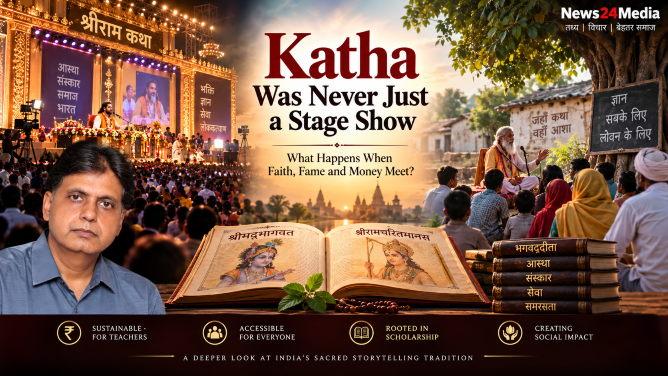
Katha Was Never Just a Stage Show: What Happens When Faith, Fame and Money Meet?
India’s sacred storytelling tradition has survived for centuries by adapting to changing times. But in the age of mega-events, celebrity culture and social media, a deeper question deserves attention: how can Katha remain sustainable without allowing access to spiritual knowledge to become a privilege of wealth?
For centuries, India did not transmit spiritual knowledge through books alone. It was heard, sung, narrated, debated and experienced collectively.
A child heard the Ramayana from an elder. A village gathered around a storyteller. Saints and scholars travelled from place to place. Bhajans transformed philosophy into music. Katha translated difficult spiritual ideas into stories ordinary people could understand and remember.
That oral character remains one of the defining features of India’s religious culture.
Academic research on the contemporary performance of the Bhagavatapurana shows that the Bhagavata-saptaha is a centuries-old tradition involving scholar-orators, sponsors and audiences. Performances that were once commonly associated with homes and temples can today take place in large public arenas and reach audiences far beyond their physical location through broadcasting.
The Wrong Question: “Why Should a Kathavachak Take Money?”
There is an easy way to discuss the economics of Katha, and there is a more useful way.
The easy question is:
Should saints and kathavachaks take money?
That formulation quickly produces controversy but very little understanding.
Spiritual activity has never existed outside material reality. Scholars require food and shelter. Musicians deserve remuneration. Assistants may depend upon their work for their livelihoods. Travel, accommodation, sound systems, electricity, security and logistics all cost money.
Supporting someone who has devoted his or her life to scholarship or spiritual teaching is not automatically the same as commercialising spirituality.
What kind of economic ecosystem can sustain spiritual teachers while ensuring that spiritual knowledge does not become dependent upon the purchasing power of the audience?
Perhaps Katha Did Not Become Expensive. Perhaps We Made the Event Expensive.
Look closely at the infrastructure surrounding a large contemporary religious programme.
There may be a huge pandal, elaborate stage design, LED walls, professional lighting, powerful sound systems, decoration, transport, accommodation, hospitality, security, videography, livestreaming, social-media promotion and special arrangements for guests.
Many of these expenses may be genuinely necessary for a gathering of substantial size.
But the existence of this event economy reveals an important distinction.
When people hear that a Katha programme was expensive, they may immediately assume that the kathavachak charged an enormous fee.
That may or may not be true in an individual case. Without reliable evidence, such assumptions should not be presented as facts.
The larger question is more interesting.
कथा महँगी हुई है, या हमने कथा का आयोजन महँगा बना दिया है?
Where commercialisation exists, responsibility cannot automatically be placed only upon spiritual speakers.
Organisers, sponsors and audiences also create expectations. If social prestige becomes attached to giant stages, celebrity speakers, VIP hospitality and massive crowds, the economics of the event naturally expand.
Then Came the Attention Economy
A second transformation may be even more significant.
Traditional spiritual authority developed largely through scholarship, teaching, community reputation, discipleship and decades of work.
Today spiritual communication increasingly operates inside the same digital environment as entertainment, politics, journalism and celebrity culture.
We can now measure followers, subscribers, likes, views, shares, viral clips and audience growth.
This has created enormous opportunities.
Someone sitting thousands of kilometres away can now listen to a discourse that an earlier generation might have travelled days to attend.
But digital metrics create a danger when visibility becomes confused with wisdom.
A scholar with fifteen thousand followers may possess extraordinary knowledge of Sanskrit texts.
Another speaker may have several million followers.
The second clearly has greater digital reach.
But the numbers alone cannot establish who possesses deeper scholarship, stronger character or greater spiritual understanding.
Followers measure audience size. They do not measure wisdom.
India May Not Have a Shortage of Spiritual Teachers. It May Have a Discovery Problem.
Beyond the large stages and famous social-media accounts lies another vast spiritual ecosystem.
Across India there are Sanskrit scholars, acharyas, temple teachers, regional kathavachaks and deeply learned practitioners who may never become internet celebrities.
Some may possess decades of study and excellent teaching ability but little digital visibility.
This creates a powerful opportunity for religious institutions, cultural organisations, schools and universities.
Scholarship • Communication • Character • Community Contribution
Digital media could then perform one of its most valuable services to Dharma:
not merely making famous people more famous, but making worthy knowledge discoverable.
If Dharma Is Universal, Accessibility Must Matter
Imagine two communities.
One is prosperous and capable of raising substantial funds for a religious programme.
The other is a small village with limited resources.
Which community needs spiritual guidance more?
There is no meaningful answer.
People everywhere experience grief, fear, family conflict, addiction, loneliness, uncertainty and questions about the purpose of life.
Now extend that thought to schools, colleges, hospitals, old-age homes, rehabilitation centres and prisons.
These places may never be able to organise a spectacular Katha.
But their inability to finance a major event should not become their inability to encounter serious spiritual thought.
A Cross-Subsidised Dharma Model
This suggests a constructive possibility.
Those who have the financial capacity to support spiritual institutions can indirectly help make spiritual knowledge available to those who do not.
Suppose a successful spiritual institution conducts fifty major programmes in a year.
Those programmes can legitimately support scholars, musicians, staff, travel, institutions and charitable work.
But imagine if part of the annual calendar were consciously reserved for programmes in villages, schools, colleges, prisons, hospitals or old-age homes where organisers paid only minimal or actual logistical expenses.
A prosperous urban event could indirectly finance a youth dialogue somewhere else.
A donor-supported programme could enable scholars to visit communities unable to afford them.
This is not a rejection of economics.
It is economics placed in the service of Dharma.
The idea resonates with the ethical spirit of Bhagavad Gita 17.20, which describes sattvic giving as giving because it ought to be done, at an appropriate place and time, without expectation of return.
That verse does not prescribe a modern institutional funding structure. But its ethical direction remains deeply relevant.
“But Katha Is Already Free on YouTube”
This is a reasonable counterargument.
Never before has so much spiritual material been available so easily.
Thousands of hours of discourses, scriptures, bhajans and philosophical discussions can now be accessed from a smartphone.
Technology has democratised information.
But information and experience are not identical.
A student can watch mathematics lectures online, yet schools continue to matter.
University lectures can be streamed, yet universities continue to matter.
Education involves more than content delivery. It includes interaction, participation, questioning, relationships and community.
UNESCO’s description of Ramlila similarly emphasises its communal dimension: performances combine narration, song, dialogue and public participation, and the tradition serves as a shared social experience.
The lesson should therefore not be that digital technology is harmful.
Rather:
Digital Dharma should extend physical spiritual community, not simply replace it.
From “How Many Attended?” to “What Changed?”
Perhaps the most important reform required is not financial.
It is about how success is measured.
After a large religious programme, impressive figures are often celebrated:
Thousands attended. Millions watched. The programme continued for seven days. Social-media clips reached enormous audiences.
These numbers tell us about scale.
They tell us much less about impact.
Did young people begin reading serious spiritual literature?
Did participants become more compassionate?
Did families resolve conflicts?
Did people volunteer for community service?
Did the programme address addiction, loneliness or civic responsibility?
Did something continue after the pandal disappeared?
These questions may be harder to advertise.
But they may come much closer to the purpose of spiritual education.
The Four Tests of a Future-Ready Katha
1. Sustainability
Can scholars, musicians, staff and institutions work and live with dignity?2. Accessibility
Can people without substantial financial resources still encounter excellent spiritual teachers?3. Scholarship
Are knowledge, character and teaching ability valued alongside popularity?4. Social Impact
Does the programme produce service, reflection, compassion, character and positive change?None of these tests requires Katha to become financially weak.
They require it to remain purposeful.
From Sacred Storytelling to Social Capital
India’s Katha tradition possesses something that governments, educational institutions and social-media platforms often struggle to achieve:
voluntary attention at enormous scale.
Thousands of people willingly sit for hours and listen. Families attend together. Multiple generations share the same space. Spiritual speakers may command extraordinary trust.
That is a form of social capital.
Imagine directing even a small portion of that influence toward contemporary problems:
drug addiction, elder care, family breakdown, digital addiction, environmental responsibility, respect for women, civic conduct, education and community service.
Then Katha becomes something larger than a religious programme.
It becomes a bridge through which ancient wisdom responds to modern social problems.
The Question Is Not Whether Katha Should Return to the Past
Traditions survive precisely because they adapt.
Research into contemporary Bhagavata-saptaha performance itself documents the movement from comparatively intimate settings toward large-scale events and global broadcasting.
The answer, therefore, cannot simply be:
“Go back.”
A more useful question is:
Technology can remain.
Large gatherings can remain.
Professional musicians can remain.
Institutions can flourish.
Kathavachaks can live with dignity.
Sponsors can contribute generously.
Beautiful programmes can continue.
There is no inherent contradiction between any of these things and Dharma.
The real test is whether, after all of them have been accommodated, the door remains open to the person who has nothing to offer except the desire to listen.
Watch: Katha, Dakshina and the Question We Need to Ask
In this News24Media video editorial, Vinod Singh examines Katha, Dakshina, accessibility and the economics surrounding modern religious discourse.
A Packed Pandal Is Not the Final Measure
Perhaps we need to stop asking only:
How big was the programme?
And start asking:
How far did the wisdom travel?
A packed pandal tells us how many people arrived.
A million views tell us how many screens were reached.
A famous name tells us how much attention could be attracted.
None of these, by themselves, tells us how many lives changed.
It can represent something more intelligent:
prosperity without exclusion,
popularity without superficiality,
technology without loss of community,
and tradition without stagnation.
Let the kathavachak be respected.
Let the scholar live with dignity.
Let musicians receive fair remuneration.
Let institutions flourish.
Let sponsors contribute.
But let the final beneficiary remain society.
Shri Ram does not belong to a price category.
Shri Krishna does not belong to an economic class.
The Gita does not belong only to those who can afford the largest pandal.
And the wisdom contained in the Bhagavata should never become the privilege of a few.
1. McComas Taylor, Seven Days of Nectar: Contemporary Oral Performance of the Bhagavatapurana, Oxford University Press.
2. UNESCO Intangible Cultural Heritage documentation on Ramlila, the traditional performance of the Ramayana.
3. Bhagavad Gita 17.20 — discussion of sattvic charity and giving without expectation of return.
Ram Navami 2026 | Sri Ram’s Civilisational Legacy | Kolkata Howrah Shobha Yatra
Discover more from
Subscribe to get the latest posts sent to your email.