Historic Vande Mataram Moment in Jadavpur: Is Bengal Reclaiming Its Nationalist Pride?


When ‘Vande Mataram’ Echoed in Jadavpur: Is Bengal Rediscovering Its Nationalist Roots?
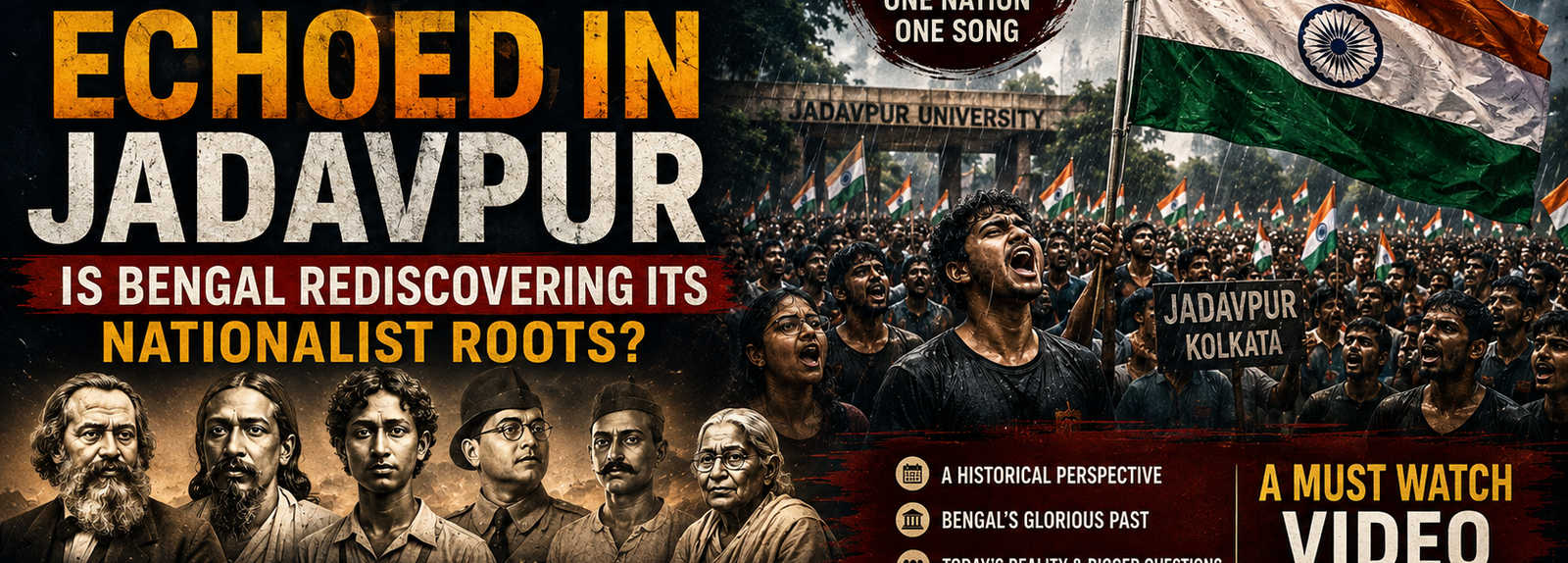
Thousands gathering in the rain near Jadavpur to sing Vande Mataram created a striking image. But beyond contemporary politics lies a deeper question: how did the birthplace of Vande Mataram reach a point where such a moment itself feels extraordinary?
There are moments in public life whose significance lies not merely in what happened, but where it happened.
The recent gathering near Jadavpur University in Kolkata was one such moment.
Amid monsoon rain, thousands gathered carrying the Indian Tricolour and joined their voices in Vande Mataram. Chief Minister, West Bengal, Suvendu Adhikari, who participated in the programme, described an atmosphere of immense national pride and invoked the legacy of Bankim Chandra Chattopadhyay.
The images were powerful.
Rain. A sea of people. Tricolours rising above the crowd. And the words — Vande Mataram.
But beyond the immediate political reactions surrounding the event, there is a question worth asking.
Why Should Vande Mataram in Jadavpur Feel Extraordinary?
Think about the historical irony.
This is Bengal.
The land of Bankim Chandra Chattopadhyay, from whose pen came Vande Mataram.
The land that became one of the great centres of the Swadeshi movement.
The land associated with Sri Aurobindo, Khudiram Bose, Bagha Jatin, Masterda Surya Sen, Matangini Hazra, Binoy-Badal-Dinesh and, ultimately, Netaji Subhas Chandra Bose.
Few regions contributed more intensely to the intellectual, cultural and revolutionary dimensions of India’s struggle against colonial rule.
And yet today, when thousands gather near Jadavpur and passionately sing Vande Mataram, the scene appears almost unexpected.
Why?
Perhaps that question tells us more about Bengal’s political and intellectual journey than the gathering itself.
Vande Mataram Was Born in Bengal
Vande Mataram was not created by a modern political party.
It predates today’s political formations by generations.
Bankim Chandra Chattopadhyay incorporated it into his celebrated novel Anandamath, and it subsequently became deeply associated with India’s nationalist awakening.
During the anti-partition and Swadeshi movement that followed the 1905 Partition of Bengal, Vande Mataram acquired enormous symbolic power.
It became more than literature.
It became an expression of resistance, self-respect and national consciousness.
Bengal was not merely participating in India’s nationalist awakening. Bengal was helping to define its vocabulary.
The Bengal That Challenged an Empire
The story extends far beyond a single song.
Bengal produced intellectual nationalism, revolutionary nationalism, cultural nationalism and powerful debates about what India itself should become.
Young revolutionaries accepted imprisonment and death. Thinkers debated Swaraj, education, identity and civilisation.
Sri Aurobindo became associated with the nationalist newspaper Bande Mataram and articulated ideas of national self-determination.
Khudiram Bose became an enduring symbol of youthful revolutionary sacrifice.
Masterda Surya Sen led the Chittagong Armoury Raid.
Matangini Hazra died carrying the national flag during the Quit India Movement.
Netaji Subhas Chandra Bose eventually gave India’s freedom struggle one of its most extraordinary international and military dimensions.
Remove Bengal from the history of India’s nationalist awakening and the story becomes profoundly incomplete.
And Then Comes Jadavpur
There is another historical layer that makes this conversation even more interesting.
The institutional history that ultimately led to Jadavpur University is itself connected with Bengal’s National Education Movement — an attempt to create an educational framework aligned with Indian aspirations during the anti-colonial era.
That makes the symbolism remarkable.
A region central to the creation of Vande Mataram.
A movement for national education.
A university whose institutional roots intersect with that history.
And more than a century later, the sight of thousands carrying the Tricolour and singing Vande Mataram near Jadavpur becomes a major political-cultural event.
How did we get here?
Bengal’s Ideological Transformation
Independent Bengal travelled through dramatically different political phases.
Communist and Left politics eventually became extraordinarily influential in the state’s political, cultural and intellectual landscape. The Left Front governed West Bengal continuously from 1977 to 2011.
University campuses naturally became important spaces for political organisation, protest, dissent and ideological debate.
Jadavpur developed a particularly visible reputation for intense student politics and competing ideological movements.
But this is where the present debate requires intellectual caution.
Criticising a government is not anti-national.
Opposing the BJP, Congress, TMC, the Left or any other political formation is not anti-national.
Dissent is an essential component of democracy.
But the reverse proposition is equally important.
Carrying the Indian flag does not make someone the property of a political party.
Singing Vande Mataram does not belong to one ideology.
And expressing pride in one’s country should not become intellectually embarrassing simply because nationalism has entered contemporary electoral vocabulary.
Nation Is Not Government
Perhaps one of the most damaging confusions in modern political debate is the tendency to treat the nation and the government as if they were the same thing.
They are not.
Governments change. Chief Ministers change. Prime Ministers change. Political parties win and lose. Ideologies rise and decline.
The nation survives all of them.
India is not the name of a government.
India is not the name of the BJP, Congress, TMC, Left or any other party.
India belongs equally to the person who supports the government and the citizen who vigorously challenges it.
That is precisely why national symbols must remain larger than party politics.
The Tricolour belongs to all Indians.
So, Is Bengal Changing?
This is where enthusiasm must be balanced by evidence.
One gathering — even one involving thousands — cannot establish the political direction of an entire state but indicate change to come.
But perhaps we can call it something else.
A cultural signal.
A moment worth observing.
A public expression that raises an intriguing question:
Is national identity becoming more confidently visible again in spaces where expressions of nationalism have often become entangled with ideological contestation?
Only time can answer that.
But the question itself deserves to be asked.
Debate Fiercely. Love the Motherland Confidently.
Universities must remain places of questions.
Read Marx. Read Gandhi. Read Ambedkar. Read Tagore. Read Aurobindo. Read Savarkar.
Agree. Disagree. Debate. Challenge governments. Challenge political parties. Challenge established ideas.
That is what an intellectually alive democracy should permit.
But India itself need not become the casualty of those disagreements.
Perhaps that is the larger message contained in those rain-soaked images from Jadavpur.
You may agree with Suvendu Adhikari.
You may strongly disagree with him.
That is democracy.
But the Tricolour is neither BJP’s nor Congress’s, neither TMC’s nor the Left’s.
The Tricolour belongs to India.
And Vande Mataram belongs to a historical inheritance far older than today’s political battles.
Perhaps, for a brief moment in the rain near Jadavpur, history completed a small circle.
A song that emerged from Bengal and became one of the great expressions of India’s national awakening was once again heard through thousands of voices in Bengal.
Whether it represents political change remains to be seen.
But it certainly gives Bengal an opportunity to revisit its history.
Governments change. Parties change. Ideologies change.
The Nation Remains.
Nation First does not mean Party First.
It means Motherland First.
🎥 Watch the Video Commentary
When Vande Mataram Echoed in Jadavpur: Is Bengal Rediscovering Its Nationalist Roots?
In this special video commentary, we travel from Bankim Chandra Chattopadhyay and the Swadeshi movement to Jadavpur and contemporary Bengal, examining the historical journey behind a scene that has once again brought nationalism, dissent, political ideology and Bengal’s identity into public debate.
Do you see the Jadavpur gathering simply as a political event, or as a cultural signal of something deeper happening in Bengal?
Share your perspective.
Vande Mataram.
Discover more from
Subscribe to get the latest posts sent to your email.