Gold Jewellery Making Charges Exposed: The Costly Math Showrooms Don’t Tell You


The Gold Jewellery Math Showrooms Don’t Explain: When 33% Is Actually Closer to 50%
A simple denominator switch reveals why the “Making Charge” printed on your bill may be telling only half the story — and why the real number to watch is what you pay over and above the gold itself.
Walk into any jewellery showroom in India this festive season, and you’ll likely hear a familiar reassurance: “Making Charge is only 30%, sir.” It sounds reasonable. It sounds transparent. But run the same number through a different calculation, and it tells a very different story — one that could change how you evaluate every gold purchase from here on.
The trick isn’t in the number. It’s in what the number is being measured against.
A ₹100 Example That Changes Everything
Consider a piece of Gold jewellery priced at ₹100. Of that, ₹67 represents the value of the gold itself, and ₹33 is the making or value-addition charge. Displayed against the final bill, that making charge looks like 33% — a figure most buyers accept without a second thought.
But ask a different question: how much extra was paid over the actual gold value? Divide ₹33 by ₹67, and the answer jumps to roughly 49.25% — nearly half again what the gold itself is worth.
₹33,000 ÷ ₹67,000 × 100 = 49.25%
Same rupee amount. Two different denominators. Two dramatically different impressions of what you’re actually paying.
Why the Base Matters More Than the Percentage
On a ₹1,00,000 purchase — ₹67,000 in gold and ₹33,000 in making — the buyer walks out with gold worth ₹67,000, not ₹1,00,000. The remaining ₹33,000 covers craftsmanship, design, branding, retail overhead, and margin. These have real value. What they may not have is resale value.
It’s a distinction worth internalising: gold is an asset. A gold jewellery invoice is not automatically the same thing.
The Question Every Buyer Should Ask
- Is this making charge calculated on gold value, or on the final billed price?
- What is the exact rupee figure — not just the percentage?
- What does that rupee figure work out to as a percentage of gold value alone?
It’s worth noting that not every jeweller structures pricing this way — several calculate the making percentage directly against gold value, which is a more transparent baseline. The point isn’t to allege wrongdoing; it’s to ask which base is being used before accepting a headline percentage.
The Odd Economics of a Rising Gold Price
Making charges expressed as fixed rupee-per-gram figures were once the norm and were relatively easy to reason about. But when making charges are pegged as a percentage of gold value, a strange dynamic emerges.
If gold worth ₹1,00,000 carries a 20% making charge, that’s ₹20,000. If the market price of that same quantity of gold later rises to ₹1,50,000, the making charge — still 20% — becomes ₹30,000. Nothing about the manufacturing process changed. The labour, the machine time, the design complexity are identical. Only the gold price moved. Yet the making charge rose in step with it.
“If the workmanship didn’t change, why should the making charge rise just because gold did?”
Handmade and Machine-Made Aren’t the Same Story
A fair reading of this requires nuance. Intricate, hand-finished pieces — the kind that take skilled artisans days to complete — carry genuine manufacturing cost, and a higher making charge on such pieces is defensible. Simple, repeatable, machine-produced gold jewellery operates on a different cost structure altogether.
The useful question at the counter isn’t whether a making charge exists, but what specific workmanship justifies its size — and whether the piece in question is handmade or machine-made at all.
The Real Math Behind “50% Off”
Festive discount banners advertising “50% off on making charges” invite a similar recalculation. A 30% making charge, discounted by 50%, doesn’t disappear — it becomes 15%, not zero. The number that matters isn’t the discount percentage advertised, but the final rupee figure that remains, and what that figure represents as a share of the gold value underneath it.
The Day-One Exit Test
Perhaps the most revealing exercise a buyer can run is a single question to the salesperson: if this piece were purchased today and sold back tomorrow, what would the buyback value be?
On a ₹3,00,000 purchase, that buyback figure might land closer to ₹2,20,000. That gap doesn’t necessarily mean the gold jewellery is a poor product — it means the expenditure and the immediately recoverable value of the asset are two different numbers, and conflating them can distort how the purchase is understood as an investment.
A Five-Number Checklist for Buyers
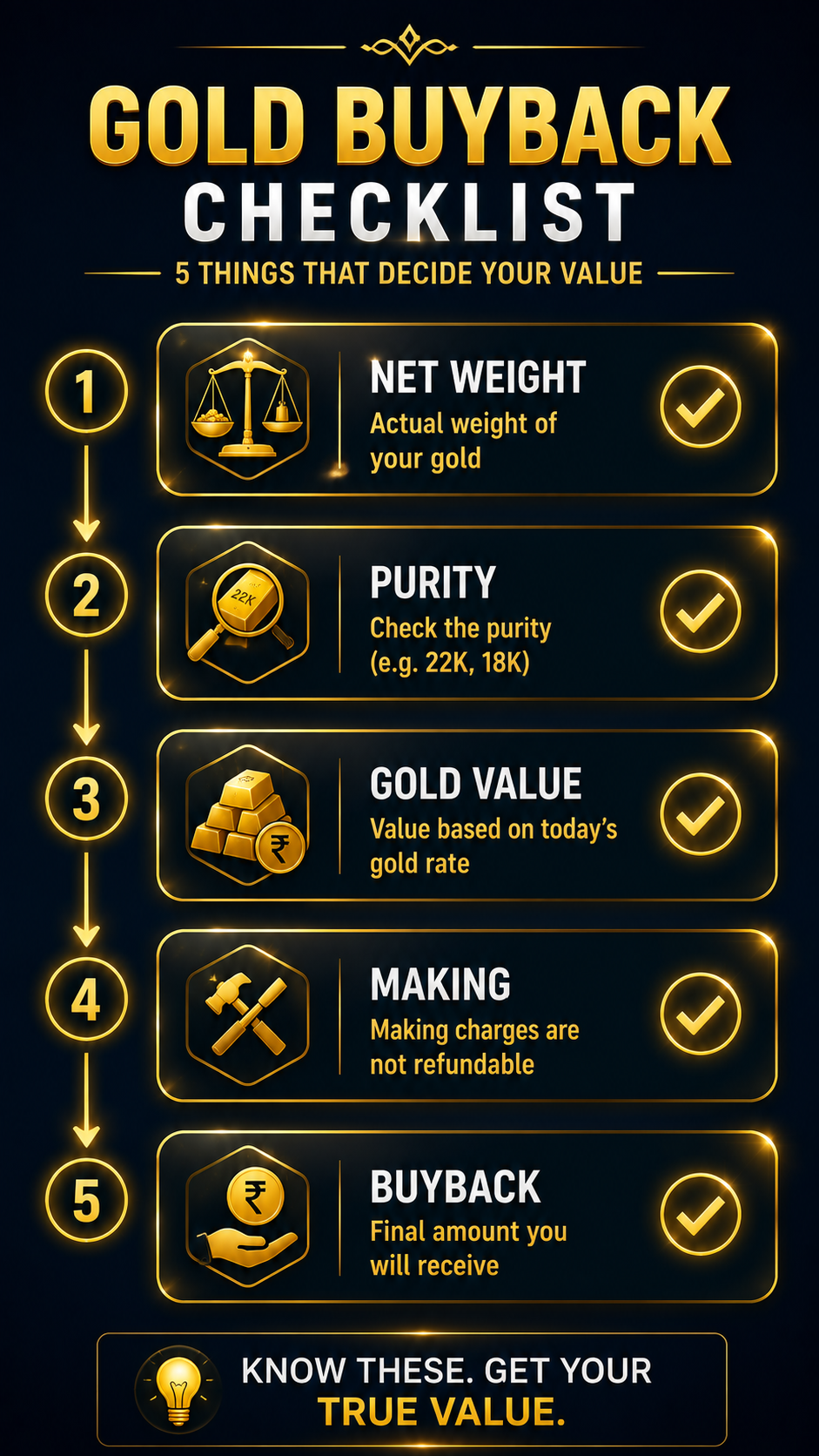
Before You Pay
- Net gold weight — how many grams of actual gold are in the piece?
- Purity — 22K, 18K, or otherwise?
- Actual gold value — at today’s rate, what is that gold worth?
- Making/value addition — the rupee figure, and what it works out to as a percentage of gold value (making ÷ gold value × 100)
- Buyback value — what would you recover tomorrow, and what does the written buyback policy state about deductions?
A Question the Industry Might Also Consider
The same math raises a fair question for the trade itself: within a substantial making or value-addition charge, how much genuinely reflects artisan labour and manufacturing, and how much reflects design, brand premium, retail overhead, and margin? Buyers arguably have a right to know whether they are purchasing gold, craftsmanship, or a retail experience — all three being legitimate, but not interchangeable.
Design can be appreciated. Craftsmanship can be paid for willingly. Brand premium is a legitimate choice. But when gold jewellery is also treated as an investment, the calculator becomes as essential as the eye. Don’t buy the discount — understand the denominator, and calculate the exit value.
Watch the full video breakdown on News24Media’s video platform, where this calculation is walked through step by step with real examples. Share it with anyone who buys gold jewellery as both ornament and investment.
- Har Ghar Tiranga at Saraswati World School: Students Celebrate Patriotism Through Quiz, Pledge and Tiranga Rally
- One Wrong Tap and Private Life Public — Digital Privacy Alert | News24Media
Discover more from
Subscribe to get the latest posts sent to your email.