

Marriage Without the Certificate: Why the Supreme Court Just Redrew the Line on Domestic Cruelty Protection
India’s live in relationships have moved from social taboo to legal grey zone — and now, in a fresh ruling, the Supreme Court has decided that a woman’s right to be protected from cruelty doesn’t disappear just because she never signed a marriage certificate.
For decades, Indian law drew a hard line around one word: husband. Section 498A of the Indian Penal Code, which criminalises cruelty against a woman by her husband or his relatives, was written for a world where relationships came in exactly one legally recognised shape — marriage, solemnised, registered, certified.
That world no longer fully exists. And the Supreme Court has just acknowledged it.
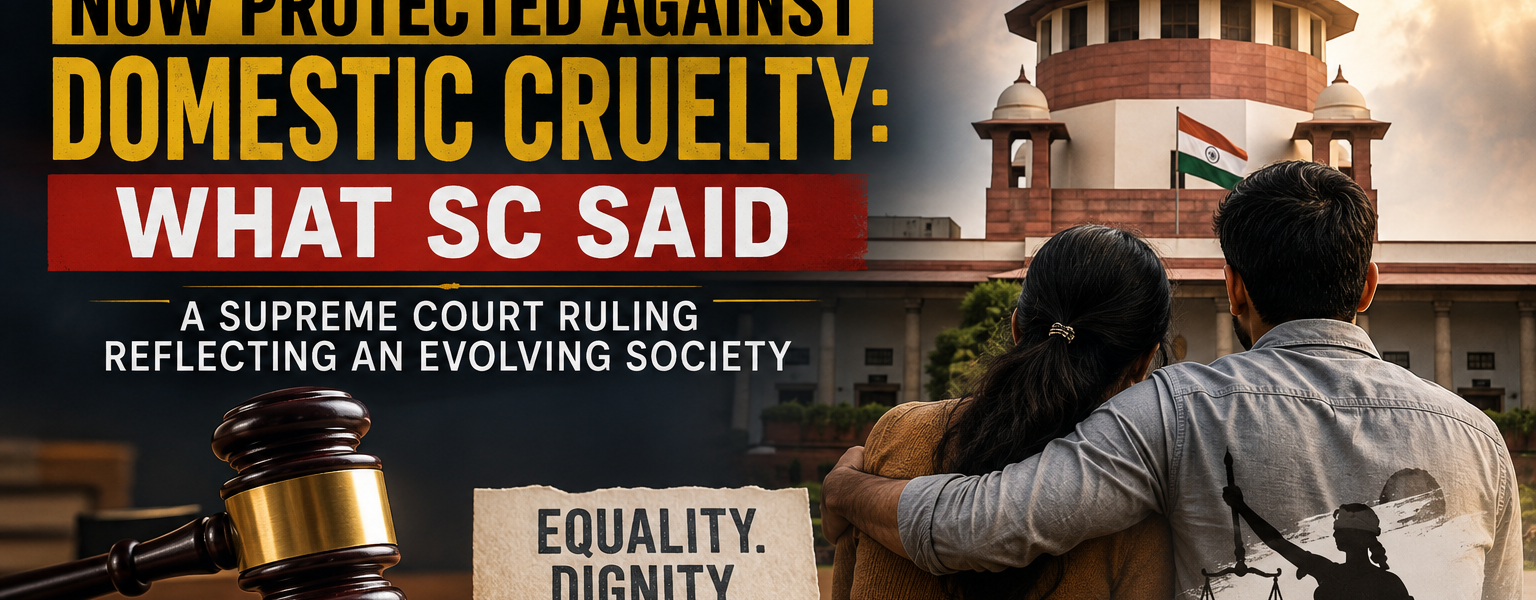
In a significant ruling, the Court has held that a woman living in a relationship that is genuinely “in the nature of marriage” cannot be denied protection from domestic cruelty simply because there was no formal wedding. The judgment doesn’t rewrite the institution of marriage — but it does something arguably more consequential: it tells India’s courts to look past the paperwork and examine the reality of a relationship.
A Question That Took Decades to Answer
The debate didn’t begin with this case. For years, courts wrestled with a narrower but related question — what happens when a man conceals an existing marriage, weds again, and later claims he was never legally a “husband” at all?
The Supreme Court’s answer, built up over a series of earlier judgments, was consistent: a person cannot use his own deception as a shield. If a man deliberately created the appearance of a valid marriage, he could not later escape criminal liability by pointing to the very fraud he committed.
That principle — substance over form — is the thread connecting the older cases to this week’s ruling. The Court has now extended it explicitly to live in relationships that function as marriages in every practical sense, even without a certificate to prove it.
What the Court Actually Said
The ruling does not say every live in relationship couple is now legally equivalent to a married one. It draws a far narrower, fact-specific test. For a woman to claim protection under Section 498A in a live in relationship, courts will examine:
- Whether the couple lived together for a substantial period of time
- Whether they shared a domestic household in a manner resembling marriage
- Whether the relationship, in its totality, genuinely resembled a marital bond
Only where these conditions are met — and where credible evidence of domestic cruelty exists — can a woman invoke the same criminal protection available to a legally married wife.
No, This Doesn’t Mean Every Relationship Is Now “Marriage”
This is the point most likely to be misunderstood as the ruling spreads across social media. The Court has not declared that dating relationships, casual live-ins, or short-term partnerships now carry the legal weight of marriage. Every claim will be tested against facts — not assumed.
The ruling protects a woman in a marriage-like relationship from cruelty. It does not manufacture new marital rights, inheritance claims, or succession entitlements out of a live in relationship arrangement. Those remain governed by India’s existing marriage and personal laws, untouched by this judgment.
What Hasn’t Changed
Marriage continues to be the sole basis for inheritance rights, succession, maintenance under personal law, and property entitlements in Indian law. This ruling widens only one narrow protection — against domestic cruelty — for relationships that meet the marriage-like test. It does not equate live in relationships with marriage in any other legal domain.
Guarding Against Misuse
Section 498A has long attracted criticism over its potential for misuse — a concern the Supreme Court has addressed in previous rulings by tightening arrest procedures. Consistent with that caution, this judgment does not create an automatic presumption of guilt. Every complaint will still require a fair investigation, an examination of evidence, and adherence to due process before any criminal liability attaches.
In effect, the Court is trying to hold two principles simultaneously: expanding protection for genuine victims of domestic cruelty, while preserving safeguards against the misuse of criminal law.
Why This Ruling Matters Beyond the Courtroom
India’s live in relationships were once confined to a handful of metropolitan pockets. Urbanisation, higher education, career mobility, and financial independence have since pushed the practice into cities and towns far beyond Delhi and Mumbai. The numbers remain modest next to marriage — but as a social reality, they are no longer easy to ignore.
Law, inevitably, is catching up to that reality — not by promoting a lifestyle, but by refusing to let a lifestyle choice become a loophole for cruelty. As the Court’s reasoning makes clear, the Constitution’s promise of dignity and equal protection was never meant to depend on whether a ceremony took place.
The Bottom Line
Marriage remains India’s dominant and most legally significant social institution — this ruling does not challenge that. What it does is close a narrow but important gap: a woman cannot be left without recourse against domestic cruelty simply because her relationship, however marriage-like in substance, lacked a certificate in form.
Whether that principle expands further, or stays confined strictly to Section 498A, will likely be tested in the courts that follow. For now, the message from the Supreme Court is unambiguous — cruelty does not become lawful simply because a relationship was never formalised.
What’s your take — does this ruling reflect a changing India responsibly, or could it open the door to new legal disputes? Share your view in the comments below.
Meta Facebook PM Modi Row: Error, Algorithm, or Accountability?
Discover more from
Subscribe to get the latest posts sent to your email.