
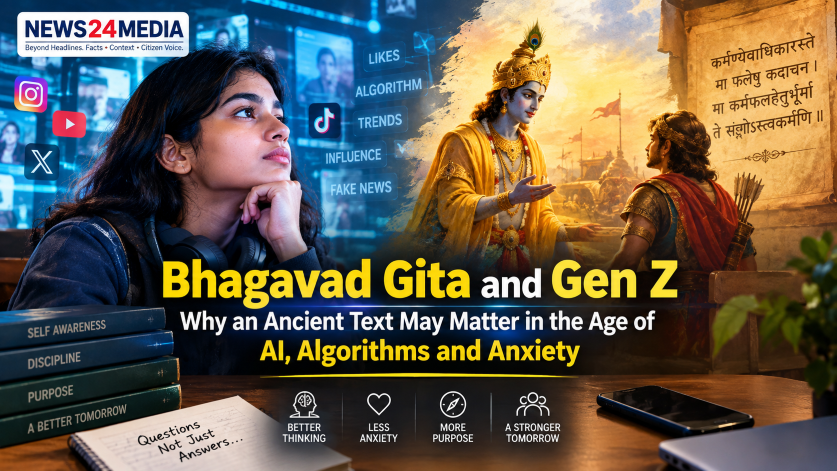
Bhagavad Gita and Gen Z: Why an Ancient Text May Matter in the Age of AI, Algorithms and Anxiety


Beyond Reels and Rituals: What Gen Z Is Actually Looking for in the Bhagavad Gita
Maybe the challenge was never getting young people to open an ancient text. Maybe it is helping them see that its questions were written for exactly the world they are drowning in — one of AI, algorithms, anxiety and endless choice.
Bhagavad Gita and Gen Z: Why Ancient Wisdom Matters in the Age of AI
There is a comfortable story adults like to tell about Generation Z: a generation raised on smartphones, reels and chatbots that has neither the patience nor the appetite for a 5,000-year-old philosophical text. It is a tidy story. It is also, the evidence suggests, mostly wrong.
India’s young are unmistakably online — that much is not in dispute. What is in dispute is what that means for their inner lives.
But saturation is not the same as satisfaction. Recent reporting on India’s Gen Z describes a generation building spirituality on its own terms — personalised, self-directed, assembled rather than simply inherited — instead of walking away from it altogether. A 2026 academic study tracking 816 Gen Z participants at spiritual mega-events in India dug into exactly this tension: how digital exposure, peer networks and highly individual motivations now shape whether, and how, young people show up for ritual.
That distinction is worth sitting with, because it quietly reframes the entire debate.
The real question may no longer be “Will Gen Z accept the Bhagavad Gita?”
It may be: “What is a generation drowning in information actually looking for inside it?”
From a shortage of information to a flood of it
Every earlier generation’s spiritual problem was, at root, a supply problem: texts were scarce, teachers were far away, and knowledge itself had to be sought out, often at real cost.
Today’s teenager has the inverse problem. Before breakfast, she can ask an AI model for career advice, scroll past ten conflicting motivational reels, absorb a hundred strangers’ opinions on love and ambition, and still have a full day of unsolicited advice from parents, teachers and algorithms ahead of her.
The scarce resource is no longer information. It is discernment.
Which of these hundred voices deserves fifteen minutes of her attention? Which desire is worth chasing, and which is worth questioning? When does ambition sharpen a life, and when does it quietly start running it? What does success mean if reaching it costs her the very peace she was chasing it for? And what does she do when two duties — to herself, to her family, to her work — pull in opposite directions at once?
These are not abstract questions. They are, almost verbatim, Arjuna’s questions on the battlefield of Kurukshetra. And that is precisely where the Gita becomes strange and useful again: its setting is not a classroom where Krishna hands Arjuna new facts. Arjuna already knows the facts — the politics, the kinship, the stakes of war. What he has lost is the ability to act on what he knows.
Knowledge has stopped being enough for him to make a decision. That, more than anything, is the Gita’s opening move — and it is also Gen Z’s daily condition.
A framework for questions, not a shelf of answers
Most spiritual content built for feeds arrives pre-packaged as an answer: how to succeed, how to stop worrying, how to become disciplined, how to stay positive. It is content built to resolve, not to unsettle.
The Bhagavad Gita opens somewhere almost opposite: in confusion. Arjuna doesn’t ask for a slogan; he lays down his bow and admits he cannot see the right path. What follows across eighteen chapters is not a motivational speech but a long argument — through action, knowledge, discipline, attachment, the nature of the self, devotion and liberation — that refuses to shortcut its own complexity.
That structure changes what the text can offer a young reader. The point is not to hand Gen Z a conclusion — “here is what the Gita says, apply it.” It is to hand them Arjuna’s method: what, exactly, is the problem I am trying to solve? Asked seriously, that single question turns scripture from something passively received into something actively thought through — which is closer to how this generation already engages with everything else it takes seriously.
The overlooked parallel: the economics of attention
The defining commercial fact of this era is that attention is the product being sold, and everyone is bidding for it — platforms, advertisers, creators, algorithms, all competing for fragments of a single waking day.
Framed this way, an old philosophical tradition and a very new economic one turn out to be arguing about the same territory.
The modern question is usually phrased defensively: how do I control my phone? But underneath it sits a harder question: who, exactly, controls my attention? And underneath that, harder still: can I notice an impulse without being obligated to obey it?
That is no longer merely a “digital wellness” problem. It is a question about the relationship between the senses, the mind, judgment and action — the exact terrain the Gita and the wider Indian philosophical tradition have mapped for millennia. The smartphone is new. The struggle for mastery over one’s own attention is not.
Why turning the Gita into reels creates its own problem
A real ecosystem of short-form spiritual content already exists, and it is not without merit. A 2025 study of 70 short videos from five prominent spiritual speakers found recurring themes — resilience, karma, detachment, self-discipline, ethical dilemmas — consistently tied to contemporary anxieties around careers, relationships and mental health. The researchers’ conclusion was cautiously optimistic: digital storytelling can widen access without necessarily flattening the underlying ideas.
That is genuinely encouraging. It is also, on its own, incomplete.
A forty-second reel can spark curiosity about a profound idea. It cannot carry the idea’s full weight — no format that short was ever built to. The risk isn’t digital spirituality itself; it’s mistaking the gateway for the destination. A reel might make someone curious about karma yoga. A podcast might sketch its context. A conversation might push back on a lazy interpretation of it. But real engagement, eventually, needs something slower: reading, sitting with difficulty, dialogue, and ideally the original text alongside careful scholarship or teaching.
What that suggests is a new kind of digital literacy for spiritual knowledge — one built in four deliberate stages:
| Stage | What it looks like |
|---|---|
| Discover digitally | A reel, a clip, a short video sparks initial curiosity |
| Question critically | Ask what’s being simplified, and why, before accepting the framing |
| Study deeply | Move to the text, a teacher, or serious scholarship |
| Reflect personally | Test the idea against one’s own life, not just repeat it |
That is a very different ambition from simply making ancient wisdom “go viral.”
The mental-health conversation deserves the same caution
Academic interest in connecting Gita teachings to resilience and psychological wellbeing is real and growing. A 2025 paper links concepts such as detached action, mastery of the mind, and purpose to how young people navigate self-doubt, stress and ethical dilemmas. A separate, smaller study involving 80 adolescents reported lower anxiety among regular Gita readers than non-readers — a finding worth noting, though its observational design and small sample size mean it shows an association, not proof that reading the Gita itself lowers anxiety.
That distinction matters enormously, and it is the one place this conversation can least afford to get sloppy. The Bhagavad Gita can be explored as a genuine source of philosophical reflection, meaning, discipline and spiritual practice. It should never be casually marketed as a substitute for professional mental-health care. Doing so wouldn’t elevate the Gita — it would diminish both the text and the science.
Maybe Gen Z doesn’t need a simplified Gita at all
This may be the single most important reframe in the entire debate: accessible and simplistic are not the same word.
This is a generation that routinely masters genuinely difficult subjects the moment it decides they matter — competitive coding, machine learning, complex game economies, financial markets, music production, the biomechanics of their own fitness. Why assume, uniquely of serious philosophy, that they can’t handle the real thing?
Perhaps the right question was never “how do we make the Bhagavad Gita easier?” but rather:
“How do we make the questions the Bhagavad Gita is asking impossible to scroll past?”
Set side by side, the ancient conversation and the daily one turn out to be startlingly close:
| The modern question | The Gita’s question underneath it |
|---|---|
| What should I watch next? | What governs your attention? |
| How do others see me? | Who are you beyond your external identity? |
| How fast can I succeed? | What is right action, and what is your claim on its result? |
| Can machines become intelligent? | What do we even mean by mind, self and consciousness? |
Put that way, the ancient conversation stops sounding ancient.
From religious transmission to intellectual exploration
There is a further possibility worth naming directly: the Bhagavad Gita does not need to matter only to someone who approaches it devotionally. It can equally be read as philosophy, ethics, psychology, literature and civilisational thought — and that opens very different doors for very different young readers.
A management student can wrestle with detachment from outcomes. A computer-science student can debate intelligence against consciousness. A teenager can interrogate desire and attention. A teacher can sit with duty when two responsibilities collide. A philosophy student can set Indian conceptions of the self against Western ones. And a believer can keep encountering Krishna exactly as before — through devotion.
None of these approaches cancels the others out. Together, they are simply evidence of how wide this text actually is.
The responsibility isn’t only Gen Z’s
Every generation eventually complains about the one behind it. They don’t read. They’re always on their phones. They have no patience. All they watch are reels. Some of that criticism has real grounding — but criticism, on its own, has never once produced curiosity.
So parents, teachers, spiritual institutions and educators face a question of their own, and it is not a comfortable one: do we want young people to simply inherit our conclusions, or to develop the capacity to interrogate life’s deepest questions for themselves?
If the answer is the latter, then a young person asking “why should I believe this?” cannot automatically be read as disrespect. It may, in fact, be the opening move of the most serious engagement the tradition could hope for.
The opportunity actually in front of us
The digital revolution has created real risks — distraction, misinformation, superficiality, a relentless bidding war for attention. But it has also created something no previous generation of seekers ever had: a teenager anywhere in India can now reach Sanskrit texts, translations, lectures, comparative philosophy, serious scholarship and teachers from across the world, from a single device in her pocket.
The same phone that can burn five idle hours can also open one of humanity’s oldest philosophical conversations. Technology doesn’t automatically weaken tradition, and it doesn’t automatically strengthen it either. What matters is what we build with it.
The task in front of educators and spiritual communicators, then, was never simply to put the Bhagavad Gita on another screen. It is to help a generation move — deliberately — from scrolling to questioning, from questioning to exploration, and from exploration to understanding.
That, perhaps, is where the conversation about the Gita and Gen Z should go next. Not “how do we make an old book fashionable?” but something closer to the truth of it:
How do we help a new generation discover that some of its newest problems are, in fact, humanity’s oldest questions wearing new clothes?
News24Media Perspective
This article extends the conversation Vinod Singh opened on Youthaspire about how timeless knowledge finds a way to speak to a changing generation. The embedded video works as the opening proposition; this piece deliberately goes a level deeper — into attention economics, digital spirituality, critical thinking, the actual (and limited) mental-health evidence, intellectual inquiry, and the difference between accessibility and simplification.
- Press Information Bureau — Comprehensive Modular Survey: Telecom, 2025
- Economic Survey 2025–26, Government of India
- DW — How India’s Gen Z is redefining spirituality
- ScienceDirect — Digitally framed, ritually transformed: Gen Z at spiritual mega-events (2026)
- DataReportal — Digital 2025: India
- Journal of Communication and Management — Dissemination of the Bhagavad Gita Through Digital Storytelling (2025)
- Educational Quest — The Bhagavad Gita and Generation Z: Spiritual Guidance for Self-Discovery
- Dev Sanskriti International Journal of Hindu Studies — Anxiety Levels: Regular Gita Readers vs Non-Readers
- Katha Commercialisation: Has Sacred Storytelling Entered the Attention Economy?
Discover more from
Subscribe to get the latest posts sent to your email.