No Address Given, No Fear Spared: IPS Ajay Pal Sharma’s Bold Move Against Voter Intimidation in Bengal 2026


‘You Will Not Be Spared’: The Day IPS Ajay Pal Sharma Came to Jahangir Khan’s Door
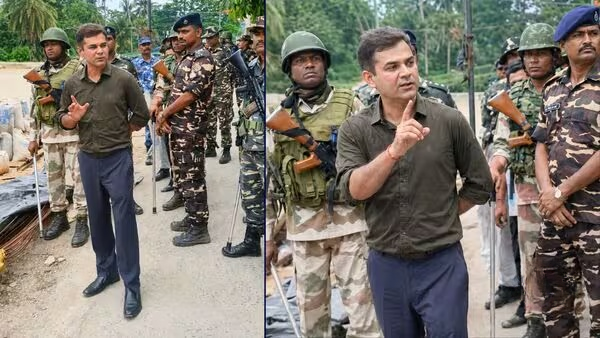
There are names in Bengal that people do not say out loud. There are addresses that residents will not give, even to figures of authority. Jahangir Khan, the Trinamool Congress candidate from the Falta assembly constituency in South 24 Parganas, had apparently become one such name. When complaints reached IPS officer Ajay Pal Sharma that Khan was threatening voters ahead of Phase 2 of the Bengal Assembly elections, Ajay Pal Sharma drove to the scene to investigate. Khan was not there. Local residents claimed not to know where he lived. More remarkably, even the local police declined to provide accurate directions to a candidate’s residence — to a senior IPS officer and Election Commission observer. Ajay Pal Sharma’s team conducted its own search and found the house anyway.
What Ajay Pal Sharma found at Jahangir Khan’s residence compounded the story. Under official norms, Khan held Y-category security — entitling him to a maximum of ten police personnel. Fourteen armed guards were found at the premises. Sharma immediately demanded an explanation from the district Superintendent of Police, exposing in real time the kind of institutional capture that has historically insulated powerful actors in Bengal’s political ecosystem from accountability. The confrontation was recorded. The video went viral. And Ajay Pal Sharma’s words entered the public record without ambiguity: “Tell Jahangir — if he intimidates people, we will deal with him strictly as per the law. Don’t even dare to issue threats to people. I will not spare even the biggest of goons if I receive a complaint.”
Ajay Pal Sharma is a 2011-batch IPS officer of the Uttar Pradesh cadre, currently serving as Additional Commissioner of Police in Prayagraj. He earned the ‘encounter specialist’ designation through a record of direct engagement with organised crime in UP — a state not historically known for gentle policing. The Election Commission of India’s decision to appoint him as Police Observer for South 24 Parganas was itself a message: this district, and this phase, would not be managed from behind a desk. Ajay Pal Sharma belongs to a cohort of eleven new police observers the ECI deployed ahead of Phase 2, reflecting an unusually interventionist posture for the commission in this cycle.
The background that makes this moment significant is decades deep. West Bengal carries the distinction, per National Crime Records Bureau data, of recording the highest rate of political murders in India. Research by the Observer Research Foundation and independent legal scholars documents how political violence in Bengal has functioned not as aberration but as instrument — deployed by successive ruling parties, from Left to TMC, to suppress electoral opposition through booth capturing, voter intimidation, post-election revenge attacks, and the deliberate immobilisation of state machinery. The 2021 assembly polls saw opposition workers killed in the weeks following results, drawing Supreme Court attention. The cultural architecture of this violence is what produced the silence Ajay Pal Sharma encountered at Falta: residents who would not speak, policemen who would not point, and a candidate secure enough behind his extra complement of guards to be absent when trouble called.
Phase 1, conducted on April 23, 2026 across 152 constituencies, produced a striking counter-narrative. Voter turnout reached 92.35 per cent — Bengal’s highest since independence, surpassing the 85 per cent of 2021 and 83.2 per cent of the 2024 Lok Sabha elections. Sporadic violence did occur: a BJP candidate was chased and beaten in Kumarganj, polling agents were removed at gunpoint in parts of Murshidabad, and a CAPF team suffered injuries in Birbhum. The election was not violence-free. But the scale of participation — nearly 3.6 crore voters exercising their franchise — represents a structural shift. People vote when they believe their vote will count and their person will be safe. The numbers suggest that, in aggregate, enough Bengal voters felt both for the first time in recent memory.
The Jahangir Khan episode, now frozen in a viral video, carries meaning beyond its immediate political context. It demonstrates that the culture of impunity that sustains electoral violence is not a force of nature — it is a product of institutional withdrawal. When institutions re-engage, when an officer tracks an address no one would give, when excess guards become a public accountability question rather than a quiet arrangement, the architecture of fear begins to crack. Whatever the final tally on May 4, 2026, one outcome of this election is already secured: the people of Bengal were given the structural conditions to vote. For a state whose democratic health has been debated for three decades, that is not a small thing. It is, in fact, everything.
SOURCE: News24Media editorial research | Primary reporting: DNA India, SocialNews XYZ, Zee News, Republic World, The Week | Academic source: Observer Research Foundation / IJIRL Political Violence in West Bengal (2024) | All figures from Election Commission of India official data
Discover more from
Subscribe to get the latest posts sent to your email.