
Why Students Fear Mathematics in Indian Schools: The Hidden Crisis Behind Maths Anxiety


Education Editorial | News24Media
The Real Reason Students Fear Mathematics in Indian Schools
Maths fear is not born in children. It is often created by weak foundations, pressure-based teaching, poor confidence, and a system that treats mistakes as failure.
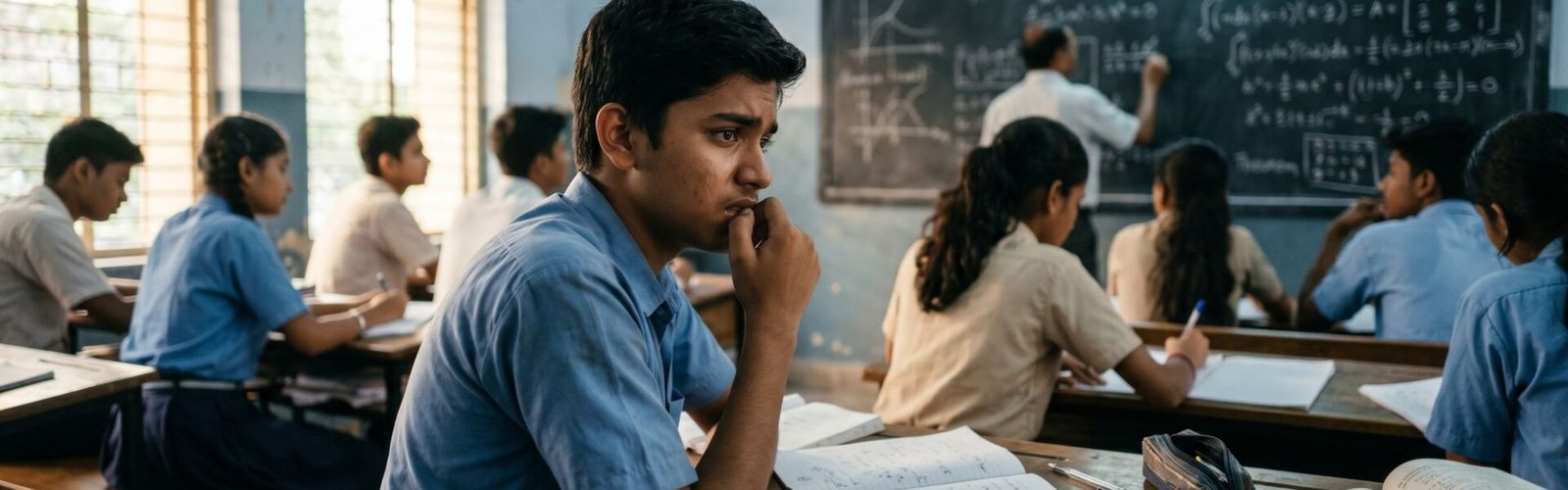
F or many students in Indian schools, mathematics is not just another subject. It is a source of fear, pressure, embarrassment, and sometimes lifelong self-doubt. The moment a teacher writes a fraction, algebraic equation, or geometry problem on the board, a section of students silently withdraws—not because they are lazy, but because they have already decided, “Maths is not for me.”
Students Fear Mathematics is so common that it has become normalised. Parents say, “My child is weak in maths.” Students say, “I hate maths.” Teachers say, “They don’t practise enough.” But the real story is more complex. Mathematics fear is rarely the result of one bad chapter or one difficult exam. It is usually built slowly over years through weak foundations, hurried teaching, exam pressure, poor feedback, and repeated experiences of failure.
India’s foundational learning data shows why the problem begins early. ASER 2024 tracks basic reading and arithmetic among children aged 5–16 in rural India, underlining that arithmetic remains a core learning outcome challenge across school years. The issue is not simply that students fear mathematics in Class 9 or 10; the fear often begins much earlier, when number sense, basic operations, and problem-solving confidence are not built properly.
Maths Fear Is Not the Same as Maths Weakness
One of the biggest mistakes schools and parents make is to treat mathematics anxiety as laziness or lack of intelligence. In reality, a student may understand a concept in a relaxed setting but freeze during classwork, oral questioning, or examination. This is mathematics anxiety—a psychological response in which fear interferes with performance.
The OECD has documented that maths anxiety is a global concern. In its analysis of PISA data, it noted that many students worry about mathematics classes and feel tense when required to do mathematics, showing that fear of maths is not limited to India alone. PISA itself measures whether 15-year-olds can use mathematics, reading, and science knowledge to meet real-life challenges, not just reproduce memorised content.
Editorial Insight
A child does not fear mathematics because numbers are naturally frightening. A child fears mathematics when numbers repeatedly become symbols of embarrassment, punishment, comparison, and failure.
The First Real Reason: Weak Foundations
Mathematics is cumulative. A child who does not fully understand addition struggles with subtraction. A child who is shaky in multiplication struggles with fractions. A child who fears fractions struggles with algebra. By the time the student reaches Class 8, 9, or 10, the fear appears to be about “algebra” or “geometry,” but the real problem may be hidden in Class 3 or 4 concepts.
This is why mathematics is different from many other subjects. In history or literature, a student may recover by focusing on a new chapter. In maths, old gaps follow the student like shadows. If the foundation is weak, every new chapter feels like a threat.
The Second Reason: Rote Learning Does Not Work in Maths
Many students try to study mathematics the way they study theory subjects: memorise formulas, copy solved examples, and reproduce steps in the exam. This may work briefly for familiar questions, but it collapses when the problem is slightly changed.
Mathematics requires understanding patterns, relationships, logic, and application. A formula is useful only when a student knows where, why, and how to apply it. Without this understanding, maths becomes a memory burden instead of a thinking tool.
This is also why CBSE and NEP-linked reforms are increasingly moving toward competency-based and application-oriented learning. The direction is clear: the future of maths education cannot be built on mechanical repetition alone.
The Third Reason: Fear of Making Mistakes
Mathematics is a subject where mistakes are visible. A wrong answer is immediate. A calculation error is exposed. A student who writes an incorrect step on the board may feel embarrassed in front of the class. Over time, this creates avoidance.
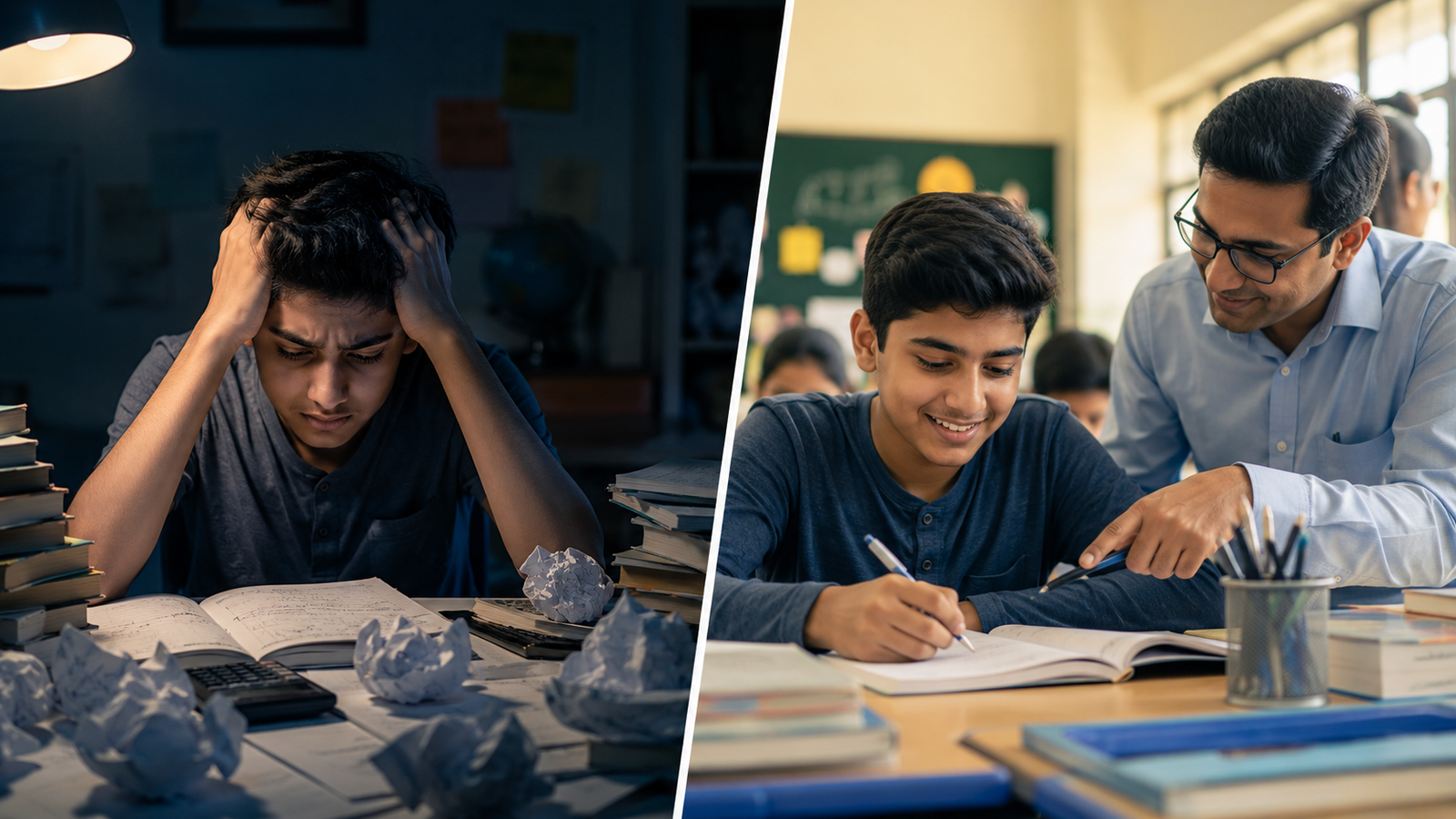
Instead of seeing mistakes as part of learning, many classrooms treat them as proof of weakness. This damages confidence. Students stop asking questions. They copy answers silently. They avoid difficult problems. Eventually, they do not just fear wrong answers—they fear trying.
The Fourth Reason: Speed Is Mistaken for Intelligence
In many classrooms, the student who solves fastest is seen as “good in maths.” But speed is not the same as understanding. Some students think deeply but slowly. Others need visual explanation, repeated practice, or a different approach.
When speed becomes the main measure, slow learners begin to believe they are weak. This is dangerous because mathematics confidence depends on clarity, not just speed. A child who understands slowly can still become strong in maths if given proper support.
The Fifth Reason: Teaching Often Moves Faster Than Learning
Mathematics teaching often becomes syllabus-driven. Teachers are under pressure to complete chapters, conduct tests, prepare students for exams, and maintain records. In this process, real understanding can be sacrificed.
A teacher may finish the chapter. The notebook may be complete. Homework may be given. But the central question remains: did the students actually understand?
This is where institutions must become more serious. Forward-looking schools are increasingly focusing on lesson planning, regular monitoring, copy checking, class tests, and identification of weak learners so that academic gaps are detected early rather than after final results.
The Sixth Reason: Parents Often Add Pressure Without Realising It
Parents want their children to succeed, but sometimes the language used at home increases fear. Statements like “Why can’t you solve this?”, “Maths is very important,” or “You will fail if you don’t improve” may be well-intentioned, but they can create emotional pressure.
Students Fear Mathematics does not need more fear. The student needs diagnosis, encouragement, practice, and patient correction. Parents must shift from marks pressure to learning support.
The Seventh Reason: Maths Is Not Connected to Real Life
Many students ask, “Where will I use this?” This question is not rebellion; it is a signal. If mathematics is taught only as symbols and procedures, students fail to see its purpose. But maths is everywhere: budgeting, shopping, measurement, coding, architecture, data analysis, banking, sports statistics, and problem-solving.
Recent local innovations show how hands-on learning can reduce fear. A government primary school in Gujarat’s Panchmahal district introduced a “maths park” with geometric shapes, abacus tools, number lines, and activity zones to make abstract concepts physical and enjoyable. Such examples show that when maths becomes visible and experiential, fear can begin to reduce.
The Bigger Reality
India does not have a shortage of hardworking students.
The country has a shortage of educational systems that convert hard work into deep learning.
Principal, Saraswati World School
How Schools Can Reduce Maths Fear
The Students Fear Mathematics can be reduced, but not through slogans. It requires a systematic academic approach.
- Diagnose early: Identify whether the student is weak in concept, calculation, language, attention, or confidence.
- Build foundations: Strengthen arithmetic, fractions, tables, and number sense before rushing into advanced topics.
- Encourage mistakes: Treat errors as learning signals, not character flaws.
- Use examples: Connect maths with shopping, measurement, maps, sports, technology, and daily life.
- Slow down when needed: Completion of syllabus should not become more important than completion of understanding.
- Track weak learners: Maintain records of students who repeatedly struggle and provide remedial support.
- Train teachers: Teachers must be equipped to explain concepts in more than one way.
At many tops schools , the growing emphasis on structured classroom monitoring, student performance tracking, and regular academic review reflects the kind of institutional seriousness required to address learning gaps before they become fear.
Students Fear Mathematics so What Students Can Do
Students must understand one important truth: being weak in mathematics today does not mean being weak forever. Maths improves through clarity and practice, not panic.
- Do not hide doubts.
- Solve a few problems daily instead of cramming before exams.
- Write every step clearly.
- Revise old basics regularly.
- Ask “why” before memorising formulas.
- Do not compare your speed with others.
Conclusion: Maths Fear Is a System Problem, Not a Child’s Failure
The fear of mathematics in Indian schools is not simply a student problem. It is a teaching problem, a confidence problem, a foundation problem, a parenting problem, and a system problem.
If schools only ask students to practise more without understanding why they are afraid, the fear will continue. If parents only demand marks without supporting learning, anxiety will deepen. If teachers only complete syllabus without checking understanding, weak foundations will remain hidden.
Mathematics should not be a subject that divides children into “smart” and “weak.” It should be a subject that teaches logic, patience, confidence, and problem-solving.
The real goal is not merely to make students score better in maths. The real goal is to make them stop fearing it.
News24Media Education Desk | Focus: Students Fear Mathematics and Mathematics Anxiety in Indian Schools
Discover more from
Subscribe to get the latest posts sent to your email.