
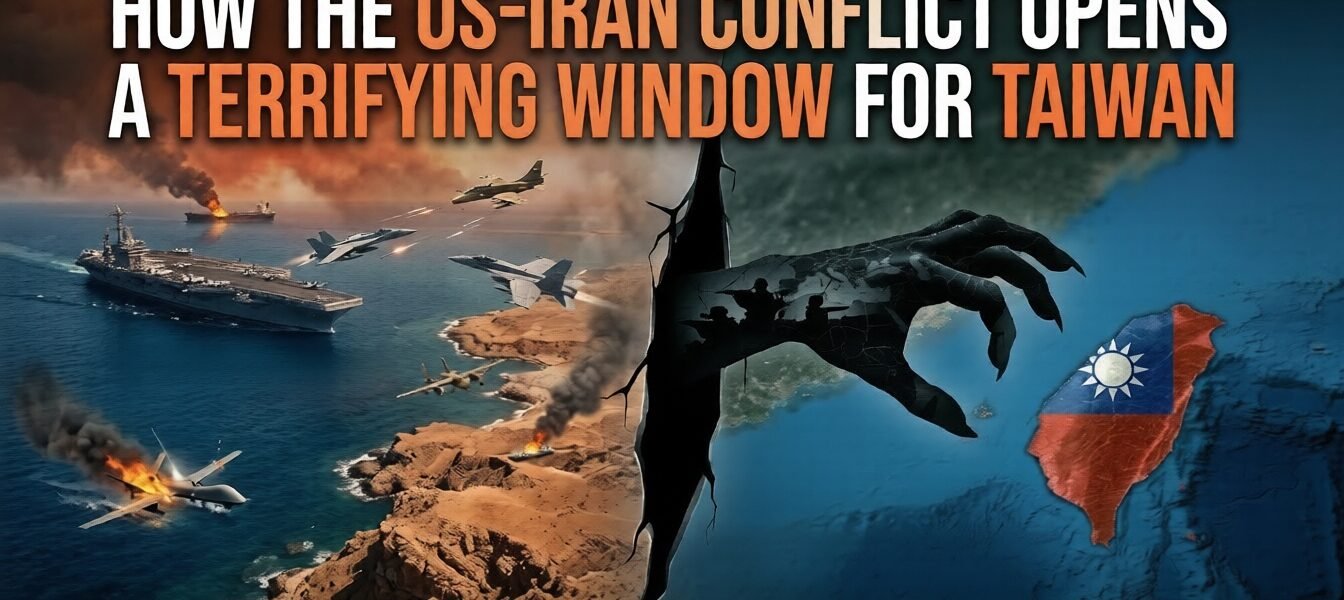
Taiwan Faces a Terrifying Window Opened by the US-Iran Conflict


The Perfect Storm: How the Middle East Crisis is Opening a Terrifying Window for a Taiwan Invasion
The world in March 2026 is witnessing a geopolitical earthquake. As the grinding war in Ukraine crosses its devastating five-year mark, a new and catastrophic conflict in the Middle East has completely consumed the strategic bandwidth of the United States. With Washington deeply entangled in a rapidly escalating war with Iran, a perilous vacuum is opening in the Indo-Pacific, and an increasingly aggressive China is taking highly calculated steps to exploit it.
The catalyst for this global realignment was the launch of Operation Epic Fury in late February 2026, a joint US-Israeli decapitation strike against Iranian military infrastructure that resulted in the death of Supreme Leader Ali Khamenei. Instead of capitulating, Iran retaliated by effectively closing the Strait of Hormuz, paralysing a critical waterway that handles roughly 20 million barrels of oil and 20% of the world’s seaborne oil trade daily. The economic shockwaves have been devastating. Brent crude prices surged to a staggering $126 per barrel. In heavily import-dependent nations like India, the government has been forced to invoke emergency powers under the Essential Commodities Act to ration natural gas supplies.
To contain this spiralling crisis, the US military has been forced into an emergency redeployment of critical assets away from Asia. Elements of the 31st Marine Expeditionary Unit and the amphibious assault ship USS Tripoli have been rushed from their homeport in Okinawa, Japan, toward the Persian Gulf. This sudden shift of premier amphibious and air defence forces away from the first island chain has inadvertently handed Beijing its most promising strategic window in decades.
While global attention remains fixated on burning oil tankers, China has drastically escalated its preparations for a Taiwan contingency. Knowing that a direct conventional invasion carries massive logistical risks—particularly a severe shortage of dedicated military amphibious landing craft —Beijing is actively rehearsing a massive civilian-military mobilisation. Between December 2025 and January 2026, satellite tracking data revealed an unprecedented maritime anomaly: massive flotillas of 1,300 to 2,000 Chinese fishing vessels assembling 300 kilometres northeast of Taiwan.
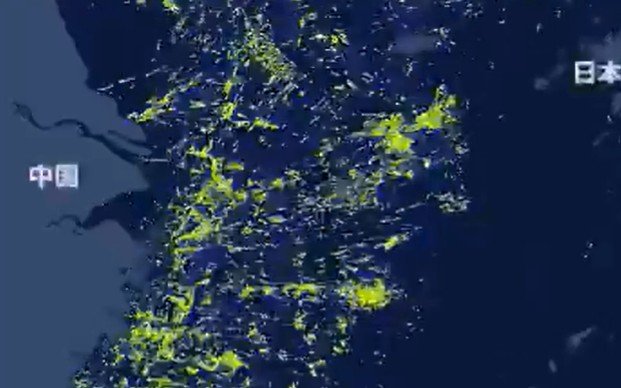
These were no ordinary fishermen. Operating in near gale-force winds that forced professional South Korean fleets to flee, the Chinese ships held rigid, 400-kilometre-long inverted L-shaped formations for over 30 hours. Naval experts have identified these manoeuvres as command-and-control exercises by the People’s Armed Forces Maritime Militia (PAFMM), rehearsing for a catastrophic blockade. By deploying thousands of civilian hulls to choke the sea lanes, China aims to sever Taiwan from vital support coming from Japan and South Korea, weaponising a deniable “gray zone” armada that legally complicates any US naval response.
Underpinning this entire military standoff is the fragile “Silicon Shield.” Taiwan Semiconductor Manufacturing Company (TSMC) currently captures 72% of the global pure-play foundry market, producing the advanced nodes essential for a booming global artificial intelligence industry projected to reach $500 billion in AI chip revenues in 2026. While some strategists argue that the world’s total dependence on Taiwan’s chips prevents an invasion, this shield is morphing into a ticking time bomb. As both the US and China pour billions into building domestic chip manufacturing, a dangerous window is opening between 2027 and 2032. If China feels it can survive the technological fallout before the West fully diversifies its supply chain, the primary economic deterrent against an invasion could evaporate entirely.
Yet, Taiwan is far from a helpless victim. Deeply studying Ukraine’s five-year survival against Russia and Iran’s current asymmetric naval campaign, Taipei has executed a radical doctrinal shift. Taiwan is no longer just preparing to defend its beaches; it is preparing to inflict unspeakable damage on the Chinese mainland.
Central to this is Taiwan’s “porcupine” strategy. By the end of 2026, Taiwan is projected to possess the highest density of anti-ship missiles in the world, with an arsenal exceeding 1,400 advanced munitions, including massive domestic production of the supersonic Hsiung Feng III and 400 US-supplied Harpoon missiles. More terrifying for Beijing is Taiwan’s highly classified Yun Feng (Cloud Peak) supersonic cruise missile. Capable of flying at Mach 3 with an extended range of up to 2,000 kilometres, the Yun Feng puts major mainland economic and political hubs—from Shanghai to Beijing—directly in the crosshairs.
Taiwan is also rapidly scaling a “Hellscape” defence architecture, heavily investing in a domestic drone industry with a goal of producing 180,000 uncrewed units annually by 2028. This multi-layered web of kamikaze drones, smart sea mines, and uncrewed surface vessels is explicitly designed to slaughter a Chinese invasion fleet before it ever touches the sand.
This explosive standoff is further complicated by regional proxy actors. North Korea has aggressively stepped in as a strategic spoiler for Beijing. Timed perfectly to maximise regional anxiety, Pyongyang recently fired over ten ballistic missiles toward the Sea of Japan, sharply reminding the world of its capability to ignite a secondary front at will. With intelligence pointing to an expansion of its Yongbyon nuclear enrichment facility and Russian technical assistance in developing new guided-missile destroyers, North Korea is successfully pinning down South Korean and US forces that might otherwise assist Taiwan.
As the pieces move on this deadly chessboard, China’s economic preparation reveals its ultimate intent. Over the past decade, Beijing has amassed a colossal strategic petroleum reserve of over 1.2 billion barrels, capable of sustaining the country through a hermetic six-month blockade. While a distracted America and a volatile global economy present a tantalising opportunity for China to strike, Taiwan’s newly forged retaliatory teeth guarantee that an invasion would not be a swift victory, but an apocalyptic gamble. The world holds its breath as the ultimate test of deterrence unfolds.
Read the comprehensive research paper here
Discover more from
Subscribe to get the latest posts sent to your email.








1 COMMENTS