Giorgia Meloni’s G7 Body Language Goes Viral — But What Did Évian Actually Decide?


Giorgia Meloni’s G7 Body Language Goes Viral — But What Did Évian Actually Decide?
Clips of Meloni’s greeting with Volodymyr Zelenskyy, her exchange with a late-arriving Donald Trump, and her banter with Narendra Modi dominated social feeds out of the G7 summit in Évian-les-Bains. Here’s what the footage shows, what remains unverified, and what the seven leaders actually agreed on Ukraine, Iran and AI.
A few seconds of video did more to define global perceptions of the 52nd G7 Summit than its final communiqué ever will. While Donald Trump, Volodymyr Zelenskyy, Emmanuel Macron and four other heads of government spent three days in Évian-les-Bains negotiating over Ukraine, the Strait of Hormuz and the governance of artificial intelligence, a parallel and far more widely watched summit was unfolding on phone screens. A brief greeting between Giorgia Meloni and Zelenskyy was captioned online as an awkward near-kiss. A clip of Giorgia Meloni waiting on a late-arriving Trump turned into a referendum on who “won” their exchange. A lighter moment with Narendra Modi turned a private joke about Instagram followers into a trending hashtag. None of this will appear in the G7’s official record. All of it, within a day, had reached more people than the record itself ever will.
01Seven Leaders, One Lake, and a Crowded Agenda
The 52nd G7 Summit ran from 15 to 17 June 2026 in Évian-les-Bains, on the French shore of Lake Geneva — the same town that hosted the G8 in 2003, making it the first to host the gathering twice. France’s President Emmanuel Macron, holding this year’s rotating presidency, had built the formal agenda around reducing global economic imbalances, but the headlines were set elsewhere: the war in Ukraine and the sanctions regime on Russia, a fragile US-brokered framework to end the conflict with Iran and reopen the Strait of Hormuz to shipping, energy security, migration, the governance of artificial intelligence, and, new to the G7 calendar this year, a joint push on cancer research and mortality.
Trump arrived having already described his earlier meeting with Zelenskyy as “very good,” telling reporters he would do what he could to end the war while reviving his often-disputed claim to have personally settled eight conflicts. Ukraine left the summit with a renewed statement of Western backing, even though Zelenskyy did not secure the full one-on-one meeting with Trump that Kyiv had reportedly hoped for. Italy’s position inside all of this is what makes Giorgia Meloni more than a supporting character at this summit. Since 2022 she has tried to hold a rare seat at the table: ideologically adjacent to parts of the Trump movement, institutionally anchored in the EU and NATO, and publicly committed to continued support for Ukraine — a balancing act she has kept up even as Washington has scaled back its own contribution and left European capitals carrying more of the load.
02The Zelenskyy–Meloni Clip: What’s Confirmed, What’s Just a Caption
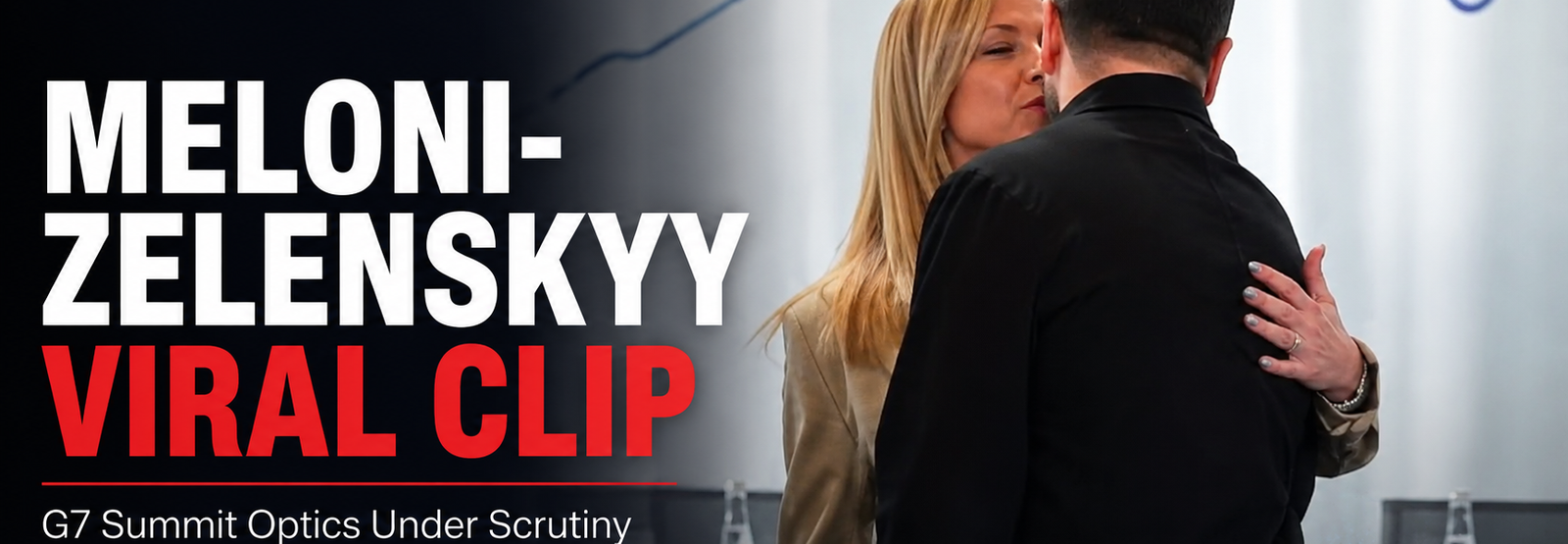
Largely unverifiedThe clip that travelled furthest involved no policy at all. On 16 June, a short video of Giorgia Meloni and Zelenskyy meeting at the summit began circulating on X, framed by widely shared posts claiming the Ukrainian president had tried to kiss the Italian prime minister and describing her reaction in strongly worded terms. The clip was quickly picked up by entertainment and viral-news outlets, particularly across South Asia, which largely repeated the framing of the original posts rather than offering independent verification of their own.
What can actually be established is more modest. European greeting protocol between heads of government routinely includes a cheek-kiss or air-kiss exchanged in passing — a gesture that, compressed into a handful of video frames, shot from a single angle, and stripped of its lead-up and follow-through, can look like almost anything to an audience already primed by a caption to see something specific. At least one outlet covering the clip noted that it had not been officially confirmed and that the camera angle may have shaped how the moment appeared. No statement addressing the clip has come from Palazzo Chigi, Giorgia Meloni’s office, or from the Ukrainian presidential press service, and no major international wire service or fact-checking organisation appears to have examined it independently as of this writing. That does not make the clip fake. It means the only thing actually established is that two leaders greeted each other quickly in front of a camera, and that a caption — not the footage itself — supplied the rest of the story.
03“He’s 45 Minutes Late”: Giorgia Meloni and Trump Share a Frame
Multiple sources, lower-tier outletsTrump generated his own viral moment simply by being late. Footage shared widely on X captured Giorgia Meloni, standing with other officials before his arrival, asking whether he was actually coming and then answering her own question: he was, by her count, 45 minutes behind schedule. When Trump did appear and launched into an extended aside about a UFC event held to mark his birthday, cameras lingered on Giorgia Meloni appearing to look away while other leaders, including Macron, stayed visibly engaged. Commentary online ran in a familiar direction, with users contrasting what they read as Giorgia Meloni’s unbothered composure against a Trump several described as unusually subdued.
It is worth being precise about the limits of that reading. A raised eyebrow, a held gaze, a shifted stance: these are the raw material of body-language commentary, and they are genuinely ambiguous out of context. Boredom, diplomatic restraint, jet lag and irritation can all produce near-identical footage. What is not ambiguous is that Trump has had real friction this year with several G7 counterparts, Giorgia Meloni among them, over being consulted on decisions that affect them directly — friction that gives this kind of clip a ready-made narrative to slot into, whether or not that narrative is what actually happened in the room.
04A Crowded Field of Viral Moments — Not Just Giorgia Meloni
Giorgia Meloni was far from the only leader mined for content at Évian, and not every viral clip cast her as uneasy. A hot microphone caught her telling fellow leaders she had quietly given up smoking a month earlier, drawing an admiring “You stopped? Bravo!” from European Commission President Ursula von der Leyen — a moment that, by several accounts, even reached the World Health Organization. In an entirely different register, Giorgia Meloni greeted Narendra Modi ahead of the leaders’ group photo by joking that the two of them were the internet’s most famous couple, reviving the years-old “Melodi” meme that began after their early encounters at the G20 and has since been fed by selfies, a viral gift of toffees in Rome weeks earlier, and recurring photo-ops at summits. Macron, too, picked up his own viral greeting clip with Giorgia Meloni. Taken together, the pattern says less about any one leader than about how summit cameras now treat every handshake as raw footage waiting for a caption.
05The Bridge-Builder: How Giorgia Meloni Built Her Diplomatic Image
None of this happens in a vacuum. Giorgia Meloni became Italy’s first woman prime minister in October 2022, leading a coalition built around her own Brothers of Italy party on Europe’s nationalist right. That biography is precisely what makes her summit choreography worth watching: she has spent three years cultivating a public image as disciplined, camera-literate and ideologically unmovable, while working inside the EU, NATO and G7 frameworks that her political tradition once treated with suspicion. She has kept Italy aligned with continued support for Ukraine even as parts of her own governing coalition — and the US administration she is otherwise ideologically closer to — have shown markedly less enthusiasm for that position. That alignment has not been frictionless: by several accounts, Trump has clashed this year not only with Macron, Britain’s Keir Starmer and Germany’s Friedrich Merz but with Giorgia Meloni too, over being consulted on his own decisions. A prime minister fluent enough in optics to turn a smoking confession into a wellness headline, and a toffee gift into a recurring international meme, is also a prime minister who understands exactly how much a thirty-second clip can do to — or for — her image. That fluency is part of why both the warm moments and the awkward ones attach to her so easily.
06Do Women Leaders Get Read Differently?
Giorgia Meloni’s summit footage also sits inside a longer-running argument about whether female heads of government are read differently than their male counterparts. Commentators who study political communication have long argued that women in leadership face closer scrutiny of expression, tone and physical comfort than men in equivalent positions — that a male leader’s stiffness reads as gravitas while a female leader’s reads as discomfort or hostility. Évian offers some support for that case: Giorgia Melonii’s expressions with both Zelenskyy and Trump were treated as legible windows into her feelings in a way few clips of, say, Macron’s face were. But the same summit complicates a simple version of the argument. Trump’s own body language was dissected just as aggressively, his late arrival and reportedly subdued demeanour during the UFC aside treated online as evidence of weakness rather than restraint. The fairer conclusion may be that viral diplomacy scrutinises everyone, but applies different vocabularies to what it finds: assertiveness in a woman becomes “no-nonsense” framing online, while a similar trait in a man becomes leadership, and uncertainty in a man becomes “off” where in a woman it might be read as warmth. Whether Giorgia Meloni’s G7 was really about her diplomacy, or about how the internet has learned to watch powerful women, is a question worth holding open rather than settling on the strength of a few clips.
07How to Watch a Viral Summit Clip Without Getting Fooled
None of the above is an argument against watching summit footage closely; it is an argument for watching it correctly.
- Trace a clip back to its earliest known source, not the account that made it go viral.
- Watch the full, uncut sequence where it exists, not the six-second excerpt built for sharing.
- Compare wire-service footage from AP, AFP or Reuters pools against handheld phone clips — angle and framing change what a gesture looks like.
- Treat a caption as a claim to be checked, not a description of what is actually on screen.
- Look for confirmation, denial, or even silence from the offices actually involved before accepting any account as settled.
- Stay alert to AI-manipulated political video, which by 2026 has made it harder than ever to assume a convincing clip is unedited footage rather than something assembled afterward.
08What Évian Actually Decided
Verified — multiple wire sourcesIt is worth restating, against all of this, what Évian was actually for. G7 leaders reaffirmed support for Ukraine even without delivering Zelenskyy the bilateral meeting he wanted, while the UK separately announced new sanctions targeting the tanker fleet Russia uses to evade oil and gas restrictions. Leaders welcomed, with varying enthusiasm, a US-brokered framework with Iran built around no Iranian nuclear weapons, a toll-free reopening of the Strait of Hormuz, and a lifting of sanctions — a deal whose finer details were still being clarified on the summit’s margins. France’s presidency pushed economic-imbalance and global-governance themes that rarely trend, alongside new commitments on AI, online safety for children, and, for the first time at a G7 leaders’ summit, cancer as a named health priority. None of that is built for a six-second clip, which is exactly the problem: the genuine business of the summit is harder to compress into something shareable than a raised eyebrow is — which means the optics summit will keep outperforming the policy summit in reach, even when it has far less bearing on what actually happens next in Kyiv, the Gulf, or Brussels.
09The Second Summit
Strip away the captions and what Évian actually shows is unremarkable: tired leaders, long days, routine greetings, and a handful of unscripted seconds that cameras happened to catch. What is new is not that diplomats have feelings on their faces; it is that every one of those seconds now has a second life as content — edited, captioned and sent around the world faster than any embassy could issue a clarification. For Giorgia Meloni, as for the six other leaders who shared that lakeside stage, the real test of modern diplomacy is no longer confined to the negotiating room. It now includes surviving the version of the summit that plays out afterward, frame by frame, on a billion individual screens — where the difference between a greeting and a scandal can come down to nothing more than where the camera happened to be standing.
Discover more from
Subscribe to get the latest posts sent to your email.