
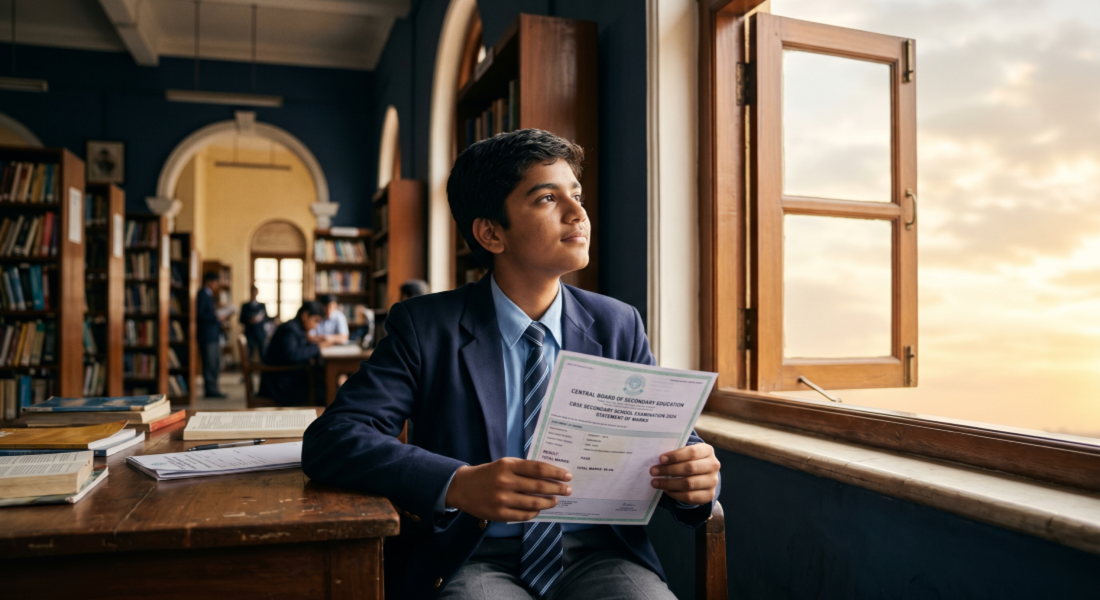
CBSE Class 10 Results 2026: Why Your Child’s Score Marks the Start of a Bigger, Brighter Journey


Beyond the Marksheet: What India’s CBSE Class 10 Results 2026 Really Reveal About Our Schools, Our Students, and Our Future
As millions of students across India receive their Class 10 board results, the numbers tell only one part of the story. The deeper narrative — of discipline, institutional culture, parental partnership, and the crossroads of career choice — demands urgent attention from every school, every parent, and every student who believes education is more than a score.
Every year, when the Central Board of Secondary Education announces Class 10 results, India pauses. Families gather around screens, teachers refresh portals in tense anticipation, and students — many of them only fifteen or sixteen years old — are thrust into a moment that will quietly but decisively shape the rest of their academic lives. The CBSE Class 10 Results 2026 are no different. Across thousands of schools in every state, across urban centres and small-town classrooms alike, the results of this year’s board examination carry within them a profound message — one that extends far beyond percentages and pass rates.
This is not merely a story about who scored above 95 percent, or which school produced the most distinctions. It is a story about what Indian schooling has become, what it must aspire to be, and why the decisions that follow a Class 10 result matter as much as the result itself. In the age of artificial intelligence, global competition, and rapidly shifting career landscapes, the Class 10 board examination represents something elemental: the first serious reckoning between a young person and their own potential.
What the 2026 Results Reveal About Indian Schooling Today
The CBSE Class 10 Results 2026 reflect a school system that is, in many ways, maturing with purpose. Pass percentages across several regions have shown sustained improvement, and the proportion of students securing above 80 percent in core subjects has grown steadily over recent years. This is encouraging. But raw statistics conceal as much as they reveal.
What is increasingly evident is a growing disparity between institutions that take education seriously as a long-term civilisational project and those that treat it primarily as an annual performance cycle. The schools that consistently produce excellent results are not doing so by accident. They are doing so because they have constructed cultures of learning — cultures in which students feel both challenged and supported, in which teachers are invested not just in syllabus delivery but in the intellectual awakening of each child.
In 2026, the data broadly suggests that urban CBSE-affiliated schools continue to outperform rural ones in aggregate terms, though many exceptions exist that prove the more important rule: it is institutional seriousness, not geography, that is the defining variable. Schools with structured mentorship programmes, consistent formative assessment practices, and engaged parental communities have produced results that would be considered remarkable anywhere in the world.
 Excellent results are never accidental. They are the cumulative product of a school’s philosophy — its respect for the craft of teaching, its belief in every student, and its refusal to treat examinations as the ceiling rather than the floor of ambition.
— News24Media Editorial Analysis, 2026
Excellent results are never accidental. They are the cumulative product of a school’s philosophy — its respect for the craft of teaching, its belief in every student, and its refusal to treat examinations as the ceiling rather than the floor of ambition.
— News24Media Editorial Analysis, 2026
Why High-Performing Schools Stand Apart
It is tempting, and perhaps comforting, to attribute exceptional board results to exceptional students — as if talent were a fixed quantity distributed unevenly at birth. But anyone who has spent time observing India’s finest CBSE schools knows that this explanation is insufficient. High-performing schools are not merely lucky recipients of gifted students. They are architects of academic excellence.
What distinguishes them is, first and foremost, a coherent institutional philosophy. In schools that consistently perform well, education is understood not as the transmission of information but as the cultivation of capacity. Teachers in these institutions are not merely subject-matter functionaries; they are practitioners of a craft that demands patience, creativity, and genuine affection for young minds. The head of institution is not only an administrator but a pedagogical leader who shapes culture through daily example and consistent expectation.
Strong CBSE performers also invest heavily in the structures that surround learning. Regular internal assessments modelled closely on board examination patterns, robust doubt-clearing sessions, and a culture in which asking questions is celebrated rather than discouraged — these are the hallmarks of a school that is serious about results for the right reasons. They also tend to engage parents not as peripheral observers of their children’s schooling, but as active partners in it.
Institutions such as Saraswati World School in Hooghly , West Bengal, exemplify this integrated approach. Operating with an awareness that Class 10 is not a finishing line but a launching pad, such schools focus on building in their students not only subject competency but the metacognitive habits — the capacity for self-assessment, self-correction, and self-directed learning — that will serve them across a lifetime of academic and professional challenges. This orientation toward student character, not just student performance, is what distinguishes schools that produce genuinely prepared young people from those that merely produce impressive result sheets.
The Role of Teachers, Leadership, Systems, and Home
No single factor explains school success. It is always a confluence. In the most consistently excellent CBSE schools, four pillars stand with remarkable regularity: inspired teaching, purposeful leadership, robust systems, and a nurturing home environment.
The teacher remains the irreplaceable centre of the educational universe. In an era where EdTech evangelists sometimes speak of the classroom as a site awaiting disruption, the CBSE Class 10 results offer a quiet counterargument. The schools with the finest results are almost always the ones with the finest teachers — individuals who have chosen to take the responsibility of a student’s intellectual life seriously, year after year, period after period, student after student. This is not romantic sentiment. It is observable fact.
School leadership shapes the environment in which teaching occurs. A principal or director who prioritises professional development for teachers, who maintains high expectations without creating anxiety, and who builds a school culture in which failure is understood as feedback rather than catastrophe, creates the conditions under which excellence becomes routine. Systems — structured timetables, assessment calendars, early intervention for struggling students, regular parent communication — are the infrastructure that sustains this culture over time.
And then there is the home. The research is unambiguous and has been for decades: students whose parents are engaged with their learning, who have access to a quiet study environment, who feel emotionally secure and intellectually encouraged at home, consistently outperform peers who lack these advantages. The CBSE Class 10 Results 2026 reflect this reality with uncomfortable clarity. A school’s work and a family’s work are not separate; they are interdependent chapters of the same story.
◆ Key Takeaways — What Makes a High-Performing CBSE School
- Philosophy before performance: The best schools treat results as a consequence of culture, not a goal unto themselves.
- Teachers as craftspersons: High results track directly to sustained investment in teaching quality and professional growth.
- Institutional systems matter: Consistent formative assessment, early identification of struggling students, and structured academic calendars create predictability and security.
- Parental partnership is non-negotiable: Schools that actively involve parents in the learning journey produce measurably better outcomes at Class 10.
- Leadership sets tone: A school’s head shapes its culture; an academically purposeful principal produces an academically purposeful school.
- Student agency is cultivated: Top schools teach students to own their learning — through self-assessment, revision habits, and honest engagement with their own gaps.
Class 10: A Turning Point, Not Merely a Result
India’s education system has an unfortunate tendency to treat board examinations as destinations. They are not. They are junctions. The CBSE Class 10 result is perhaps the most consequential academic junction a student will encounter before their college entrance examination — because it is the moment at which the path begins to narrow, in the most constructive sense of that phrase.
After Class 10, a student chooses their stream. This choice — Science, Commerce, or Arts and Humanities — is not merely an academic preference. It is, in many cases, the first exercise of genuine self-determination in a young person’s educational life. Done well, with proper guidance and honest self-reflection, it is an act of intellectual courage. Done poorly — driven by parental pressure, peer conformity, or the false prestige hierarchy that places Science above all other disciplines — it can condemn a talented young person to years of misalignment between their natural capacities and their academic environment.
Schools and parents must understand this. The Class 10 result is important. But what happens next — the quality of the conversation that follows, the guidance that is offered, the assumptions that are interrogated — is equally, perhaps more, important.
Stream Selection After Class 10: A Decision That Shapes Destinies
The proliferation of career options in contemporary India has made stream selection both more consequential and, paradoxically, more liberating than it was for previous generations. The rigid determinism of the past — in which a Science student became an engineer or a doctor, full stop — has been replaced by a more fluid landscape in which interdisciplinary careers, creative fields, entrepreneurial ventures, and digital professions cut across the old stream boundaries.
Nevertheless, the stream chosen at Class 11 still sets the intellectual trajectory of the subsequent two years, and — through the subjects studied — significantly shapes higher education eligibility and early career direction. A student who discovers a passion for economics but has chosen the pure Science stream faces a structural obstacle. A student drawn to law who has studied Commerce will find the transition smoother. These are not insurmountable challenges, but they are real ones.
What students and parents need, in the immediate aftermath of the CBSE Class 10 Results 2026, is not anxiety, but informed deliberation. The Science stream remains the broadest gateway — it preserves the largest number of future options, from medicine to engineering to pure research to data science. Commerce opens avenues in business, finance, chartered accountancy, economics, and management. The Humanities and Arts streams — historically undervalued in India — are increasingly recognised as the foundation for careers in law, civil services, journalism, international relations, psychology, design, and the rapidly growing creative economy.
Parents who force high-scoring children into Science out of convention, or who steer Arts-inclined children toward Commerce out of financial anxiety, do their children a disservice that compounds with time. The mark that matters most at this junction is not the one on the board result — it is the honest mark of a child’s genuine interest, aptitude, and aspiration.
Beyond Marks: What Parents and Students Must Really Understand
There is a peculiarly Indian affliction — not unique to India, but acutely felt here — in which the percentage on a board result is treated as a proxy for a child’s worth. The student who scores 94 percent is celebrated; the one who scores 72 percent is counselled with barely concealed disappointment. This conflation of marks with merit, and of merit with value, is educationally corrosive and deeply unfair.
Board examinations test a specific, valuable, but ultimately limited set of capacities: the ability to retain, recall, apply, and express knowledge within a time-constrained, standardised format. They do not — cannot — test curiosity, creativity, interpersonal intelligence, entrepreneurial instinct, artistic vision, physical coordination, or the thousand other human capacities that translate into meaningful professional contribution and fulfilling personal life.
The students who will define India’s next decade are not necessarily the ones who topped their Class 10 boards. They are the ones who, whatever their mark, developed the habit of inquiry — the relentless, joyful, sometimes inconvenient tendency to ask why things are the way they are and to imagine how they might be otherwise. The role of parents, schools, and counsellors in the wake of the 2026 results is to help every student — the high scorer, the average scorer, the student who must sit for improvement — to locate that habit within themselves, and to chart a forward path grounded in honest self-knowledge rather than social performance.
◆ Why This Matters — The Stakes Beyond the Scorecard
India will produce approximately 1.5 crore Class 10 graduates from CBSE-affiliated schools over the coming years. Each of these students faces a higher education and career landscape that is more complex, more competitive, and more rapidly evolving than any previous generation has encountered. The quality of guidance they receive at this junction — the conversations had, the assumptions challenged, the possibilities opened — will not only shape individual lives but the aggregate human capital that determines whether India’s demographic dividend becomes a prosperity dividend. The CBSE Class 10 Results 2026 are not simply a moment of institutional reporting. They are a call to every stakeholder in Indian education to take their responsibility to young people with the seriousness it deserves.
A Lesson for Average and Underperforming Schools
For every school that reported exceptional CBSE Class 10 Results 2026, there are many that did not. For these institutions — and their leaders, teachers, and communities — the appropriate response is neither denial nor despair but honest diagnosis.
Underperformance in board examinations rarely has a single cause. It is typically the surface expression of deeper institutional dysfunctions: inconsistent academic standards, inadequate teacher development, insufficient student support structures, poor communication with parents, or a school culture in which mediocrity has been tacitly accepted as the ceiling rather than the floor. Addressing these issues requires not cosmetic interventions in the weeks before the next board cycle, but sustained, structural, leadership-driven transformation.
Schools that have watched their counterparts achieve outstanding results in 2026 should resist the temptation to attribute the difference to luck, location, or socioeconomic privilege alone. While these factors are real, they are not deterministic. Across India, schools in resource-constrained contexts — in smaller towns, in institutions without fee structures that fund lavish infrastructure — have demonstrated that a committed faculty, a principled leadership, and a culture of genuine academic seriousness can produce results that rival or exceed those of far more handsomely provisioned institutions. The variable that matters most is will — the institutional will to hold itself to a higher standard, year after year, without exception.
The Future of Students in the Age of Competition and Career Uncertainty
The world that India’s Class 10 graduates of 2026 are entering is one of extraordinary complexity. Artificial intelligence is reshaping the labour market with a speed that outpaces educational curriculum reform. The professions that will employ the greatest number of young Indians in 2040 — many of them in roles that do not yet have names — will demand combinations of technical literacy, creative problem-solving, emotional intelligence, and adaptive capacity that no board examination, however well-designed, can fully assess.
This is not cause for panic. It is cause for a fundamental reorientation of what Indian schools understand as their purpose. The schools that will serve their students best in this environment are those that treat board results not as ends but as means — means of building confidence, establishing academic discipline, and creating the foundational knowledge base upon which more complex competencies can be built. They are schools that complement rigorous academic preparation with genuine attention to student character, collaboration, and curiosity.
Higher education institutions — universities, colleges, and professional programmes — are already beginning to shift their evaluation frameworks in this direction. Aptitude tests, portfolio assessments, and interdisciplinary entrance examinations are supplementing the traditional marks-based selection model. The Class 10 result remains a gateway credential, but it is increasingly one gateway among several in a more nuanced landscape of opportunity.
Students who emerge from Class 10 with strong marks and, more importantly, a genuine sense of where their interests and capacities lie, are well-positioned for this landscape. Those who carry forward only a number — without the self-awareness, the learning habits, or the intellectual curiosity that number should ideally represent — will find the terrain ahead more challenging than their scorecard suggests.
◆ A Higher Education Roadmap — Choosing the Right Path After Class 10
- Science Stream: For students inclined toward Medicine (NEET), Engineering (JEE), Research, Data Science, or Technology entrepreneurship. Demands strong analytical aptitude and genuine interest in scientific inquiry.
- Commerce Stream: For students drawn to Business, Finance, Chartered Accountancy (CA), Economics, Management, and Entrepreneurship. Best suited to those with numerical confidence and strategic thinking.
- Humanities / Arts Stream: The stream of lawyers, civil servants, journalists, diplomats, psychologists, historians, designers, and social entrepreneurs. Undervalued in India; increasingly essential in the 21st-century economy.
- Vocational & Skill-Based Tracks: Rapidly gaining legitimacy under NEP 2020 frameworks. For students with defined practical aptitudes, these offer direct pathways to dignified, well-compensated professional careers.
- Integrated and International Programmes: For students targeting global higher education — IB, A-Levels, and international foundation programmes are complementary pathways worth exploring alongside conventional CBSE continuation.
What India’s Schools Must Learn From the 2026 Results
The CBSE Class 10 Results 2026 offer Indian education a mirror. In that mirror, the finest schools see confirmation of what sustained seriousness and genuine student-centricity can produce. Average schools see an honest reflection of the distance between current practice and genuine potential. And underperforming schools — if their leaderships are willing to look unflinchingly — see a diagnosis of what must urgently change.
India’s education system is large enough, diverse enough, and — in its finest expressions — excellent enough to lead the world in producing thoughtful, capable, adaptable young people. But it will only do so if it refuses the easy comforts of complacency, resists the pressure to reduce learning to test-preparation, and commits to the deeper, slower, more rewarding work of building young human beings who are not merely examination-ready but life-ready.
The Class 10 results matter. They signal effort, discipline, and capability. But they are the beginning of the story, not its conclusion. The schools, parents, and students who understand this — who treat the marksheet as a starting point for a far more important conversation about the future — are the ones who will define what Indian education can truly become.
In the end, a CBSE result is a conversation starter. The most important question it opens is not “How much did you score?” but “What will you build with what you have learned, and who will you become in the building?” The finest schools in India — from Kendriya Vidyalayas in the northeast to boarding institutions in the hills to urban schools like those in the Hooghly heartland of West Bengal — understand this instinctively. They produce not only students who pass examinations, but young people who are ready to engage, with confidence and curiosity, the extraordinary complexity of the world that awaits them. That is what the CBSE Class 10 Results 2026, at their best, represent. And that is what every school in India should aspire to make its ordinary standard.
Published by News24Media | news24media.org | Education & Higher Learning | CBSE Class 10 Results 2026 Special Feature | © News24Media
CBSE 10th result 2026, CBSE Class 10 Results 2026, future after Class 10, career roadmap after CBSE 10th, higher education guide after Class 10, science commerce arts after 10th
Discover more from
Subscribe to get the latest posts sent to your email.





1 COMMENTS