

SHVR : India’s New Mandatory Green and Hygiene Rating for Every School — 6 Areas, 60 Indicators, and an 8-Step Action Plan for School Leaders
The Swachh Evam Harit Vidyalaya Rating is no longer a voluntary award programme. Every school with a UDISE+ code — government, aided, or private — must now participate annually. Here is everything principals, administrators, and parents need to know.
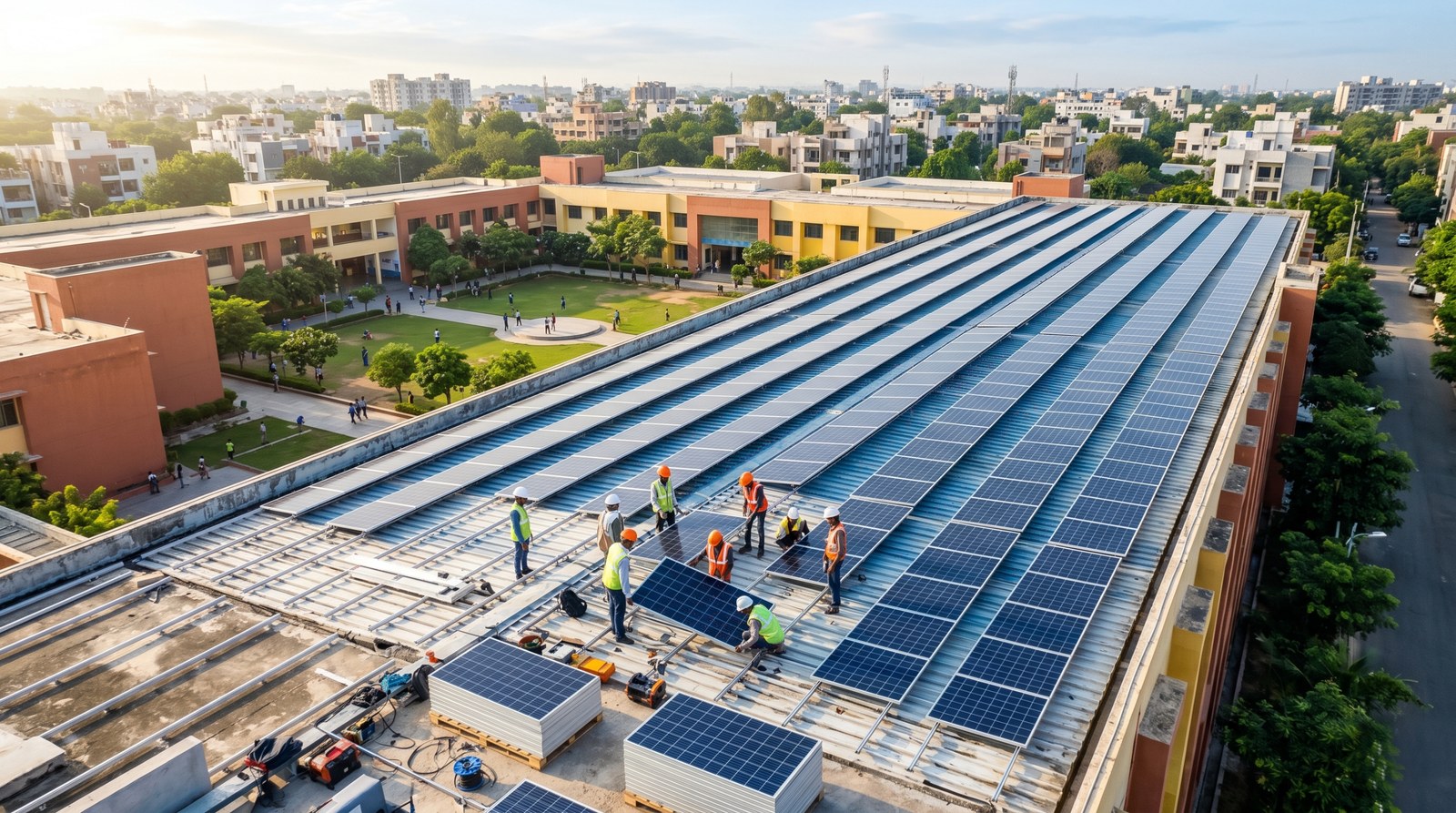 Featured: Modern school campus with rooftop solar — India, 2026
India’s schools are now operating under a new and non-negotiable compliance requirement. The Swachh Evam Harit Vidyalaya Rating — universally abbreviated as SHVR 2025-26 — was launched on July 29, 2025 by Union Education Minister Dharmendra Pradhan at the Akhil Bharatiya Shiksha Samagam in New Delhi. With that launch, the Ministry of Education transformed what was previously a voluntary award into a mandatory annual rating system that applies to every school in the country carrying a valid UDISE+ code.
The scope is sweeping. Government schools, government-aided schools, private schools, residential institutions, tribal welfare schools, minority institutions, Kendriya Vidyalayas, Navodaya Vidyalayas, and all other CBSE-affiliated schools are required to register, self-assess, submit documentary evidence, and receive a rating across six assessment areas covering 60 indicators. The process runs on an annual cycle — meaning a school’s compliance obligation does not end after one submission. It renews every year.
This article provides a complete, verified breakdown of everything SHVR 2025-26 entails: the six assessment areas and what they actually measure, how the rating system works, the registration process, and a practical eight-step action plan for school leaders who want to start preparing today.
What Is SHVR 2025-26, and How Does It Differ from the Old SVP?
SHVR builds directly on the Swachh Vidyalaya Puraskar (SVP), which was first launched in 2016-17 under the Swachh Bharat Mission to recognise schools for sanitation excellence. By its third edition, SVP had engaged over 8.23 lakh schools across India. SHVR is the fourth and most significant evolution of this programme — but the shift is more than cosmetic. It represents a structural change in how the government measures and demands school-level environmental and hygiene standards.
| Parameter | Swachh Vidyalaya Puraskar (SVP) | SHVR 2025-26 |
|---|---|---|
| Nature | Voluntary | Mandatory |
| Type | Award-based recognition | Rating and compliance |
| Cycle | Periodic / irregular | Annual — every year |
| Scope | Primarily government schools | All UDISE-registered schools |
| Framework alignment | Swachh Bharat Mission | NEP 2020 + Mission LiFE |
| Assessment | Limited indicators | 60 indicators across 6 areas |
| Rating scale | Award categories | 5-star + Bronze / Silver / Gold |
| Digital platform | Partial | Full — portal + mobile app |
The addition of the word “Harit” — meaning green — is significant. SHVR is not simply an upgraded cleanliness audit. It is a combined assessment of hygiene, sanitation, and environmental sustainability. Solar energy adoption, rainwater harvesting, plastic-free campus initiatives, and tree plantation are now formal assessment criteria with direct impact on a school’s star rating.
“SHVR is not a form you fill and forget. It is a mirror that shows a school exactly where it stands — and it holds that mirror up every single year.”
— Vinod Singh, Publisher, News24Media Education Edge
The Six Assessment Areas — What SHVR Actually Measures
The 60 indicators in SHVR 2025-26 are distributed across six areas. The structure is deliberately layered: the first two areas address basic survival needs, the middle two address daily operational discipline, and the final two address long-term cultural and environmental transformation. A school that is strong across all six is genuinely building the kind of institution that parents, students, and the Ministry of Education are looking for in 2026.
Drinking water availability, access points, quality testing records, and Rainwater Harvesting systems.
Functional units, gender-separated facilities, CWSN-accessible infrastructure, and daily cleaning logs.
Station adequacy, continuous soap availability, proper technique training, and hygiene poster display.
Waste segregation, documented cleaning schedules, campus cleanliness, and systematic asset upkeep.
Active Eco-clubs, teacher training records, student Green Champions, and community engagement.
Rooftop solar, plastic-free campus, tree plantation with survival tracking, composting, and energy conservation.
Area 1 — Water: Beyond the Tap
The Water area evaluates a school not just on whether drinking water is available, but on whether it is safe, consistently accessible, and supplemented by a Rainwater Harvesting mechanism. Assessors look for documented water quality testing records, age-appropriate access point placement, and functional purification systems. Schools with Rainwater Harvesting systems — rooftop collection directed to recharge pits, underground storage tanks, or landscape diversion — score significantly higher. Beyond the rating benefit, properly designed harvesting systems can reduce municipal water dependency by an estimated 20 to 30 percent, which translates directly into reduced operating costs.
☐ Identified and documented safe drinking water source
☐ Water purification system — functional and regularly serviced
☐ Water quality testing records — minimum quarterly
☐ Access points at age-appropriate height and location
☐ Rainwater Harvesting system — rooftop collection to storage or recharge
☐ Overhead tank regular cleaning log
☐ Water meter installed and monthly readings recorded
Area 2 — Toilets: Numbers Are Not Enough
The most common mistake schools make in the Toilets area is counting units rather than evaluating functionality. SHVR does not reward the existence of toilet blocks — it rewards toilets that are genuinely usable, properly maintained, gender-separated with adequate privacy, and accessible to children with special needs. Girls’ toilets receive particular scrutiny: functional doors, working latches, and structural privacy are non-negotiable requirements. Daily cleaning records with staff signatures for each shift are considered documentary evidence of operational discipline, not formality.
Area 3 — Handwashing: Soap Every Day, Not Just on Inspection Day
Handwashing is one of the most consistently underperforming areas in school sanitation assessments — not because facilities are absent, but because soap is often present only during inspections. SHVR’s assessment methodology is designed to catch this gap. Evaluators look for continuous soap availability, handwashing stations near both toilet blocks and meal areas, and evidence of ongoing behaviour reinforcement through technique training and hygiene poster displays. The public health case is clear: according to the World Health Organization, proper handwashing with soap reduces diarrhea and respiratory infections among school-age children by 30 to 50 percent, which has a measurable positive effect on attendance and learning outcomes.
Area 4 — Operation and Maintenance: From Reactive to Systematic
The Operation and Maintenance area makes an important distinction that many schools miss. SHVR does not just want evidence that problems get fixed — it wants evidence that a system exists to prevent and document them. Schools need documented cleaning schedules, three-bin waste segregation with student training, maintenance logs for assets, and a Swachhata Action Plan (SAP) that shows structured, forward-looking campus management rather than reactive problem-solving. The SAP is itself a required submission in the SHVR process.
Area 5 — Behaviour Change: Building the Culture, Not Just the Infrastructure
This is arguably the most underestimated of the six areas — and simultaneously the most transformative. Infrastructure without behaviour change is temporary. SHVR recognises this by requiring documented evidence of active Eco-clubs, teacher training sessions, student-led initiatives such as Green Champions and Cleanliness Ambassadors, awareness campaigns, and School Management Committee engagement. Schools that have invested in student leadership programmes find that this area becomes a virtuous cycle: empowered students reinforce hygiene and green behaviour, which improves scores, which motivates further investment.
Area 6 — Mission LiFE: Lifestyle for Environment, Embedded in School Life
Mission LiFE — Lifestyle for Environment — is Prime Minister Modi’s initiative to make environmental responsibility a daily individual habit rather than an occasional institutional gesture. SHVR’s sixth area embeds this directly into the school assessment. Indicators include rooftop solar energy adoption, a verifiably plastic-free campus, annual tree plantation drives with survival rate tracking, kitchen waste composting, herbal or kitchen gardens, and documented energy conservation practices. In West Bengal, the WBREDA and WBSEDCL rooftop solar programmes have already enabled more than 2,000 schools to install solar capacity — demonstrating that this is an achievable standard, not an aspirational one.
How the Rating and Selection System Works
SHVR operates on a five-star scale with Bronze, Silver, and Gold sub-categories. The selection process works through four levels, ensuring that top performers are identified through a rigorous layered verification process rather than self-reported scores alone.
| Level | Who Evaluates | How Many Schools Proceed | Timeline (2025-26 cycle) |
|---|---|---|---|
| School | Self-assessment via portal or app | All UDISE schools | Aug 4 – Sep 30, 2025 |
| District | District level committee — CMOs as evaluators | 8 per district (3 Rural Cat I, 3 Rural Cat II, 1 Urban Cat I, 1 Urban Cat II) | Oct 1 – Oct 31, 2025 |
| State / UT | State Nodal Officer + state committee | Max 20 per state / UT with 5-star rating | Nov 8 – Dec 5, 2025 |
| National | Cross-validation team | Top 200 schools — Certificate of Merit | Dec 15, 2025 – Feb 15, 2026 |
The annual cycle means the obligation is continuous. A Certificate of Merit in 2025-26 does not carry forward — the school must maintain or improve its performance in the 2026-27 cycle to retain its rating level. This shifts the mindset required from “pass once” to “build a genuinely sustainable institution.”
How to Register: Step-by-Step
Registration for SHVR 2025-26 is entirely digital and designed to be completed directly by school heads without requiring external technical assistance. The SHVR mobile app is available for both Android and iOS, and the web portal at shvr.education.gov.in offers the same complete functionality.
Step 1: Visit shvr.education.gov.in or download the SHVR mobile app. Click “Login / Sign Up” at the top right of the portal.
Step 2: Enter school UDISE+ code and registered mobile number. Verify with OTP. The system automatically pre-fills school name, district, state, block, and village from the UDISE+ database.
Step 3: Complete the School Profile Form — a one-time mandatory step. Review and confirm pre-filled UDISE+ information. The six survey category cards on the Dashboard become active only after the School Profile Form is submitted.
Step 4: Fill the 60-indicator self-assessment survey across all six category cards. Upload geo-tagged photographs as mandatory supporting evidence for each of the six categories.
Step 5: Prepare and submit the Swachhata Action Plan (SAP). Submit the complete assessment before the deadline. Track status and access certificates via the portal Dashboard.
Helpdesk: NCERT — shvr@ncert.nic.in or +91-95999-61434
The 8-Step Action Plan: Where to Start and How to Progress
No school needs to overhaul everything simultaneously. The following eight-step framework is designed to move any school — regardless of its current baseline — toward SHVR readiness through a phased approach that manages financial pressure while building genuine institutional capacity.
-
0Run a SHVR Baseline Assessment. Log into shvr.education.gov.in with your UDISE+ code before doing anything else. Work through the 60-indicator self-assessment survey to understand exactly where your school currently stands across all six areas. Download your Swachhata Action Plan template. This baseline data will determine the sequence of every subsequent step.
-
1Conduct an Energy and Water Audit. Document current electricity consumption by zone (classrooms, corridors, labs, administrative), current water usage, all leakage points, and infrastructure inefficiencies. This audit generates the data needed for cost-benefit decisions at every subsequent step.
-
2Complete LED Conversion and Leakage Repair. The fastest and most cost-effective green upgrade available to any school. Replacing old tube lights with LED equivalents delivers immediate measurable electricity savings. Repairing all leaking taps, pipes, and tanks simultaneously improves the Water area score. These two actions together offer the highest short-term return on investment in the SHVR preparation journey.
-
3Install Rainwater Harvesting and Three-Bin Waste Segregation. Set up dry-wet-hazardous waste separation with clearly labelled bins throughout the campus and train students in correct usage. Simultaneously, design a basic rooftop rainwater harvesting system directed toward a storage tank, recharge pit, or landscape area. Both directly improve the Water and O&M area scores and represent medium-cost, high-impact investments.
-
4Assess Rooftop Solar Feasibility. Commission a free feasibility study from an empanelled solar vendor. Schools in West Bengal can contact WBREDA and WBSEDCL for programme-based support. Private schools across India can access Central Financial Assistance through empanelled vendors. Understanding what is achievable and what subsidy is available is the prerequisite for all solar investment decisions.
-
5Implement Passive Cooling Upgrades. Not every heat management challenge requires air conditioning. Reflective roof coatings, shaded walkways and corridors, improved cross-ventilation in classrooms, green walls, tree plantation along building perimeters, and insulated roof panels all reduce heat load without increasing electricity consumption. The goal is not to eliminate air conditioning — it is to reduce AC dependency and the operational costs that come with it.
-
6Establish Greywater Reuse Systems. Treated water from handwashing stations and RO reject water can be redirected to garden irrigation, campus cleaning, and — subject to local regulations — flushing systems. Larger campuses may consider a small-scale wastewater treatment unit. Every litre of water reused is a litre not purchased from municipal supply.
-
7Install an IoT Dashboard and Publish an Annual Green Report. Mount a digital display in the school reception area showing real-time solar energy generation, electricity savings versus the previous year, and water conservation data. Publish an Annual Green Report to share with parents, the community, and the School Management Committee. This infrastructure transforms abstract data into a visible, credible statement of institutional values — and it directly supports SHVR documentation requirements.
-
8Constitute a Student-Led Green Campus Committee. Empower students as Mission LiFE Ambassadors, Green Monitors, and Cleanliness Champions with defined responsibilities and a regular activity calendar. This committee is not a ceremonial body — it is the primary driver of the Behaviour Change area score in SHVR. Schools that invest in genuine student leadership in this area consistently outperform schools that rely entirely on staff-led compliance.
The Green Campus as a Living Laboratory
One of the most intellectually compelling dimensions of SHVR’s design is the implicit invitation to treat the sustainable campus as an active teaching tool. A composting pit teaches biology. A solar generation dashboard teaches physics. A rainwater harvesting system teaches geography, hydrology, and civic responsibility. A herbal garden teaches environmental science. A three-bin waste segregation system teaches chemistry and public health.
This is precisely what Mission LiFE, embedded in SHVR’s sixth area, is calling for — not sustainability as a separate programme, but sustainability woven into the texture of daily school life. Infrastructure is not just the building a school occupies. In the right hands, it becomes one of the school’s most effective teachers.
What This Means for School Leaders and Parents
SHVR 2025-26 is a clear institutional signal from the Ministry of Education: India’s schools are now expected to be clean, green, and accountable — not just academically productive. The framework connects NEP 2020’s vision of holistic education with Mission LiFE’s call for environmental responsibility, and it backs both with a mandatory, annually recurring compliance mechanism.
For school leaders, this creates both an obligation and an opportunity. Schools that treat SHVR as a bureaucratic checkbox will spend more effort managing documentation than building genuine capacity. Schools that treat it as a genuine institutional development framework will find that the six assessment areas align almost perfectly with what reduces operating costs, improves student health outcomes, and builds the kind of credibility that parents and communities are increasingly looking for in 2026.
For parents, SHVR creates a new accountability lever. The portal at shvr.education.gov.in is publicly accessible. A school’s rating is, by design, a matter of institutional record. Asking your child’s school what its SHVR score is — and which areas it is actively improving — is a reasonable and well-grounded question for any parent to ask at the next parent-teacher meeting.
Official Portal: shvr.education.gov.in
Mobile App: “Swachh Evam Harit Vidyalaya Rating 2025-26” — Google Play and Apple App Store
Launched: July 29, 2025 by Union Education Minister Dharmendra Pradhan
Framework: 60 Indicators · 6 Areas · 5-Star Rating · Bronze / Silver / Gold
Who Must Participate: All schools with a valid UDISE+ code — government, aided, private, KVS, NVS, minority, tribal, residential
Cycle: Annual — submission required every academic year
National Recognition: Top 200 schools — Certificate of Merit
Helpdesk: shvr@ncert.nic.in · +91-95999-61434
Governing Framework: NEP 2020 · Mission LiFE · Samagra Shiksha
Discover more from
Subscribe to get the latest posts sent to your email.