
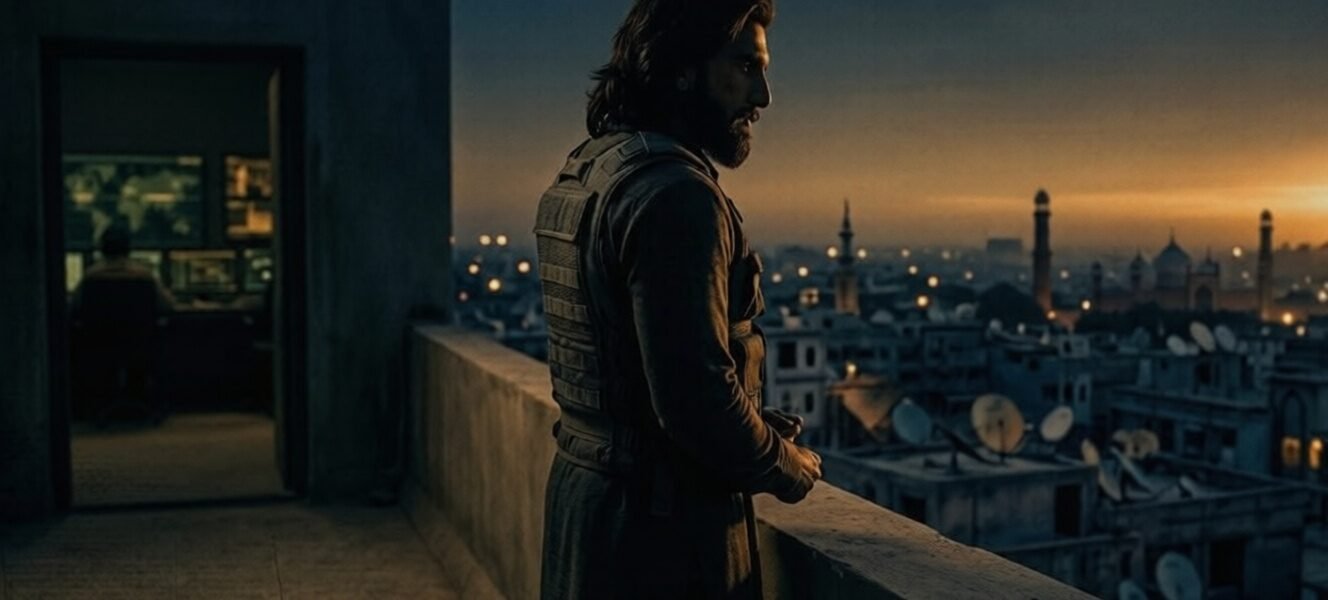
Dhurandhar: The Revenge Why Bollywood’s Most Explosive Film Is Also Its Most Honest


Special Editorial — March 2026
Dhurandhar: The Revenge
Why Bollywood’s Most Explosive Film Is Also Its Most Honest
After four decades of carefully constructed narrative, one spy thriller has walked into cinema halls across India and done something radical — it has told the audience the truth.
Something unusual is happening at cinema halls across India this weekend. Queues have returned. Booking windows are filling hours in advance. Families, students, retired officers, young professionals — crowds of a kind Bollywood has not seen in years — are buying tickets for a Hindi film with the same enthusiasm they once reserved only for big South Indian blockbusters. The film is Dhurandhar: The Revenge, directed by Aditya Dhar, and it has earned over ₹339 crore in just three days at the India box office. The opening weekend occupancy crossed 82 percent for Hindi shows. SS Rajamouli, Mahesh Babu, Allu Arjun, Jr. NTR, Ram Charan, Vijay Deverakonda — arguably the biggest names in Indian cinema today — have publicly praised the film without reservation.
The conventional explanation for such a response would be: big stars, big scale, big spectacle. Ranveer Singh, R. Madhavan, Sanjay Dutt, Arjun Rampal, Yami Gautam — the cast alone justifies interest. The production, shot across Punjab, Himachal, Ladakh, Bangkok and Thailand over 15 months, is undeniably spectacular. The running time of nearly four hours speaks to a filmmaker’s ambition. All of this is true and worth acknowledging.
But none of it fully explains the kind of emotional ownership audiences have demonstrated this week. People are not just watching this film. They are reacting to it. Whistling. Applauding. Weeping. Posting about it as if they have witnessed something they have waited a long time to see.
This editorial argues that what they have been waiting to see — and what this film delivers — is not spectacle. It is honesty.
Cultural Representation
The film does not mock Hindu practice, nor place other faiths on a pedestal. It treats both with equal dignity.
Terrorism Without Apology
The film names the ideology behind the 26/11 attacks and the cross-border threat honestly, without inversion or deflection.
Character Beyond Stereotype
Virtue and vice are not distributed along communal lines. The film refuses the formulaic moral map of the appeasement era.
The Narrative That Was Built — And What It Cost
To understand what is new about Dhurandhar: The Revenge, one must first acknowledge what came before. Hindi cinema — particularly from the 1980s onward — developed a set of representational patterns that, taken individually, appear minor. Aggregated across thousands of films over four decades, they amount to a consistent, structured worldview delivered directly into the living rooms and cinema halls of a majority Hindu nation.
Consider the depiction of faith. In film after film produced during what we may call the appeasement era, Hindu ritual — the puja, the aarti, the tilak, the recitation of mantras — was rendered as material for comedy. The priest was a stock buffoon. The devout family was superstitious, backward, or obstructing the hero’s modernity. Contrast this with the treatment of Islamic practice in the same films. Namaz sequences, the recitation of the Kalma, the depiction of religious devotion among Muslim characters — these were photographed with gravity, with soft light, with respectful silence. The message, repeated across decades, was not accidental: one faith was worthy of ridicule, the other of reverence.
The same asymmetry appeared in the depiction of festivals. Holi, Diwali, Navratri — portrayed as chaotic, dangerous, occasionally violent backdrops. Eid, by contrast, came wrapped in warmth and community. Songs embedded Urdu almost exclusively, drawing from a Lahori vocabulary that had little organic connection to the spoken language of the audience consuming it. The word for love was always the Urdu word. The prayer was always the Arabic prayer. The Hindi word for God — Ram, Krishna, Shiva — appeared with vanishing frequency after a certain decade. This was not a coincidence of artistic preference. It was the result of a particular social compact that operated within the industry for many years.
And then there was the greatest distortion of all: the treatment of terrorism.
“Indian audiences were asked, film after film, to understand their attackers better than their own grief — to see the perpetrators of 26/11 as complex victims of geopolitics rather than as men driven by a specific, named ideology.”
News24Media Editorial AnalysisIn a celebrated production from the mid-2000s, the architecture of the cross-border threat was repackaged as a story about mutual misunderstanding between India and Pakistan. A Hindu soldier carried the ideology of hatred; the Pakistanis on screen radiated warmth and goodwill. Indian audiences, many of whom had lost family in bomb blasts and cross-border attacks, were asked to absorb the lesson that they — the victims — needed to understand better. The perpetrators were rendered sympathetic. The ideology driving the violence was never named. This was not artistic nuance. It was, in the plainest terms, a lie embedded in entertainment.
What Dhurandhar Does Instead
Dhurandhar: The Revenge — the second and concluding part of Aditya Dhar’s duology — follows Jaskirat Singh Rangi, a RAW operative embedded deep within Karachi’s criminal and political networks, avenging the 26/11 attacks while confronting a more complex and far-reaching threat. The film is drawn loosely from real geopolitical events in South Asia, including Operation Lyari, the 2014 general election, and the 2016 demonetisation. Its ambitions are historical as much as they are cinematic.
Film Facts — Dhurandhar: The Revenge (2026)
Director: Aditya Dhar | Runtime: 229 minutes (theatrical)
Cast: Ranveer Singh, R. Madhavan, Sanjay Dutt, Arjun Rampal, Sara Arjun, Akshaye Khanna, Yami Gautam, Danish Pandor
Released: March 19, 2026 — coinciding with Gudi Padwa, Ugadi, and Eid al-Fitr
Box Office (India Net, Day 3): ₹339.07 crore | IMDb: 8.6/10
Note: Banned across GCC countries. Acquired by JioHotstar for digital streaming at ₹150 crore.
On Cultural Representation
The first and perhaps most immediately felt departure from the prevailing template is in how this film treats cultural and religious identity. The lead character is a Punjabi Sikh. His family, his grief, his motivation — rooted entirely in his identity as an Indian — are treated with the weight and dignity that mainstream Hindi cinema has historically reserved for other communities. His faith is not a punchline. His cultural identity is not an embarrassment to be dissolved into secularism. It is the source of his strength and his purpose.
Equally significant is what the film does not do. It does not place Hindu practice in a comic frame. It does not construct a moral hierarchy in which one community’s traditions are profound and another’s are provincial. The film simply tells a story in which the people it portrays are human beings — no more, no less — and treats the Indian in the story with the same dignity any filmmaker would naturally extend to a character they admired.
For a Hindi film, this is, surprisingly, a departure.
On Terrorism and the Naming of Ideology
The second and more politically significant departure is in the film’s treatment of cross-border terrorism. Dhurandhar: The Revenge does not offer a rationalised, both-sides account of the violence directed at India from across the border. It identifies the ideology behind the attacks — specifically, the Ghazi-inflected framework in which India is framed as Dar al-Harb and its Hindu majority as Kafir — and presents it as the operational worldview of the antagonists. The final monologue attributed to the major character Iqbal — in which he articulates precisely this framework — has become the most discussed sequence of the film.
Critics have called this propaganda. Some reviewers, as noted, have used that word explicitly. But the critical question is not whether it is propaganda — all cinema is, in some form, an argument about how the world is — but whether it is accurate. The Ghazi ideology, the concept of Mal-e-Ghanimat, the explicit framing of India as a nation to be conquered in service of an Islamic state: these are not invented provocations. They are documented aspects of the ideological architecture of groups responsible for attacks on Indian soil. Presenting them honestly in a mainstream Hindi film is not distortion. It is the end of a long period in which such honesty was withheld.
India is a nation that has lived with terrorism for more than three decades. Its citizens have absorbed bombings in its markets, attacks on its train stations, sieges of its hotels, and surgical strikes across its borders. Yet for much of that period, the cinema that those same citizens watched on weekends refused to name the thing they were living with. Dhurandhar: The Revenge names it. This is why grown men and women are weeping in cinema halls this week — not from grief, but from the unfamiliar experience of recognition.
On Character and the Moral Map
The third departure is structural. The appeasement template required a fixed moral geography: the virtuous, secular Muslim (Rahim Kaka, Abdul Chacha, the soft-spoken moderate) set against the corrupt, hypocritical, or bigoted Hindu — typically a Brahmin, typically wielding institutional power. Repeat this geography across enough films and it becomes, not story, but doctrine.
Aditya Dhar’s film does not operate from this map. Virtue and vice in Dhurandhar: The Revenge are distributed by character and choice, not by community. The film’s antagonists include men of various backgrounds. Its heroes include people who would not, in the classic Bollywood template, have been assigned to the hero’s column at all. This is not a reversal of the old prejudice — which would simply be the same problem in a different direction. It is the abandonment of the formulaic moral assignment altogether, in favour of something more honest: human complexity.
“The audience’s response is not merely enthusiasm for a good film. It is the applause of people who have finally heard their own story told to them in their own language.”
News24Media Editorial AnalysisBox Office Numbers as Cultural Verdict
The numbers deserve attention not merely as commercial data but as a cultural statement.
| Day | India Net Collection | Occupancy (Hindi) |
|---|---|---|
| Paid Preview (Mar 18) | ₹43 crore | — |
| Day 1 (Mar 19) | ₹102.55 crore | ~70% |
| Day 2 (Mar 20) | ₹82.72 crore | ~74% |
| Day 3 (Mar 21) | ₹112.80 crore | 82% |
| 3-Day Total | ₹339.07 crore |
A film that is genuinely popular because of spectacle peaks on its first day and declines steadily thereafter. A film that is popular because it has moved people grows across its first weekend. Dhurandhar: The Revenge collected its largest single-day number on Day 3, not Day 1. It is not running on marketing momentum. It is running on word of mouth — on people calling their parents, their friends, their colleagues and saying: you need to see this film.
The fact that it was banned across GCC countries even before its release is, in this context, worth noting. A film that is inoffensive does not get banned. A film that presents things as they actually are — particularly as they actually are in relation to the treatment of India by certain state and non-state actors — inevitably generates that kind of response from the very forces it is depicting accurately.
The Question of What Comes Next
It would be premature and somewhat naive to declare that the appeasement era in Hindi cinema is over on the basis of a single film, however historic its box office performance. Industries move slowly. The institutions, the funding structures, the relationships that produced forty years of selective narrative are still largely in place. A few filmmakers — Aditya Dhar, Vivek Agnihotri, Kabir Khan in some of his work — are making films from a different premise. But they remain the minority.
What has changed, and what Dhurandhar: The Revenge demonstrates with finality, is the commercial calculus. For decades, the assumption — implicit and sometimes explicit — within the Hindi film industry was that honest storytelling about Islamic radicalism, honest treatment of Hindu cultural identity, and honest representation of the cross-border threat to India were commercially risky. The audiences, the assumption went, either did not want to see such things or could not handle them.
₹339 crore in three days, at 82 percent occupancy, is a definitive rebuttal of that assumption.
The Indian audience was never too fragile for the truth. They were simply never given the opportunity to watch it. When it was offered to them — cleanly, confidently, at the scale its subject deserves — they responded with the kind of enthusiasm that transforms a film into a cultural event.
This is, for Indian cinema, a turning point. Not because one film can change an industry. But because one film, sufficiently successful, changes what other filmmakers believe is possible. The next generation of directors working in Hindi cinema now knows something their predecessors either forgot or chose to ignore: the Indian audience is not waiting for validation of a curated narrative. They are waiting for their own story.
Editorial Verdict — News24Media
Dhurandhar: The Revenge is more than the sum of its remarkable parts — its performances, its scale, its craft. It is a declaration that Hindi cinema can return to the majority of its audience without condescension. It can name what India has faced. It can treat Hindu identity with the same dignity it extends to all others. It can tell a story in which the victims of terrorism are not also cast as the ones who need to learn a lesson. The ₹339 crore in three days is not merely a box office record. It is a verdict from 140 crore people, delivered without ambiguity: we were always here. We were waiting for a film that knew that.
Akshaye Khanna Steals the Spotlight: How Dhurandhar Turned a Veteran Into the Film’s Unlikely Breakout Star
Discover more from
Subscribe to get the latest posts sent to your email.








1 COMMENTS