
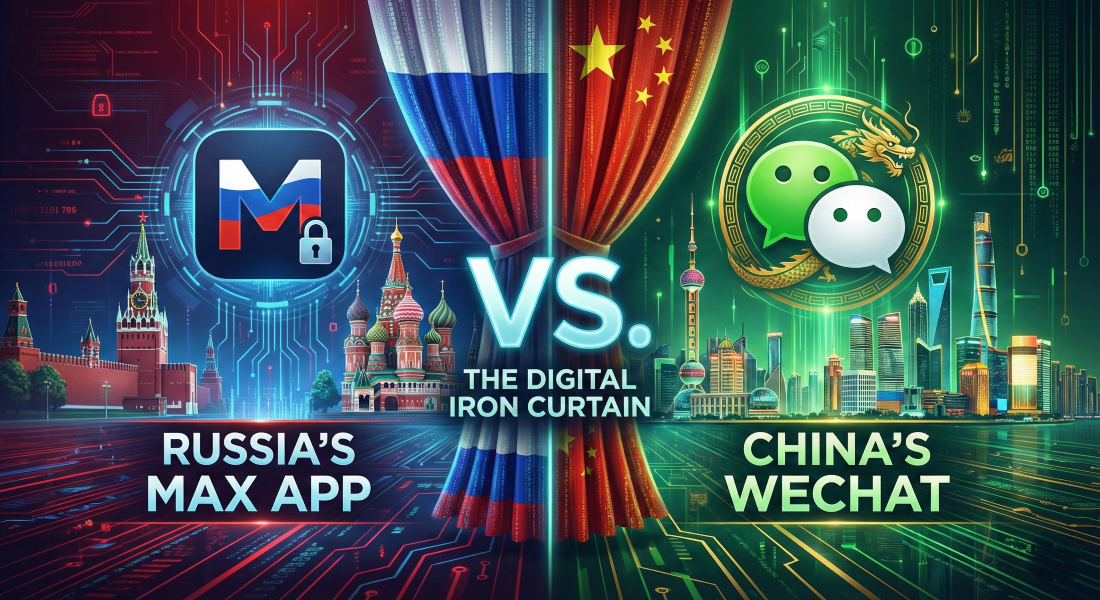
Russia Max App vs. WeChat: Inside the New Digital Iron Curtain


The Digital Iron Curtain: Russia Max App vs. China’s “WeChat”
As Russia formalises its ban on WhatsApp in February 2026, the Kremlin isn’t just cutting off a communication tool—it is deploying a replacement. The state-backed app Russia Max App is no longer just a project; it is a mandatory “super-app” designed to replicate the success of China’s WeChat.
While both apps aim to become the “OS for life,” they operate in very different social and technical climates.
Head-to-Head: The Battle of the Super-Apps
| Feature | China WeChat App | Natural “viral” growth became essential for daily life. |
| Origin Story | Grew organically as a private product of Tencent (2011). | Launched by VK (state-aligned) in 2025 by government decree. |
| Adoption Strategy | Tied to the Chinese National ID and phone number. | Mandated pre-installation; forced use in schools and civil service. |
| Identity Link | Tied to Chinese National ID and phone number. | Linked to Gosuslugi (State Services) and biometric data. |
| Privacy Model | No E2EE; data shared with CCP for “social stability.” | No E2EE; integrated with SORM for real-time FSB monitoring. |
| Financial Power | WeChat Pay: Dominates the domestic economy. | VK Pay / SBP: Integrated for taxes, fines, and local banking. |
| Legal Status | Required for almost all digital interactions in China. | Positioned as the “National Messenger” to bypass blocked apps. |

1. The Convenience Trap: Digital IDs and State Services
Both apps use convenience as the ultimate hook. In China, you cannot easily pay for a taxi or enter a mall without WeChat. Russia is following this playbook precisely:
- Russia Max App Digital ID: Uses a dynamic QR code verified via the Unified Biometric System. It is already being used at retail chains like Magnit to verify age and is intended to eventually replace physical passports for domestic travel.
- Gosuslugi Integration: While WeChat handles local city services, Russia Max App goes a step further by integrating the federal Russian bureaucracy. Need a doctor? A tax refund? A parking permit? It’s all moving inside Max.
2. Encryption: The Illusion of Privacy
The biggest casualty of the switch from WhatsApp to Max is End-to-End Encryption (E2EE).
- The Chinese Model: WeChat messages are encrypted between the client and the server, but the server holds the keys. This allows the state to filter “sensitive” keywords in real-time.
- The Russian Model: Technical audits of Max show it borrows code from TamTam (a previous VK messenger) and lacks standard E2EE. Instead, it uses encryption protocols approved by the FSB, ensuring that if a “legal assessment” is made, every message, voice note, and file is accessible to authorities instantly.
3. “Social Credit” vs. “Administrative Control”
The “China Model” is often associated with a social credit system that rewards or punishes behaviour. Russia Max App is currently more focused on administrative control:
- The Institutional Push: Since late 2025, teachers and students have been pressured to move all class chats to Max. Refusal can lead to being locked out of educational portals or “Sferum” (the state’s digital classroom).
- Biometric Mandate: Registering for Max often requires a Russian SIM, and since 2025, foreigners and citizens alike increasingly need to provide biometrics to obtain one, creating a permanent, unchangeable link between an online persona and a physical body.
The Final Verdict: A Different Kind of Sovereign Internet
While China built its “Great Firewall” as the internet was still young, Russia is trying to retroactively wall off a population that has spent 15 years using Western tools. The success of Russia Max App depends on whether the Russian public accepts the “convenience for surveillance” bargain, or if the underground VPN economy continues to thrive.
Discover more from
Subscribe to get the latest posts sent to your email.