

India · World · Politics · Truth
Bengal’s Demographic Reckoning: Historic 92.47% Turnout Rewrites the Muslim Veto Math Forever
For the first time since Independence, Hindu voters across West Bengal turned out in unprecedented numbers — triggering a structural collapse of the decades-old bloc-vote arithmetic that has decided every Bengal election. With counting on May 4, the question is no longer if the math has changed, but how severely.
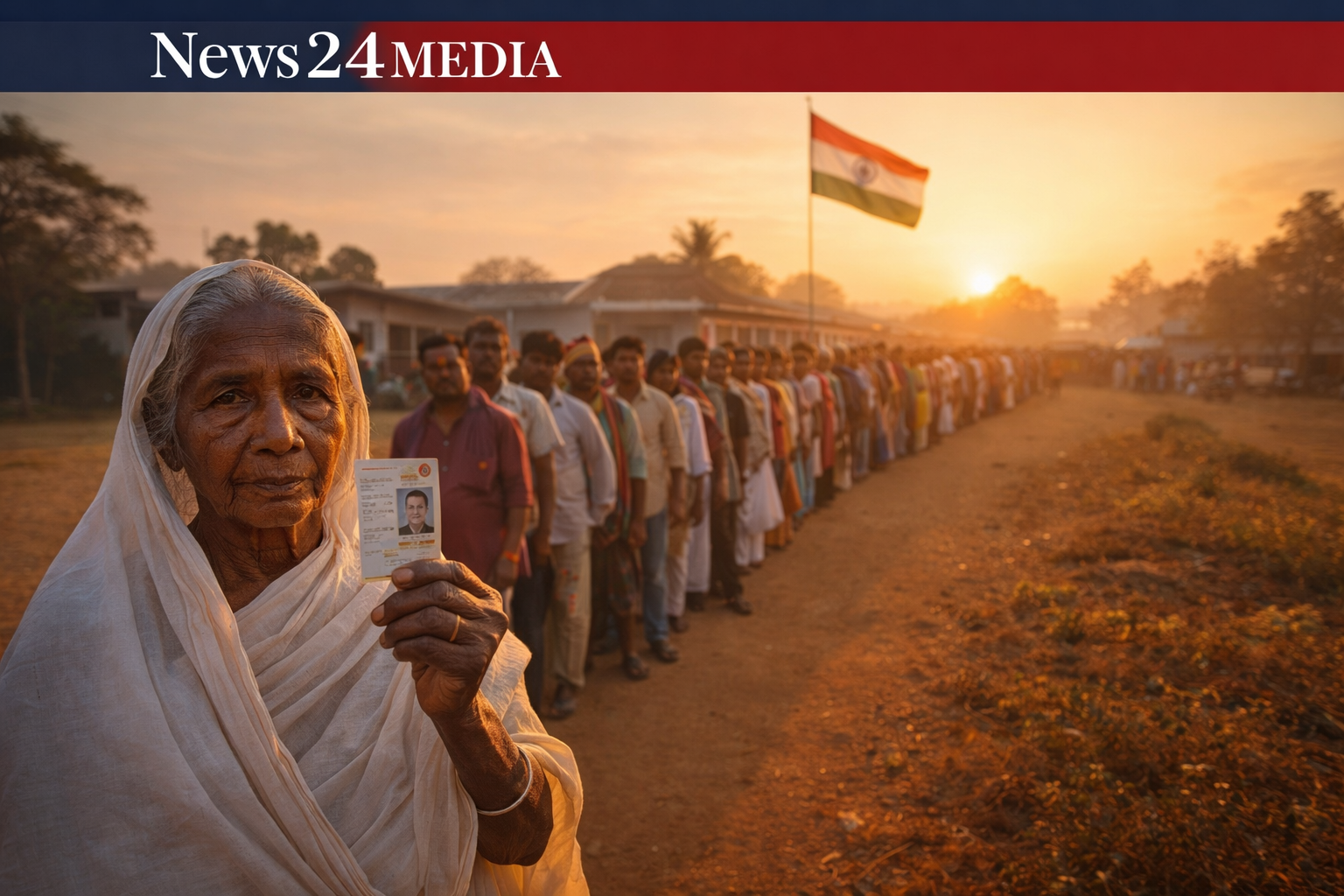
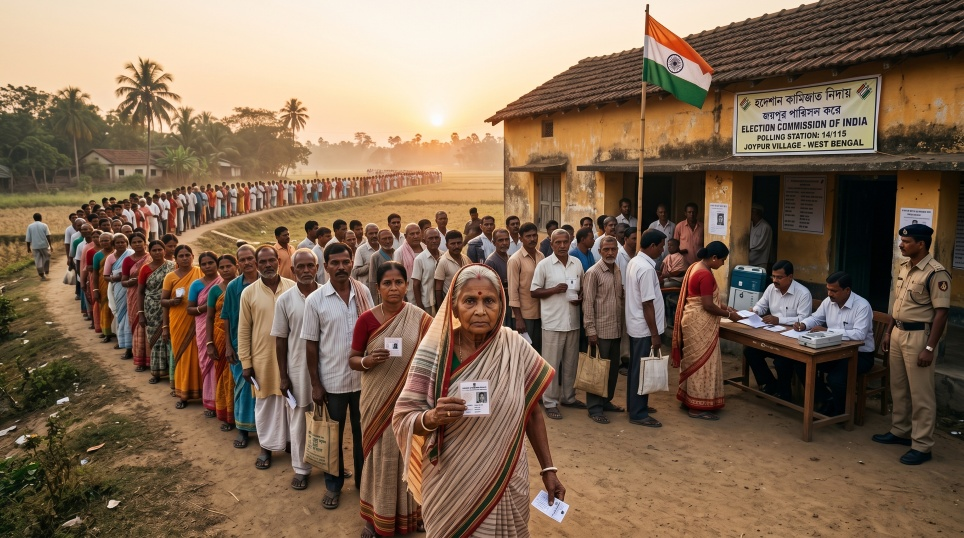
Voters queue outside a booth in Kolkata during the second phase of West Bengal Election 2026 | Representative Image
Turnout — Highest Ever
via SIR Exercise
294 Assembly Seats
West Bengal has scripted electoral history. The West Bengal Election 2026 Assembly — conducted across 294 constituencies in two phases on April 23 and 29 — recorded a staggering 92.47% voter turnout, the highest since India’s independence. This is not merely a statistical milestone. It is the sound of an old political order cracking at its foundations.
Phase one, covering 152 constituencies, registered 93.19% turnout — itself a single-phase record. Phase two, across 142 constituencies in the TMC’s strongest southern belt including Kolkata, Howrah, and South 24 Parganas, saw long queues from the moment booths opened at 7 AM. Prime Minister Narendra Modi declared that Bengal’s voters were casting their ballots in a “fearless atmosphere unimaginable in the past six or seven decades.” Whether political rhetoric or on-ground reality, the numbers do not lie: Bengal voted like never before.
The Math That Governed Bengal — And Why It Worked
To understand what West Bengal election 2026 may have shattered, one must first understand what it replaced. West Bengal’s political arithmetic has operated on a simple, brutal logic for three decades: no party wins Bengal without the Muslim vote, and the Muslim vote moves as a bloc. With approximately 28% of the state’s population, Muslims concentrated in 160 of the 294 constituencies have historically turned out at nearly 90%, delivering a unified vote share to whichever party credibly positions itself as their protector. Congress got it first. Then the Left. Then Mamata Banerjee’s Trinamool Congress — which didn’t merely inherit the bloc, it cemented it.
“The Muslim bloc at 90% turnout delivers roughly 25% of total votes as a disciplined unit. Fragmented Hindu voters, turning out at sub-60%, could never arithmetically counter it — until now.”
—Electoral Arithmetic Analysis, News24Media ResearchTMC converted Muslim-heavy districts — Murshidabad, Malda, North 24 Parganas, Birbhum — into impenetrable fortresses through welfare delivery, identity politics, and an unrelenting anti-BJP posture. CSDS-Lokniti data confirmed the scale: TMC captured nearly 77% of Muslim votes in 2021, while BJP received a negligible 6%. Congress and the Left, despite their own minority appeasement histories, were simply outmanoeuvred and marginalised.
The Collapse: Why 92.47% Changes Everything
At 92.47% overall turnout across a state of nearly 68 million voters, the arithmetic of dominance inverts. When turnout approaches near-universal participation, no single community can retain a veto. If Muslim voters turn out at 90% — as historically consistent — and Hindu voters have now crossed 93–95% participation (the implied figure at this aggregate), the bloc advantage evaporates. Each Hindu vote, previously diluted by stay-home abstention, now carries its full demographic weight.
The BJP has staked its entire campaign on precisely this consolidation — framing the West Bengal election 2026 around Hindu identity, border infiltration, the school recruitment scandal, the R.G. Kar Medical College rape and murder case, and 15 years of anti-incumbency. TMC, for its part, doubled down on welfare schemes, Bengali cultural pride, and Muslim reassurance — contesting the SIR voter roll deletions as targeted disenfranchisement of minorities.
- Bhabanipur — Mamata Banerjee vs Suvendu Adhikari; the election’s most symbolic seat, with 51,000 voters deleted via SIR
- Sandeshkhali — Land-grab controversy severely damaged TMC among local women voters
- North & South 24 Parganas — 64 seats, TMC won 58 in 2021; South 24 Parganas is ~35% Muslim
- Barrackpore / Bhatpara — Volatile TMC-BJP flashpoint constituencies
- Jadavpur / Ballygunge / Rashbehari — Urban Kolkata bellwethers for the wave
The SIR Factor: Nine Million Deleted Names
The Election Commission’s Special Intensive Revision (SIR) of electoral rolls became the campaign’s most explosive controversy. Over 9.1 million voters — nearly 12% of the electorate — were removed from the rolls, with 65% of the undecided cases involving Muslims. In at least 25 constituencies, the number of deleted names exceeded the previous election’s victory margin. TMC called it deliberate disenfranchisement. BJP called it removal of ghost voters and illegal infiltrators. Courts are still adjudicating. Whoever is right, the effect on seat outcomes on May 4 will be immediate and measurable.
Exit Polls: The Numbers That Shook Nabanna
Two major exit polls have projected an unprecedented BJP majority. The P-MARQ poll projects BJP at 150–175 seats against TMC’s 118–138 — the saffron party crossing the majority mark of 148 for the first time in Bengal’s history. The Matrize poll projects BJP at 146–161 seats against TMC’s 125–140. In 2021, TMC won 213 of 292 seats; BJP won just 77. If exit polls are even directionally correct, this would be the most dramatic single-election reversal in Bengal since 1977 — when the Left swept out the Congress in one fell swoop.
“What starts in Kolkata is always the symbol of a wave for Bengal. Last time, not one Kolkata seat went to BJP. The change in the air this time is undeniable.”
— Political Observers, West BengalThe results on May 4 will answer one of India’s oldest political questions: can a majority community exercise its democratic mandate when it chooses to? Bengal’s voters — across communities, across generations, in record numbers — have already answered one question decisively. They showed up. What they chose will be written in history.
West Bengal election 2026
Discover more from
Subscribe to get the latest posts sent to your email.