
Google Fitbit Air: A Bold $99 Screenless Tracker That Could Shake Up the Wearable Tech Market


Google Fitbit Air: The $99 Screenless Health Tracker Changing How We Wear Technology
Twelve grams. No screen. No notifications. Google’s newest wearable is the quietest device it has ever made — and it may signal the most important shift in health tech since the smartwatch.
Imagine a health tracker so light you forget you are wearing it, so quiet it never interrupts you, and so affordable it undercuts nearly every serious rival on the market. That device now exists. On 7 May 2026, Google officially launched the Google Fitbit Air — a screenless, 12-gram wrist-worn health sensor priced at $99.99 — and in doing so placed a bold bet that the future of wearable health technology is not a smarter screen, but no screen at all.
The Google Fitbit Air is, by design, the opposite of everything a modern smartwatch represents. There is no display to tap, no notifications to dismiss, no apps to navigate. The pebble-shaped sensor — just 34.9mm long and 8.3mm thin — sits silently on the wrist, tracking your body around the clock, and reports its findings through the Google Health app on your smartphone. The data goes to you when you want it, not when the device decides to deliver it.
What It Tracks — and What It Costs
Despite its minimalist form, the Google Fitbit Air packs serious sensors. The device monitors heart rate continuously, detects heart rhythm irregularities including atrial fibrillation (AFib), measures blood oxygen (SpO2), tracks heart rate variability (HRV), logs sleep stages and duration, and records skin temperature trends. Activity detection is automatic — no button presses required. An accelerometer and gyroscope handle step counting and workout detection passively. Water resistance is rated to 50 metres, so swimming and showering present no concern.
Battery life reaches seven days on a full charge, with a five-minute fast charge delivering a full day of use. The device is compatible with Android 11 or above and iOS 16.4 or above, requiring a Google Account and the newly rebranded Google Health app — which replaced the Fitbit app on 19 May 2026. Core health metrics are free. Google Health Premium, at $9.99 per month after a three-month free trial included with purchase, unlocks the Gemini-powered AI Health Coach, which generates personalised recovery plans, sleep analysis, and adaptive workout recommendations.
“Simple, affordable and comfortable enough to wear 24/7 — Google says the screenless design is built to allow users to live in the moment.”
— News 24 Media researchWhy Screenless Wearables Are Having a Moment
The Google Fitbit Air does not emerge from nowhere. It arrives at the crest of a category-wide recalibration. Whoop has built a loyal athletic following on a subscription-based screenless band. Oura Ring has proven that health tracking in ring form — invisible, jewellery-like — commands premium pricing and genuine clinical credibility. Market analysts tracking the wearables sector note that screenless devices are experiencing a surge, precisely because users are growing exhausted by glowing screens on every surface of their lives.
Screenless bands are also worn tighter, more consistently, and removed less frequently — particularly during sleep, where the most clinically valuable data is generated. A device that never comes off is, in data quality terms, worth far more than a smartwatch sitting on a charging pad at 11 p.m.
The Automatic Watch + Health Strap Pairing
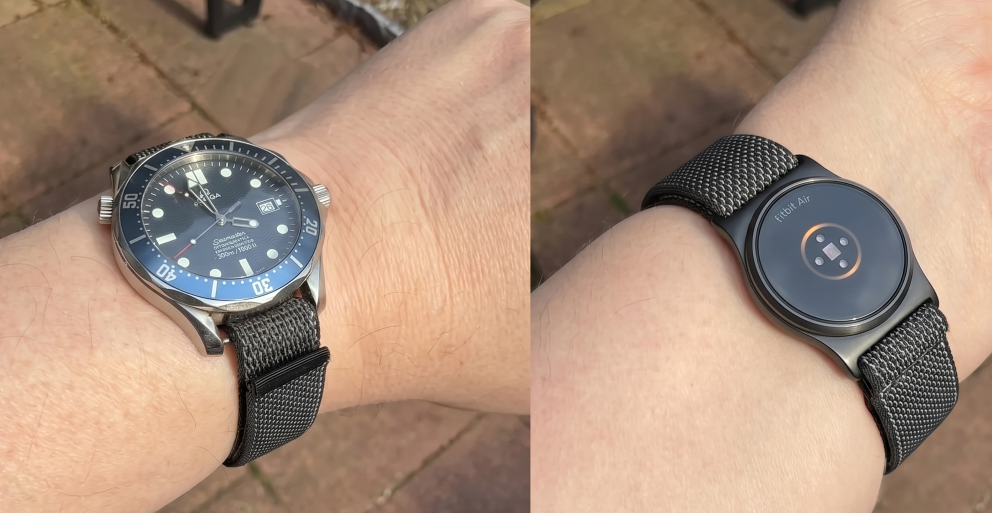
The most culturally interesting development around the Google Fitbit Air is a behaviour no manufacturer scripted: watch enthusiasts are pairing it with their mechanical and automatic watches. The dilemma has existed for years — a finely crafted Seiko, Orient, or Swiss automatic represents identity and craftsmanship; a smartwatch belongs to the world of product cycles and planned obsolescence. Many watch lovers refused to choose. The Google Fitbit Air offers a resolution.
At 12 grams and 8.3mm thin, the pebble is unobtrusive enough to wear on the opposite wrist, stacked alongside a watch strap, or on the upper arm as third-party accessories arrive. On 3 June 2026, Google released official 2D CAD drawings and accessory design guidelines for the Google Fitbit Air, explicitly inviting independent designers and brands to build custom bands — including, as DC Rainmaker noted, combination holders that could integrate the pebble alongside any watch strap. The accessory ecosystem is in its early days, but the intent is clear: the Google Fitbit Air is a sensor that adapts to your life, not a device that demands you adapt to it.
This pairing reflects a broader shift in how people relate to technology. Devices are becoming invisible infrastructure; personal style remains intensely visible. The automatic watch on the wrist tells the world who you are. The health strap quietly tells you how you are doing.
What It Means for the Market
At $99.99 with free core features, the Google Fitbit Air is the most accessible entry point in the screenless health tracking category to date. Whoop 5.0 costs $239 per year on subscription. Oura Ring 4 retails at $349. The Fitbit Air asks less money and less commitment while delivering comparable passive monitoring within Google’s established health ecosystem. Garmin is reportedly developing its own screenless band, and rumours of a screenless Apple device continue to circulate among analysts — signals that the category Google has now entered at scale is one the industry’s largest players take seriously.
A Note on Health Data and Responsible Use
Wearable health data is a wellness guidance tool, not a substitute for clinical diagnosis. Optical sensors have documented accuracy limitations during vigorous movement, and AFib detection on the Fitbit Air is not intended for users under 22 with known arrhythmias. Users should review Google’s data privacy and retention policies, and consult a qualified healthcare professional for any concerning readings.
The wrist is no longer a battleground between the smartwatch and the traditional watch. A third option has arrived — quiet, light, invisible in its ambition, and increasingly unavoidable in its implications. The Fitbit Air does not shout for attention. That, precisely, is the point.
The Fitbit Air is the most significant mass-market wearable launch of 2026 — not for what it adds to your wrist, but for what it removes from it. At $99.99, it makes passive, AI-enhanced health monitoring accessible to everyone.
Discover more from
Subscribe to get the latest posts sent to your email.