
Leadership Development in Schools: The Powerful Reason It Matters More Than Exam Scores for a Child’s Future


Beyond Marks: Why Discipline, Teamwork and Leadership Development in Schools Matter More Than Examination Scores in Preparing Students for Life
A report card measures what a student has learned. It rarely measures what a student is becoming.
Every March, as board examination results approach across India, a familiar ritual unfolds. Neighbourhoods compare percentages. Coaching institutes plaster hoardings with the photographs of toppers. Parents measure their own worth, quietly, against the marks their children bring home. For a few intense weeks, a single number — 95%, 97%, 99.2% — becomes shorthand for a young person’s entire potential.
It is a ritual worth questioning, not because academic rigour is unimportant, but because the number tells an incomplete story. Board examinations measure recall, comprehension and application within a defined syllabus and a fixed window of time. They do not measure whether a student can lead a team through a crisis, negotiate a disagreement with dignity, take responsibility for a mistake, or persist through failure without losing self-belief. Yet it is precisely these qualities — leadership, discipline, teamwork, integrity, communication, emotional intelligence — that determine how a person actually performs in college, at work, in public life, and in the quiet decisions of everyday adulthood.
Why Marks Carry Disproportionate Weight
India’s preoccupation with examination scores has deep roots. A colonial-era examination system built around ranking and gatekeeping, combined with intense competition for limited seats in professional courses, has for decades made marks the most visible — and most easily compared — proxy for ability. Marks are quantifiable, publishable and comparable across lakhs of students in a way that leadership or resilience simply are not. It is far easier for a newspaper to publish a topper’s list than to measure a student’s capacity for ethical judgment.
This is not unique to India, but the scale and intensity of the comparison here is unusual. The result is an education culture where a single examination cycle can shape a young person’s self-image for years, regardless of what it actually predicts about their future.
What Examination Results Do — and Do Not — Predict
Research across educational psychology and workforce studies converges on an uncomfortable but important finding: academic scores are, at best, a partial predictor of long-term professional and personal success. Many high scorers go on to accomplished careers. But equally, many students who were unremarkable on paper go on to build institutions, lead organisations, win elections, found companies and shape public opinion — because they developed, often outside the classroom, the ability to organise people, absorb setbacks, communicate persuasively and act with integrity under pressure.
Conversely, some toppers struggle when they step into environments where there is no fixed syllabus, no single correct answer, and no examiner assigning marks — environments that reward initiative, collaboration and the ability to handle ambiguity. This is not a criticism of academically strong students; many combine both sets of strengths. It is, rather, an argument that schools cannot afford to treat academic performance as a substitute for the rest of a young person’s development.
What Is Leadership Development in Schools, and Can It Be Taught?
Leadership Development in Schools is frequently misunderstood as authority — a title, a badge, a position at the front of the room. In an educational context, it is better understood as a form of service. Genuine leadership is the willingness to take responsibility for outcomes that affect others: to listen before speaking, to make a difficult decision and stand by it, to absorb criticism without becoming defensive, and to put the needs of a team above personal convenience.
Whether Leadership Development in Schools can be taught is a question educators have debated for decades. The evidence increasingly suggests that while temperament varies from child to child, the specific behaviours of leadership — active listening, conflict resolution, public speaking, delegation, accountability — can be deliberately practised and strengthened, much like any other skill. What matters is that schools create real situations in which students must exercise these behaviours, with real consequences, rather than simply describing leadership in a textbook chapter.
Discipline as an Inner Quality, Not a Punishment
Discipline in Indian schools has too often been associated with rules, uniforms, and the fear of punishment. This is a narrow and ultimately counterproductive understanding. True discipline is an internal quality rather than an external constraint — the ability to honour a commitment even when no one is watching, to manage one’s own time, to control one’s emotions in a difficult moment, and to accept responsibility for an outcome rather than assign blame elsewhere.
- A genuinely disciplined student keeps promises made to teammates and teachers alike.
- They can work productively without direct supervision.
- They demonstrate consistency between what they say and what they do.
- They accept correction as information, not as an attack.
Schools that rely purely on imposed discipline — rules enforced through fear — often see that discipline evaporate the moment supervision is removed. Schools that cultivate self-discipline give students something they carry with them for life.
The Student Council as a Laboratory for Leadership Development in Schools
Few school structures do more to develop real leadership than a functioning Student Council. Unlike a classroom lesson on Leadership Development in Schools, a Student Council places students inside situations with genuine stakes: an event that must be coordinated within a deadline, a dispute between classmates that must be resolved fairly, a teacher who must be persuaded, a peer group that must be motivated when enthusiasm is flagging.
Through this process, students learn to plan under constraints, communicate across different audiences — peers, teachers, parents, and sometimes the wider community — and take decisions they must then defend. They learn what it feels like to be publicly accountable for a result, and to accept criticism gracefully when things do not go as planned. These are precisely the competencies that universities and employers describe as most lacking in otherwise well-qualified young graduates.
Why Schools Hold Investiture Ceremonies
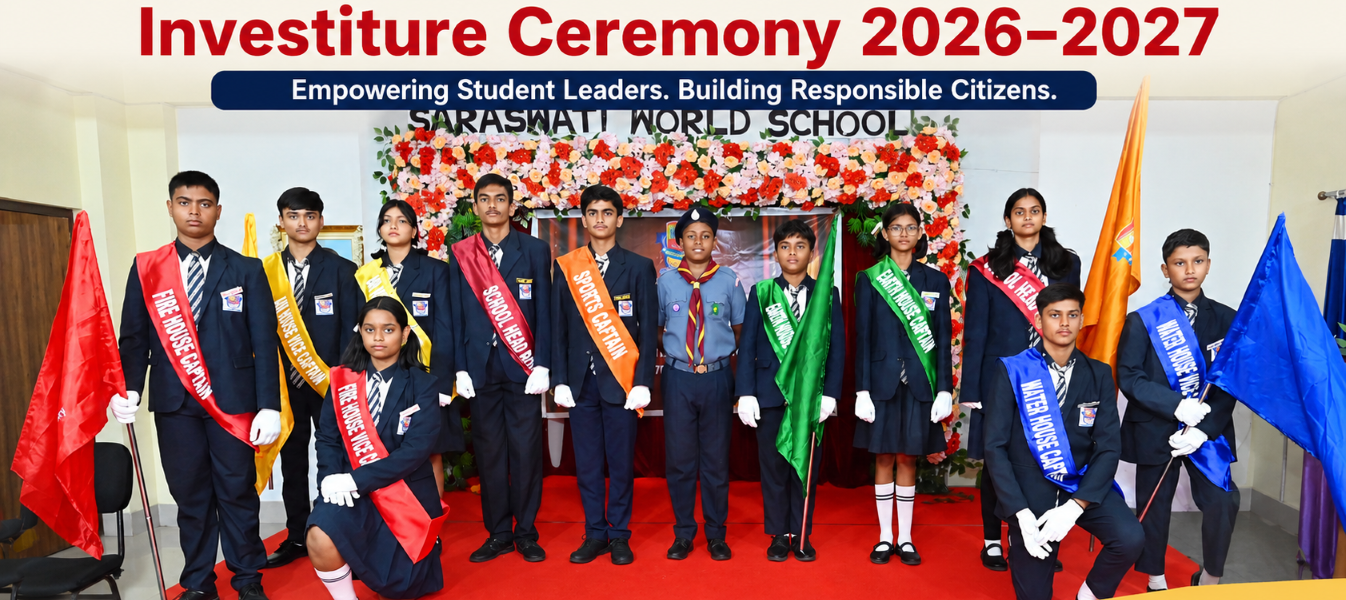
The Investiture Ceremony, a tradition observed by schools across India at the start of each academic year, exists to formalise this transfer of responsibility. It is not, at its best, a celebration of status. When a Head Boy or Head Girl, a Sports Captain, House Captains, Vice Captains or a Scout Cadet is invested with a badge in front of the school community, the badge is a symbol of an obligation accepted, not a privilege granted.
The oath administered at such ceremonies, usually by the Principal, asks students to publicly commit to values — integrity, service, discipline, fairness — in front of the very peers who will hold them to that commitment for the rest of the year. This public, ceremonial dimension matters. Psychologically, a promise made aloud, in public, in front of one’s community, carries a different weight than a private resolution. It is precisely this weight that schools intend to create.
Case Study: Saraswati World School’s Investiture Ceremony, 2026–2027

Saraswati World School’s Investiture Ceremony for the academic year 2026–2027 offers a useful illustration of how these ideas translate into practice. The ceremony opened with the traditional lighting of the lamp, followed by a welcome song and a cultural presentation, before dignitaries formally invested the newly elected Student Council.
Somdev Barman and Prajukta Ram were invested as Head Boy and Head Girl for the year, alongside the Sports Captain, House Captains, Vice Captains and the school’s Scout Cadet. Each was called forward individually, presented with a badge, and asked to take a public oath of office administered by the Principal — a pledge of integrity, discipline and service to the school community. The solemnity of that moment, rather than its ceremony, was the point: students were not being congratulated for an achievement already completed, but being asked to accept a responsibility not yet discharged.
The occasion also saw recognition from the UNESCO Club of Education Charter, which acknowledged the school’s commitment to educational excellence and separately honoured the Principal for educational Leadership Development in Schools — a recognition that reflected the institution’s broader emphasis on developing students holistically rather than purely academically. Taken together, the ceremony was a practical demonstration of an educational philosophy: that responsibility, once formally accepted in public, tends to be carried more seriously than responsibility merely assigned.
The Value of Teamwork Beyond the Classroom
Modern workplaces, from technology companies to public administration, increasingly organise work around teams rather than individuals working in isolation. The ability to collaborate — to share credit, absorb a colleague’s mistake without resentment, and coordinate toward a shared goal — has become as economically valuable as technical expertise itself.
Students who take part in House activities, sports, the Student Council, Scouts and NCC programmes, cultural events, or community service projects are, often without realising it, building exactly this capacity. They learn what many students confined solely to academic study do not encounter until much later: how to function inside a group where success depends on more than individual effort.
Schools as Miniature Democracies
A school that takes student participation seriously functions, in a modest but real sense, as a miniature democracy. Elections for the Student Council, structured debate, shared decision-making about school events, and mechanisms for students to raise concerns all mirror — at a manageable scale — the civic structures students will encounter as adults. Delegation, accountability to a constituency, respect for institutional processes, public speaking, and the ability to manage a crisis calmly are not abstract citizenship values taught from a textbook; they are behaviours rehearsed, sometimes clumsily, inside school corridors and assembly halls.
Character, once formally accepted in public, tends to be carried more seriously than character merely assumed in private.
What Global Research Says
This shift in educational thinking is not confined to India. The OECD’s Future of Education and Skills 2030 framework argues that students need a broader set of competencies — including agency, collaboration and responsibility — to navigate a world of rapid change, not merely subject knowledge. The World Economic Forum’s Future of Jobs research has repeatedly placed leadership, social influence, and collaboration among the skills employers expect to matter most in the coming years, alongside analytical thinking. CASEL’s framework for social-emotional learning identifies self-management, relationship skills and responsible decision-making as core, teachable competencies that schools can deliberately build into the student experience, rather than leaving to chance. Research from institutions such as the Harvard Graduate School of Education has similarly emphasised that structured opportunities for student voice and responsibility — not just instruction about values — are what actually build character and leadership capacity. UNICEF’s work on life skills education makes a parallel case for equipping young people with the practical competencies — communication, negotiation, coping with stress — that determine wellbeing well beyond the classroom.
None of this research suggests that academic content should be diluted. It suggests, instead, that competency and character development need to be treated as a parallel, equally deliberate strand of school life — not an incidental by-product of extracurricular activity.
The Indian Policy Shift: NEP 2020
India’s National Education Policy 2020 explicitly acknowledges this gap. It calls for a move away from rote, memory-based assessment toward competency-based, experiential and multidisciplinary learning, with holistic development named as a central goal rather than an afterthought. The CBSE’s ongoing shift toward competency-based questions in board examinations reflects the same underlying recognition: that the ability to apply knowledge, reason through unfamiliar problems, and work collaboratively matters as much as the ability to recall a syllabus.
Within this policy shift, structures like the Student Council and ceremonies like the Investiture Ceremony are not decorative traditions. They are precisely the kind of experiential, responsibility-based learning that NEP 2020 asks schools to build deliberately into the academic year, rather than treat as optional extracurricular activity.
Chairman, Saraswati World School
Conclusion: Educating for Life, Not Only for Examinations
The purpose of school education was never meant to be the production of examination toppers alone. It is meant to be the production of responsible citizens — people capable of leading a team, keeping a promise, absorbing a setback, and acting with integrity when no one is watching. Marks will always matter; they open doors to colleges, courses and early opportunities. But they are the first door, not the destination.
When schools consciously and deliberately cultivate leadership, discipline, teamwork, empathy and service — through structures as tangible as a Student Council, an Investiture Ceremony, or a House competition — they are not distracting students from academic success. They are completing an education that examinations alone could never provide.
“A report card may measure what a student has learned, but leadership, discipline, and character determine what that student ultimately becomes.”
Discover more from
Subscribe to get the latest posts sent to your email.





1 COMMENTS