
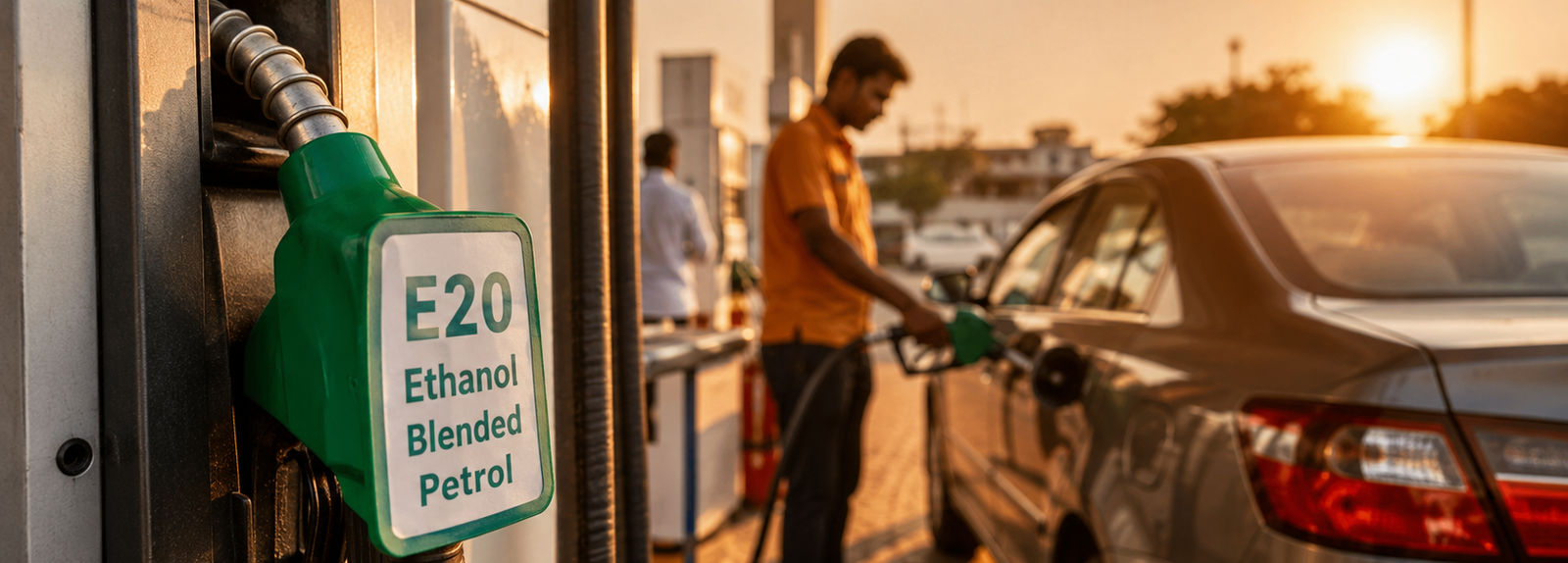
Ethanol Petrol Panic: Engine Damage Myth or Mileage Reality? India Needs Facts, Not Fear


Ethanol Petrol Rumour: Engine Damage or Mileage Anxiety? India Needs Facts, Not Fear
Viral videos claim E20 fuel is destroying engines, breeding insects and voiding warranties. The government says none of that is true — but the real story India is missing is a quieter one, about mileage, honesty and trust.
Somewhere between a WhatsApp forward and a fuel pump, India’s motorists lost their peace of mind. In recent weeks, videos claiming that ethanol-blended petrol is silently wrecking car engines, corroding fuel tanks, and voiding insurance policies have spread faster than any government press release could hope to travel. Car owners have swapped anxious notes at service centres. Two-wheeler riders have asked pump attendants, half-seriously, whether they should hunt for the last drums of “pure” petrol. Somewhere in this noise, an important public conversation — about fuel efficiency, vehicle compatibility and honest communication — has been drowned out by a louder, cruder one: does E20 destroy your engine? It does not. But the anxiety it has provoked is real, and it deserves a serious answer rather than a dismissive one.
The Government’s Answer: No Engine Damage, But Don’t Pretend Nothing Changed
Facing a wave of viral claims, the Ministry of Petroleum and Natural Gas issued a detailed, ten-point rebuttal on July 3, addressing allegations ranging from excessive water consumption in ethanol production to insects being drawn to fuel tanks and warranties being void on E20-run vehicles. The ministry’s position, backed by testing from the Automotive Research Association of India (ARAI), the Society of Indian Automobile Manufacturers (SIAM) and vehicle makers themselves, was unambiguous: there is no scientific evidence of E20 causing engine failure or widespread mechanical damage in compatible vehicles.
That is not a token reassurance. ARAI’s long-term trials ran to roughly 40,000 kilometres for passenger vehicles and 20,000 kilometres for two-wheelers, tracking drivability, startability and acceleration alongside emissions. ARAI Director Dr Reji Mathai has publicly stated that these controlled tests found no evidence of engine breakdowns linked to E20, even as they confirmed something else worth taking seriously: a measurable, if modest, dip in fuel consumption.
Maruti Suzuki’s real-world service data adds useful scale to this picture. The company reportedly serviced 28.4 million vehicles in 2025-26, of which more than 15 million were over three years old and therefore not certified for E20 — yet no pattern of E20-related damage was recorded among them, according to the government’s statement. That is a large enough sample, across old and new vehicles alike, to move this out of the realm of anecdote.
What Ethanol Petrol Blending Actually Is — and Why India Is Doing It
Ethanol blending means mixing ethanol, a renewable fuel typically derived from sugarcane, molasses, damaged foodgrain, or surplus maize and rice, into petrol in a fixed proportion — 20% under the current E20 standard. India reached its 20% blending target in December 2025, years ahead of the original 2030 timeline and up sharply from around 1.5% blending in 2013-14. That acceleration was not incidental; it was the product of a deliberate industrial and agricultural build-out, with the country’s installed ethanol production capacity now at roughly 2,000 crore litres and procurement for the current supply year projected to exceed 1,200 crore litres.
The logic behind the push is straightforward economics. India imports the overwhelming majority of the crude oil it consumes, and every litre of ethanol blended into petrol is a litre of crude that does not need to be shipped in, refined and paid for in dollars. According to the government, the Ethanol Petrol blending programme has saved more than ₹1.9 lakh crore in foreign exchange and displaced over 310 lakh metric tonnes of crude oil imports since 2014-15, while cutting an estimated 930 lakh metric tonnes of carbon dioxide emissions. On the agricultural side, the programme has reportedly channelled over ₹1.6 lakh crore directly to farmers — sugarcane growers first, and increasingly maize cultivators, who now account for more than 40% of ethanol feedstock and require far less irrigation than paddy.
Put simply: Ethanol Petrol blending is not a fuel gimmick. It sits at the intersection of energy security, farm income and foreign exchange management — three concerns that matter enormously to a country that still imports roughly 85% of its crude requirement.
Mileage Loss Is Not Engine Damage — and India Needs to Stop Conflating the Two
This is the crux of the controversy, and it is where the government’s own communication has, at times, been muddled enough to fuel doubt. Ethanol carries a lower calorific value than petrol — its energy content per litre is meaningfully less — which means an Ethanol Petrol-blended fuel will, on balance, deliver marginally fewer kilometres per litre than pure petrol, all else being equal. ARAI’s controlled testing puts this at a 2-6% drop in fuel consumption for E20 compared with E10. Some official statements have referenced a “30% lower calorific value” figure for ethanol itself, which is technically true of ethanol as a standalone compound — but the government has had to clarify that this number describes ethanol’s energy density, not the real-world mileage drop motorists actually experience once it is blended at 20% into petrol and run through an engine tuned to use it.
Mileage depends on driving habits, tyre pressure, servicing and AC load far more than on fuel type. — Government clarification, July 2026
Maruti Suzuki has cited a more concrete, relatable figure: for a car delivering 20 kilometres per litre, the drop from E20 could be in the region of 0.6 km/litre. That is a real cost to the consumer’s wallet — not something to be waved away — but it is an entirely different category of problem from an engine that seizes, corrodes or fails. Conflating the two, whether by rumour-mongers or by careless officials, does a disservice to a public that deserves a precise answer to a precise question.
Where genuine caution is warranted
None of this means every vehicle on Indian roads is equally suited to E20. Older engines not designed for higher ethanol content, vehicles with ageing rubber seals and fuel lines, two-wheelers with carburettors rather than fuel injection, and vehicles that have sat idle with fuel in the tank for extended periods may be more susceptible to wear or starting issues over time — points that automobile manufacturers and SIAM have themselves acknowledged in a general sense, even as they maintain that no widespread damage pattern has emerged. The manufacturers’ own advisories, not viral videos, are the correct reference point for owners of pre-2023 vehicles wondering whether their specific model is E20-compatible.
India Is Not Experimenting Alone: The Global Ethanol Petrol Record
One of the more effective threads in the misinformation campaign has been the implication that India is running an untested, solitary experiment on its citizens. The global record says otherwise. Brazil has run on high Ethanol Petrol blends — including pure hydrous ethanol (E100) as an alternative at the pump — since the 1970s, built around its Proálcool programme and vast sugarcane economy; it remains the most-cited global success story for Ethanol Petrol transition, precisely because it demonstrates that the shift takes sustained policy commitment rather than happening overnight. The United States has mandated Ethanol Petrol blending (chiefly E10, with E15 and E85 available) for close to two decades under its Renewable Fuel Standard, built around its domestic corn economy. Several other countries, including in Europe and Southeast Asia, run their own blending mandates at varying percentages. India’s own EBP programme, according to SIAM, was explicitly designed after studying these international experiences, including Brazil’s, and adapted for Indian vehicle fleets and climatic conditions over more than two decades of calibrated rollout — not a rushed policy improvised in a single budget cycle.
This context matters. It does not mean India’s execution has been flawless, or that every consumer concern is automatically invalid — but it does mean the “India as guinea pig” framing that has powered much of the viral panic is factually thin.
Who Benefits From the Fear?
It would be intellectually lazy — and journalistically irresponsible — to wave away every E20 sceptic as a paid troll or a saboteur. Genuine consumer frustration over reduced mileage, unclear manufacturer guidance, and a communication vacuum from oil companies has created fertile ground for rumour, and that frustration is legitimate on its own terms. At the same time, it would be equally naive to pretend that the Ethanol Petrol rollout has no interested parties on either side of the argument.
The controversy has visible political dimensions. Karnataka’s Home Minister Priyank Kharge publicly accused the Union government of turning “3.6 crore Indians” into unwitting subjects of an untested experiment — a charge the Attorney General’s office has rejected as a mischaracterisation of unrelated Supreme Court proceedings concerning ethanol procurement contracts, not the fuel’s scientific safety. Union Petroleum Minister Hardeep Singh Puri, in turn, dismissed the broader wave of criticism as a “make-believe narrative,” while still conceding that fuel efficiency may decline slightly under E20. Both statements are, in their own way, evidence of how quickly a technical fuel-policy question has been pulled into partisan terrain — which is exactly the environment in which misinformation travels fastest and nuance travels slowest.
Beyond party politics, it is reasonable to ask — without asserting proof of any specific actor’s intent — whether sections of the conventional fuel-retail and import ecosystem have institutional reasons to be uneasy about a policy engineered to shrink crude oil demand over time, and whether platforms and content creators who profit from outrage-driven engagement have their own incentives to amplify alarming claims regardless of accuracy. These are legitimate lines of inquiry for investigative follow-up, grounded in institutional incentives rather than anonymous accusation — and readers deserve reporting that pursues them with evidence, not innuendo.
What the record actually shows
Official, testable claims — not spin: ARAI’s 40,000 km passenger-vehicle trials found no engine failure pattern; the 2-6% mileage dip is measured and modest; SIAM and OEMs have confirmed E20-compliant vehicles retain full warranty and insurance validity; the “10,000 litres of water per litre of ethanol” claim has been challenged with distillery-level water-use data of 3-5 litres per litre produced.
What Consumers Should Actually Worry About
Strip away the panic, and the legitimate consumer concerns are practical, not existential. Buying fuel from unauthorised or adulterated sources remains a genuine risk, Ethanol Petrol-blended or otherwise. Vehicles that are not E20-certified — particularly those manufactured before roughly 2023 — deserve a direct check with the manufacturer or an authorised service centre rather than reliance on social media claims. Fuel system components, especially rubber seals and gaskets in older vehicles, benefit from routine inspection regardless of blend. And realistic expectations on mileage — a few percentage points, not a catastrophic collapse — will save owners from misattributing ordinary driving variables (traffic, AC use, tyre pressure, servicing intervals) to the fuel itself.
A consumer checklist for the E20 era
- Fuel only at authorised, branded pumps — verify E20 labelling and dispensing accuracy
- Check your owner’s manual or manufacturer helpline to confirm E20 certification for your specific model year
- Keep to manufacturer-recommended service intervals; ask specifically about fuel-line and seal checks on older vehicles
- Track your own mileage over several tankfuls rather than reacting to a single reading or a viral post
- Report any suspected fuel-quality issue to the Bureau of Indian Standards or your Oil Marketing Company, not just social media
- Treat warranty and insurance claims on E20-compliant vehicles as protected — SIAM and insurers have confirmed this in writing
Conclusion: The Real Failure Is Communication, Not Combustion
The engines are, by the weight of current evidence, not the problem. What India actually has on its hands is a trust deficit — the product of technical clarifications arriving late, in fragments, and often only after a rumour has already reached ten million views. A policy with genuine strategic merit — cutting crude imports, strengthening farm incomes, improving energy security — has been allowed to be defined in the public mind by fear rather than by fact, because the government, oil marketing companies and automobile manufacturers took too long to speak with one clear voice.
The fix is not complicated, even if it is overdue: proactive, plain-language disclosure of real mileage impact by vehicle segment; a single, authoritative, continuously updated public resource — rather than press conferences called only in response to viral panic; and manufacturers naming, model by model, exactly which vehicles are and are not E20-ready. India does not need to choose between defending a strategically important policy and being honest about its trade-offs. It needs to do both, loudly and early, before the next rumour fills the silence.
Editorial note on sourcing
This editorial draws on the Ministry of Petroleum and Natural Gas’s July 2026 clarification, ARAI testing data as reported via ANI and Business Today, SIAM’s official statement, and Business Standard’s reporting on the government’s point-by-point rebuttal, alongside public statements from Union Minister Hardeep Singh Puri and Karnataka Home Minister Priyank Kharge. Readers are encouraged to consult the original PIB and SIAM releases for full technical detail.
Discover more from
Subscribe to get the latest posts sent to your email.