
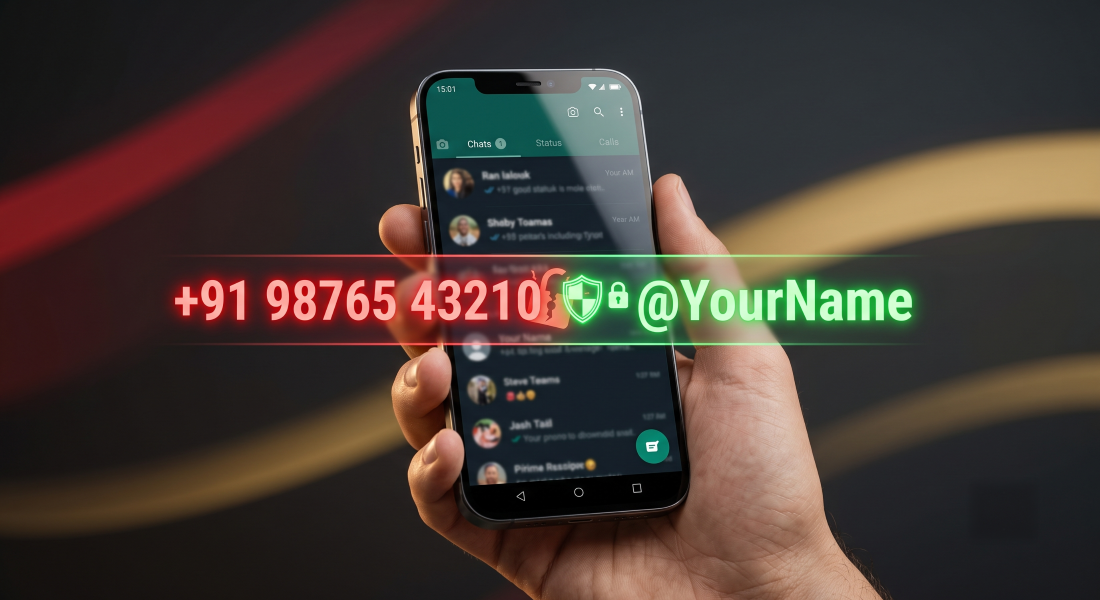
WhatsApp Username Feature: Will Phone Numbers Finally Become Private?


WhatsApp Username Feature: Will Phone Numbers Finally Become Private?
Picture this: you’ve just joined your child’s school parents’ WhatsApp group, or you’re messaging a stranger about a used scooter on a local buy-sell page, or a delivery agent needs to reach you for a one-time drop-off. In every case, the price of entry has always been the same — hand over your personal mobile number to someone you barely know, and hope it doesn’t end up forwarded, stored, or misused. For more than a decade, that has been the unspoken cost of using WhatsApp. That may now be changing.
What Has WhatsApp Announced?
On June 29, 2026, WhatsApp confirmed it is rolling out optional usernames, a feature that lets people connect and chat without ever revealing their phone number. The company has not launched full WhatsApp Username-based messaging yet — but it has opened reservations, allowing the platform’s more than 3 billion global users to lock in a preferred username ahead of time.
According to WhatsApp’s official announcement, reserving a username takes just a few seconds on the latest version of the app, via Settings > Account > WhatsApp Username, and the feature will roll out gradually over the coming months, with users notified inside the app once it is available in their country. The full messaging-by-username experience is expected to go live later this year, though WhatsApp will still require a phone number to create an account in the first place.
WhatsApp’s VP and head of product framed the change around a familiar discomfort: sharing a phone number with a new classmate, neighbour, or someone met at an event can feel like a significant step, because the number is tied to so many other parts of a person’s life.
How the WhatsApp Username Feature Will Work
Once live, a WhatsApp username will function as an alternative identity layer sitting on top of the phone number that already powers the account. Key mechanics confirmed so far:
- WhatsApp Username can be 3 to 35 characters long, with no major restrictions beyond Meta’s standard policy violations.
- A built-in username generator can suggest options if a user is struggling to pick one.
- Creators, small businesses, and organisations will be able to claim a matching username already in use on Instagram or Facebook, helping them keep a consistent identity across Meta’s apps.
- WhatsApp is setting aside protected usernames for top celebrities, VIPs, and organisations to reduce impersonation risk.
- Reservations opened on a rolling basis starting June 29, 2026, with the operational launch expected later in the year.
Why Phone Numbers Became a Privacy Problem
WhatsApp’s entire identity architecture, since its founding, has been tied to the SIM card in a person’s pocket. That design choice once felt convenient — no separate sign-up, no WhatsApp Username to remember. But over the years it has quietly become one of the app’s biggest privacy gaps.
A phone number is not just a way to make calls. It is frequently linked to banking apps, government IDs, food-delivery accounts, ride-hailing services, and social media recovery options. Handing it to a stranger in a WhatsApp group effectively hands over a thread that can be pulled to find much more. It is worth being clear about a distinction many users miss: WhatsApp’s end-to-end encryption protects the content of a conversation, not the identity of the person you’re talking to. Encryption and identity privacy are two separate problems, and until now WhatsApp had only solved one of them.
“Your phone number is personal, and it’s tied to so many other parts of your life,” — Alice Newton-Rex, VP and Head of Product, WhatsApp.
Why This Matters in India and Other WhatsApp-First Countries
Nowhere is this shift more consequential than in markets like India, Brazil, and Indonesia, where WhatsApp functions less like a messaging app and more like critical civic infrastructure. In India specifically, WhatsApp is the default channel for school-parent communication, neighbourhood resident associations, small-business customer support, political outreach during elections, religious and community groups, and even government service updates in some states.
In these contexts, refusing to share a phone number is often socially or practically impossible — you cannot opt out of the school group, the housing society group, or the local political volunteer chain without losing access to information you genuinely need. WhatsApp Usernames offer, for the first time, a way to participate in that essential communication layer without surrendering a number that is also linked to UPI payment apps, Aadhaar-linked services, and personal banking in many cases.
What Changes for Users, Businesses, Creators, and Communities
For an ordinary user, the immediate change is control: a first-time contact — a seller, a delivery partner, a new acquaintance — will no longer automatically see a phone number if a WhatsApp Username is enabled. For small businesses and creators, the ability to reuse an existing Instagram or Facebook handle means brand identity carries over cleanly to WhatsApp Business conversations, rather than customers having to look up and save a ten-digit number. For community administrators running large groups — parent groups, alumni networks, resident welfare associations — usernames offer a way to onboard new members without a public roster of phone numbers circulating in chat history.
Security Features: No Directory, Exact Username, Optional Key
WhatsApp has been deliberate about avoiding the trade-off that has made discovery features on other platforms a stalking and harassment vector. Unlike apps such as Instagram, WhatsApp will not offer a searchable directory or partial-match suggestions — a WhatsApp Username must be typed in exactly to start a first conversation. An additional, optional “username key” is also being introduced, giving users a further layer of control over exactly who is permitted to message them for the first time.
This puts WhatsApp roughly in step with rivals. Telegram, Signal, and Wire have offered WhatsApp Username-based contact for years specifically to keep phone numbers private, and WhatsApp’s move effectively closes a long-standing gap between it and privacy-first competitors — a notable shift for the world’s largest messaging platform.
Possible Risks and Unanswered Questions
The rollout is not without open questions. WhatsApp Username squatting — early adopters grabbing common names, brand terms, or recognisable handles to resell or impersonate — is a realistic concern, which is likely why WhatsApp is reserving names for celebrities and organisations in advance. Impersonation risk also rises whenever a platform introduces a second, more flexible identity layer; a convincing fake “username” account could still trick less tech-savvy users, particularly older relatives or first-time smartphone users in semi-urban and rural India who are less familiar with verification cues.
There is also the matter of internal data: WhatsApp has been explicit that a phone number will still be required to create and operate an account, meaning the number doesn’t disappear — it simply becomes invisible to other users rather than being eliminated from Meta’s systems. For users concerned about government or corporate data requests, that distinction matters.
What Users Should Do Now
Practical Checklist
- Update WhatsApp to the latest version on Android or iOS.
- Go to Settings > Account > Username to check if reservation is live in your region.
- Reserve a simple, memorable username — but avoid embedding your phone number, birth year, or other personal identifiers in it.
- Use the optional username key once it becomes available, especially if you run a business account or public profile.
- Stay alert to fake or impersonating accounts using similar usernames, particularly around brand names or public figures.
- Remember that reserving a username now does not switch it on — full messaging-by-username arrives gradually later this year.
Conclusion
WhatsApp usernames will not solve every privacy concern overnight — phone numbers remain embedded in the backend, squatting and impersonation risks are real, and adoption among less tech-savvy users will take time. But the shift is still significant: for the first time in the app’s history, identity on WhatsApp is moving away from being permanently tied to a phone number and toward something users can actually control. For 3 billion people worldwide, and especially across WhatsApp-first markets like India, that is a meaningful step from phone-number identity toward genuine user-controlled digital identity.
Discover more from
Subscribe to get the latest posts sent to your email.