
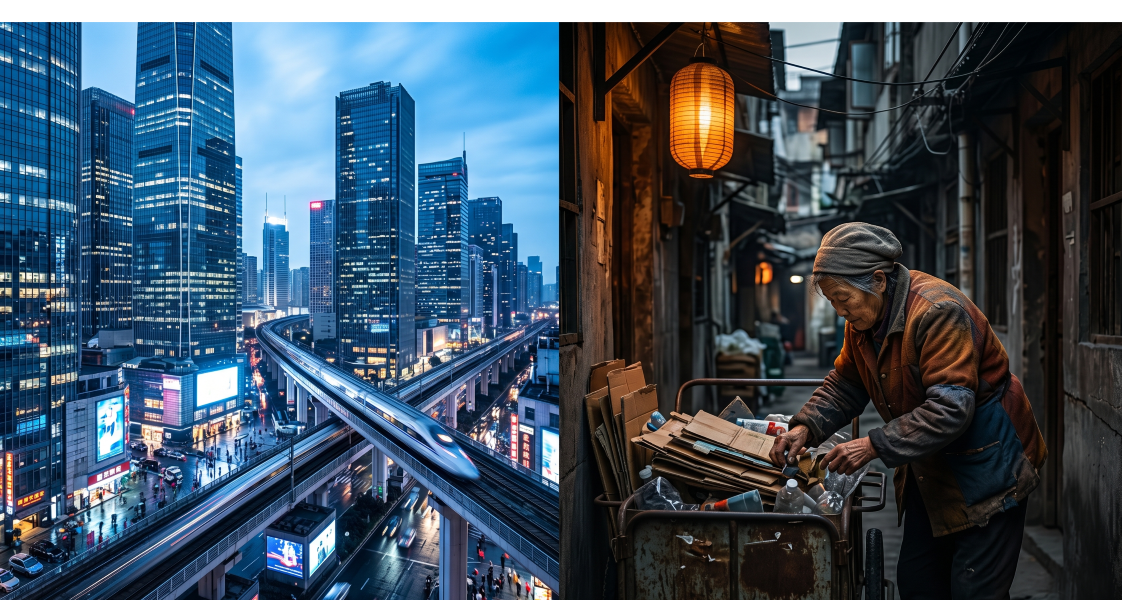
China Poverty vs Propaganda: The Inequality Crisis Exposed


Investigative Editorial | Geopolitics | China Poverty Watch
Skyscrapers Over Starvation: How China’s Propaganda Machine Is Losing the War Against Its Own Viral Reality
A wave of uncensored online videos showing elderly China poverty, street labour, and social despair is cracking the polished façade of the world’s second-largest economy — and Beijing is fighting to erase every frame
The videos are brief, unsteady, and filmed on mid-range smartphones. They do not carry the production value of Beijing’s celebrated state media documentaries. Yet they are, arguably, far more powerful. In one, a 78-year-old grandmother in Nanchong, Sichuan, cradles her monthly pension — 100 yuan, roughly $14 — and wonders aloud what food it will buy. In another, a visibly exhausted migrant worker, well past the age most would call retirement, carries building materials in 38-degree summer heat. In a third, a young graduate in Shanghai describes delivering meals on an electric scooter as “the most honest job I could find after three years of rejections.”
Each of these clips exploded online within hours of upload — and was deleted just as quickly. The Chinese internet, the most monitored information environment on earth, does not tolerate contradiction. But some leaked through: first to platforms not subject to the Great Firewall — X (formerly Twitter), YouTube, Reddit — and from there into international newsrooms, policy papers, and global public discourse. What they collectively reveal is an inconvenient truth that the Chinese Communist Party has spent billions of dollars concealing: that behind the bullet trains and the megacities, behind the Belt and Road and the semiconductor factories, there exists another China — one of grinding informal labour, pittance pensions, structural exclusion, and a generation of educated young people who cannot find work.
This editorial does not take viral clips at face value. Individual videos can be staged, exaggerated, or stripped of context. They must be treated not as proof, but as signals — signals that this investigation corroborates through credible international data, academic research, and independent reporting. What emerges is damning not because it is invented, but because it is verifiable.
I. The Gleaming Showcase: China’s Carefully Engineered Image
China’s propaganda architecture is among the most sophisticated in human history. The imagery it projects globally is formidable: 45,000 kilometres of high-speed rail — more than the rest of the world combined — a 5G network blanketing hundreds of cities, electric vehicle exports that now threaten European and American car industries, and infrastructure projects spanning 140 countries under the Belt and Road Initiative. GDP growth of 5 percent in the first quarter of 2026 was declared on schedule, and state media swiftly amplified the figure. China Daily, CGTN, and the Global Times — all party organs — produce daily content reassuring domestic and global audiences that prosperity is universal, socialism is delivering, and the Chinese Dream is within reach of every citizen.
Shanghai’s Pudong skyline, Shenzhen’s tech campuses, and the glass-and-steel corridors of Beijing’s Zhongguancun district are the images China projects abroad. They are real. China has achieved extraordinary feats of development that lifted hundreds of millions out of absolute China poverty between 1980 and 2020 — a fact acknowledged by the World Bank and most serious economists. The party declared total victory over extreme China poverty in 2021, pegging its benchmark at a rural income standard equivalent to $2.30 per day in 2017 purchasing power parity.
But here is the problem with that declaration: China poverty, and the human dignity it destroys, does not end because a government redraws a line on a chart.
II. The Other China: Rural Margins, Migrant Shadows, and Invisible Elderly
China’s official Gini coefficient — the standard measure of income inequality — stood at 0.465 in 2019, a number already well above the United Nations’ 0.4 “warning level.” Independent researchers and the World Inequality Database have consistently argued the true figure is higher still, when unreported income and capital concentration at the top of Chinese society are factored in. A 2014 study by Peking University found that just 1 percent of Chinese households held one-third of the nation’s wealth. A 2024 Stanford University and CSIS study documented growing public discontent with what respondents called an “unfair economic system.”
The rural-urban divide is structural and deliberate — engineered, in large part, by the hukou system, a household registration mechanism that tethers citizens’ access to education, healthcare, pensions, and social services to the place of their birth, not where they live or work. The World Bank’s December 2025 China Economic Update noted that urban per capita disposable income reached 41,183 RMB in the first three quarters of 2024, compared to just 16,740 RMB in rural areas. That is a ratio of nearly 2.5 to 1 — a chasm that has widened even as aggregate GDP figures have climbed.
The migrant worker cohort is perhaps the most visible and yet most legally invisible population in China. According to China’s own National Bureau of Statistics 2024 Migrant Worker Monitoring Survey, the country had 299.73 million migrant workers — nearly the entire population of the United States — with an average age of 43.2, and 31.6 percent of them aged over 50. These are the men and women who built the gleaming infrastructure. They pour concrete, stitch garments, process components, and clean hotel rooms. Yet the hukou system denies most of them access to urban social insurance at the rates urban workers receive.
The pension situation for rural and migrant workers is not merely inadequate — it is, for many, a sentence to labour until physical collapse. The national minimum standard for rural pension insurance was just 123 yuan per month in 2024, raised to 143 yuan in 2025 and 163 yuan in 2026. That is approximately $22 per month. The grandmother in the viral Nanchong video, shown with her 100-yuan monthly payment, was not an aberration. She was representative of a structural failure embedded in the architecture of the Chinese welfare state. The Council on Foreign Relations noted in January 2025 that China’s first generation of migrant workers “continue working intense labor jobs because their rural hukou denies them the better retirement benefits available to urban salaried workers.” The viral videos of elderly men pulling carts and elderly women sorting waste at roadsides are not isolated tragedies. They are retirement for hundreds of millions.
III. A Generation Betrayed: Youth Unemployment and the Lie of the Meritocracy
No dimension of China’s social crisis has generated more anxiety inside Chinese society — or more censorship from the Chinese state — than youth unemployment. In June 2023, the headline unemployment rate for urban youth aged 16–24 hit a recorded peak of 21.3 percent. Some economists, including those at the Atlantic Council, estimated the true figure reached 40 percent in rural regions, or as high as 50 percent when accounting for underemployment and part-time work. The government’s response to this data was instructive: it simply stopped publishing the statistic, suspending the release for six months before resuming in January 2024 with a revised methodology that excluded students from the calculation and no longer counted those working even one hour a week as “unemployed.”
Even with this redesigned — and, critics argue, deliberately deflated — methodology, youth unemployment climbed again to 16.9 percent in March 2026, the highest level since November 2025. In the 25–29 age bracket, unemployment rose to 7.7 percent. Meanwhile, nearly 12 million new graduates entered the Chinese labour market in 2024 alone. As The Diplomat noted in April 2026, “youth unemployment in China has left millions of graduates with little chance of finding employment, especially in jobs that suit their degrees.”
The cultural fallout has been profound. Terms like neijuan (involution — the endless competitive grind with shrinking returns) and tang ping (lying flat — opting out entirely) have become generational slogans. A viral song by an unnamed graduate declared: “I wash my face every day, but my pocket is cleaner than my face. I went to college to help rejuvenate China, not to deliver meals.” The song was banned. The singer’s platforms were silenced.
According to the United Nations High Commissioner for Refugees, the number of Chinese nationals seeking political asylum overseas climbed to 120,000 in 2023 — a twelvefold increase from the era of President Hu Jintao. In 2024, nearly 25,000 Chinese nationals were apprehended attempting illegal entry into the United States via its southern border. People do not cross deserts and risk detention to escape prosperity. They leave when they have concluded that the system at home has no place for them.
IV. Censoring the Truth: The War on “Negative Emotions”
When a viral video shows China poverty, the Chinese state has two instruments: deletion and prosecution. Both are deployed swiftly and without public explanation. Index on Censorship, in its Winter 2025 investigation, documented the fate of three high-profile content creators — dubbed the sanlianfeng (the three consecutive censures) — who were simultaneously banned from Chinese platforms in 2025. One, a cost-of-living vlogger named Hu Chenfeng, had first run afoul of censors in 2023 after filming the 78-year-old grandmother in Nanchong. The video “blew up within hours, with many viewers shocked at the level of China poverty that still existed in the country.” Within hours of its viral spread, it was deleted, and Hu’s accounts across multiple platforms were suspended.
- 2023 — Nanchong grandmother video: Footage of an elderly pensioner with 100 yuan monthly income went viral then vanished within hours. Vlogger Hu Chenfeng was banned across platforms.
- 2023 — Graduate protest song: Viral song addressing joblessness and graduate debt censored; accounts of singers shut down.
- 2023 — Migrant worker COVID case: The “hardest-working man in China,” a migrant who tested positive after months of intensive labour, was prevented from speaking to journalists. His wife’s home was staked out by state officials.
- 2025 — “Three consecutive censures”: Three unrelated popular creators simultaneously banned; a WeChat post by the Zhejiang Provincial Party Committee specifically targeted vloggers who “divided society into classes.”
- 2025 — “Negative emotions” internet campaign: China’s internet watchdog launched a systematic crackdown on influencers and platforms accused of “selling anxiety” online. China Media Project described it as lifting “the lid on the country’s obsessive and capricious control culture.”
- 2026 — “A Major Collapse Is Imminent” essay: A viral WeChat essay reflecting public anxiety over economic trajectory was repeatedly deleted; screenshots continued circulating despite bans.
The ideological framework for this censorship is revealing. Beijing’s concern is not merely political embarrassment — it is the fear that acknowledging structural inequality will corrode the party’s foundational legitimacy claim: that the CCP has delivered, and continues to deliver, universal prosperity to the Chinese people. China Media Project, which monitors state media closely, noted in January 2025 that one week of relentless state media articles on economic health prompted the observation: “Eight days, eight articles, eight assurances that China’s economy is thriving and everything is fine. When did confidence require this much convincing?”
V. The Propaganda Architecture: Projecting a China That Doesn’t Uniformly Exist
China’s global image machine is vast and sophisticated. CGTN broadcasts in multiple languages to 160 countries. The Global Times, China Daily, and Xinhua Agency maintain international editions that frame Chinese development as a model for the Global South. Thousands of foreign influencers have been recruited — sometimes transparently, sometimes through opaque third-party arrangements — to produce China-friendly content abroad. VOA News, in a March 2025 analysis, found that many foreign social media personalities cooperate with Chinese government entities or media companies to amplify CCP narratives about Chinese prosperity, innovation, and benevolent governance.
This propaganda machine is not wholly dishonest. China’s development achievements since 1978 are real and historic. Hundreds of millions did escape absolute China poverty. China does produce world-class technology, infrastructure, and manufacturing capacity. The error — and it is a deliberate one — lies in the universal framing: in presenting these achievements as evenly distributed, as experienced equally by the citizen in Shanghai’s Lujiazui financial district and the elderly farmer in Gansu province, the migrant worker in Dongguan, and the graduate from a third-tier city handing out food orders. They are not the same China.
The World Bank’s own poverty assessment noted that even after China’s 2021 declaration of victory over extreme China poverty, using a higher poverty line typical of upper-middle-income economies — the category China itself belongs to — 24.7 percent of the population in 2019 still lived below $6.85 per day. More than a third of that population lived in urban areas, invisible to official poverty metrics tied to rural classification. No new national China poverty line has been set since 2021, meaning tens of millions living in genuine hardship exist outside the statistical frame entirely.
VI. Why Viral Videos Matter — and How to Read Them Responsibly
Viral videos are not journalism. They are fragments — emotionally potent, contextually incomplete, and sometimes deliberately framed to provoke. The responsible editorial position is not to accept them uncritically, nor to dismiss them as propaganda from China’s detractors. The responsible position is to treat them as data points requiring verification against broader structural evidence — and the broader structural evidence, as this investigation demonstrates, overwhelmingly supports the picture these clips suggest.
When a video of an elderly woman sorting waste at a roadside in Chengdu is consistent with World Bank data showing rural pension payments of under $22 per month, and with NBS data showing over 30 percent of China’s 299 million migrant workers are above age 50 with minimal pension security, the video is not propaganda. It is a window. When a video of a 26-year-old graduate delivering e-commerce packages in Wuhan aligns with a youth unemployment rate of 16.9 percent and 12 million new graduates entering a saturated market, the video is not an anomaly. It is a data point that the official statistics themselves, however reluctantly, confirm.
The videos that slip through China’s censorship apparatus matter precisely because of the ferocity with which they are erased. A government that has nothing to hide does not deploy an army of content moderators, platform algorithms, and propaganda officials to eliminate footage of an old woman counting her pension. A government with nothing to hide does not launch a national campaign against “negative emotions.” The censorship is itself the confession.
VII. The Question the World Must Ask
China demands to be judged by its GDP. By that measure, its case is strong: the world’s second-largest economy at $18 trillion and counting, growing at 5 percent annually in an era of global slowdown. But GDP is an aggregate measure. It does not tell you where the growth lands, who captures the gains, or what life is like for the 300 million migrant workers whose labour built every bullet train station and every industrial park in that GDP figure.
The World Bank’s December 2025 China Economic Update made clear that unemployment insurance covers only 47 percent of urban employees — almost entirely those in the formal sector — and provides “little protection for migrant workers.” Rural migrants and informal workers receive pension payments equivalent to 12 percent of per capita rural income. Job creation in construction and services has slowed, hitting precisely the sectors that absorb low-skilled and migrant workers hardest. These are not the figures of a uniformly prosperous society. They are the figures of an economy where prosperity has been spectacularly achieved for some, and spectacularly withheld from others.
Conclusion: Power Is Not Prosperity, and GDP Is Not Dignity
China is, by every measurable aggregate, a powerful nation. Its engineering, its manufacturing scale, its diplomatic reach, and its technological ambition are not fabrications. They are real, and they deserve acknowledgement. No serious analysis of the 21st century can dismiss the scale of what China has built.
But power is not the same thing as social equality. A skyscraper does not erase the Chna poverty at its shadow. A bullet train is of limited comfort to an elderly migrant worker who cannot afford the ticket, whose pension is 163 yuan per month, and whose lifetime of labour built the tracks but did not earn her the right to retire on them.
The viral videos circulating online are not an information war. They are not fabrications by hostile foreign powers. They are, in most verifiable cases, exactly what they appear to be: fragments of a China that the Communist Party has decided you are not permitted to see. When a government responds to images of an old woman’s poverty by deleting the footage, arresting the filmmaker, and launching a national campaign against “negative emotions,” it has told the world, far more clearly than any opposition report or academic paper ever could, what it is afraid of.
It is afraid of the truth. And the truth — verified by the World Bank, the Council on Foreign Relations, the Atlantic Council, China’s own National Bureau of Statistics, and hundreds of millions of lived experiences — is that the Chinese Dream has not arrived for everyone. For many, it remains exactly that: a dream, broadcast on a screen, while they count their 163 yuan.
— News24Media Investigative Desk | news24media.org
World Bank. China Economic Update, December 2025.
World Bank. China Poverty and Inequality Platform — China. pip.worldbank.org (accessed June 2026)
Council on Foreign Relations. What Is the Chinese Pension System and Why Are Its Problems Hard to Fix? CFR.org, January 2025
Atlantic Council. Youth Unemployment in China: New Metric, Same Mess. February 2026
The Diplomat. As China Ages, a Pension Crisis Looms. February 2026
The Diplomat. China’s Economy: By the Numbers. April 2026
Asia Society Policy Institute. The 19 Percent Revisited: How Youth Unemployment Has Changed Chinese Society. September 2025
Index on Censorship. China Is Punishing Online Influencers for Spreading Doom and Gloom. December 2025
China Media Project. chinamediaproject.org, January 2025
Newsweek. 20 Million Gen Z Are Jobless in Urban China. December 2025
Foreign Policy. China’s Pensions System Is Buckling Under an Aging Population. June 2023
National Bureau of Statistics of China. 2024 Migrant Worker Monitoring Survey.
National Bureau of Statistics of China. Youth Unemployment Data (revised methodology). January 2024–March 2026
Wikipedia / Stanford University / CSIS. Income Inequality in China. Citing Peking University (2014) and Stanford/CSIS (2024)
VOA News. Foreign Bloggers Help China Spread Propaganda. March 2025
MERICS. Too Little, Too Late? China’s Pension System. 2024
Vision Times. Viral Essay Warning of ‘Impending Collapse’ Ignites Debate in China. March 2026
Discover more from
Subscribe to get the latest posts sent to your email.