
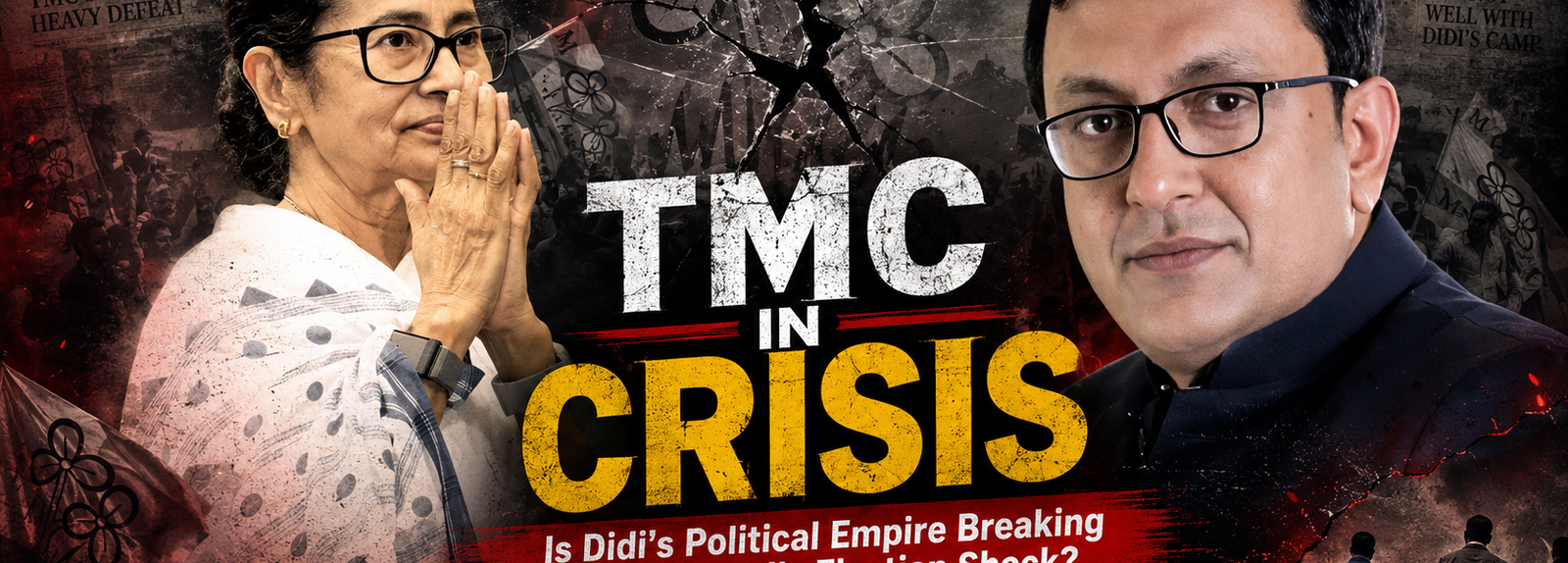


TMC After Defeat: Is Bengal Witnessing the Final Collapse of Didi’s Political Empire?
With 61 of 80 MLAs absent from Mamata Banerjee’s own meeting, forged signatures alleged on official documents, and rebel legislators reportedly claiming the “real TMC” identity — the party once called Bengal’s political mountain now looks, to many observers, like shifting sand.
There is a particular cruelty in political collapse. It is rarely dramatic. It does not arrive with a single earthquake. It arrives like the slow withdrawal of a tide — and only when the water is gone does the world see what was always buried underneath. If political observers watching West Bengal are to be believed, the Trinamool Congress is not merely facing the morning after a lost election. It may be experiencing the gradual withdrawal of the tide that kept it alive: the fear, the loyalty, and the narrative that held its many moving parts together.
On the evidence now accumulating in the public domain, what is unfolding inside the TMC is not a story about electoral arithmetic. It is a story about the nature of power itself — about what happens when a party built more on dominance than on doctrine, more on dread than on doctrine, suddenly finds itself without the instruments that made its dominance possible.
— I — The Meeting That Nobody Came To
In the calculus of Indian politics, few signals are as unambiguous as absence. When legislators stop appearing before their party chief, they are not being absent-minded. They are sending a message — one that requires no press conference, no public declaration, no signed letter of rebellion. They are communicating through empty chairs.
Reports indicate that when Mamata Banerjee convened a key legislative party meeting in the immediate aftermath of the election defeat, 61 of the TMC’s 80 MLAs simply did not attend. The meeting had to be postponed. To appreciate the political weight of this number, consider what it means: a gathering of legislators who built their careers on her name, fought elections on her face, and won seats using her symbol — and the majority of them chose, on a critical occasion, to stay away.
Political observers believe this is not a sign of logistical inconvenience. In Indian political culture, the loyalty of a legislator is measured not by their speeches but by their physical proximity to the party leader at moments of TMC crisis 2026. Absence, in this context, is a vocabulary. And the vocabulary being spoken by 61 legislators, according to reports, is: we are not certain we are still with you.
“When 61 of 80 legislators stay away from their leader’s meeting, they are not being forgetful. They are auditioning for a new political home — in full public view.”
— News24Media Editorial Analysis
— II — The ‘Forged Signatures’ Scandal and the Fracture Lines Within
The TMC crisis 2026 sharpened dramatically around a controversy that political observers describe as deeply symbolic of how badly internal trust has eroded. Reports suggest that in connection with the appointment of the Leader of Opposition in the Bengal Assembly, a letter purportedly endorsing Mamata Banerjee’s choice — party loyalist Sobhandeb Chattopadhyay — was submitted to the Speaker. West Bengal’s Chief Minister Suvendu Adhikari subsequently claimed that two TMC MLAs, Ritabrata Banerjee of Uluberia Purba and Sandipan Saha of Entally, had alleged that their signatures on this document were forged. Reports further indicate that around twenty signatures on the letter were disputed.
The TMC’s response was swift: both legislators were expelled from the party on grounds of alleged anti-party activities. But critics argue the haste of the expulsion suggests anxiety, not confidence. In political management, when a leader quickly expels dissenters rather than negotiating with them, it is often a sign that the leader fears what prolonged negotiation might reveal about the true distribution of support within the organisation.
A CID probe into the alleged forgery was reportedly ordered. The optics of the situation — a party in opposition, fighting allegations of document forgery in its own internal processes — are devastating for an organisation that once projected an image of iron-willed command.
— III — The ‘Didi-Bhaipo’ Model: When Centralisation Breeds Resentment
To understand why the TMC’s internal architecture may be crumbling with such speed, one must examine the model of power that built it. For over a decade, the TMC has operated as what political scientists might call a hyper-centralised party — one in which authority flows almost exclusively from two figures: Mamata Banerjee, the undisputed supremo, and her nephew Abhishek Banerjee, who critics have long argued has wielded disproportionate influence over candidate selection, organisational appointments, and party finances.
This model delivered electoral victories. But there is growing speculation that it also systematically hollowed out the party’s internal democratic structure. Senior leaders, veterans who built the TMC in the ground war of its early years against the Left Front, are said to have felt marginalised, overlooked, and treated as instruments of mobilisation rather than partners in governance. When such leaders win their own legislative seats and then discover that the party’s direction continues to be controlled by a narrow inner circle, the seeds of resentment are sown.
TMC stalwart Sukhendu Shekhar Ray has reportedly come out openly against Mamata Banerjee’s current leadership structure. TMC spokesperson Santanu Sen is said to have quit his role. These are not anonymous foot soldiers expressing grievance. These are recognisable party figures whose departure — or even whose public dissent — signals to other legislators that the cost of loyalty may now exceed the cost of rebellion.
Key fault lines political observers are watching
- Reports suggest approximately 50 TMC MLAs are in active contact with the two expelled rebel legislators — Ritabrata Banerjee and Sandipan Saha — who are reportedly positioning themselves as an alternative power centre.
- There is growing speculation that rebel MLAs may attempt to reach the two-thirds threshold (53 of 80 legislators) required under anti-defection provisions to claim a split and stake a legal claim to the TMC identity and its election symbol.
- Political observers note that this mirrors the 2022 Maharashtra template, where Eknath Shinde led rebel Shiv Sena MLAs, claimed the “real Shiv Sena” before the Election Commission, and ultimately won both the party name and the poll symbol.
- Senior TMC figures including Sukhendu Shekhar Ray and former spokesperson Santanu Sen have reportedly distanced themselves from the current party leadership, signalling widening dissent beyond the legislative party.
- There is growing speculation that MPs from both Houses may also be privately exploring political alternatives, though no confirmed defections from Parliament have been reported at the time of publication.
— IV — The ‘Real TMC’ Gambit: A Maharashtra Moment for Bengal?
The political development that is generating the most intense speculation — and the most consequential constitutional implications — is the reported possibility that a large bloc of TMC legislators may attempt to claim the party’s identity for themselves, effectively arguing that they are the authentic Trinamool Congress rather than the faction remaining with Mamata Banerjee.
Political and constitutional observers note that this is not an unprecedented manoeuvre in Indian democracy. In 2022, a faction of Shiv Sena MLAs led by Eknath Shinde broke away from the Uddhav Thackeray camp, claimed to be the real Shiv Sena, and ultimately won that claim before the Election Commission — acquiring both the party name and its iconic bow-and-arrow symbol. The TMC’s situation invites direct comparison.
Under the Tenth Schedule of the Constitution, a split faction can avoid disqualification if at least two-thirds of a party’s legislative members support it. For the TMC, that threshold is 53 of its 80 MLAs. Reports, which News24Media has not independently verified, suggest that rebel leaders believe they have or can secure support approaching or exceeding that threshold. If these developments are true, the constitutional and political consequences for the TMC would be profound — extending well beyond Bengal’s Assembly to potentially affect the party’s Rajya Sabha presence, its recognised status as a national party, and its long-term organisational survival.
“A party built on power rather than principle finds, when the power departs, that there is very little left to hold it together. The glue was always the patronage. Without it, the architecture simply dissolves.”
— Political Observer, cited in editorial analysis
— V — The Collapse of Fear: When the Strongman’s Shadow Retreats
Perhaps the most profound — and most underexplored — dimension of the TMC’s post-election TMC crisis 2026 is not organisational but psychological. Critics have long argued that the TMC’s political dominance in Bengal was sustained not merely by electoral popularity but by an architecture of fear: local syndicate networks, alleged intimidation of opposition workers, concentrated control over patronage flows, and a perception among ordinary voters and party cadres alike that challenging the TMC carried consequences.
When fear is the primary binding agent of a political structure, the structure’s resilience is directly correlated to the credibility of that fear. The moment voters collectively demonstrate — through a democratic verdict — that they are no longer afraid to vote against the incumbent, the foundational logic of the entire system is disrupted. A legislator who once feared the consequences of challenging party leadership now calculates differently. A local party functionary who once intimidated opposition voters now wonders whether the power that gave him that licence is truly gone.
The 2026 election verdict appears to have done precisely this. It has not merely removed the TMC from power. It has, if political observers are correct, removed the fear. And when the fear goes, critics argue, the loyalty that was rooted in fear goes with it. What remains is a calculation of survival — and survival, in the post-verdict Bengal, increasingly points away from Mamata Banerjee.
— VI — The People’s Verdict and the Weight of Democratic Memory
It would be incomplete to analyse the TMC crisis 2026 purely as an internal organisational failure without examining what the voters of Bengal were communicating through the 2026 election outcome. Democratic elections, when they produce decisive results, are rarely only about policy disagreements. They are frequently about accumulated grievances — about years of behaviour that was tolerated because there appeared to be no alternative, and which is now being repudiated precisely because an alternative has emerged.
Political analysts believe the Bengal voter was, in this election, casting a vote weighted with memory: memory of alleged violence during panchayat elections, of families that lost breadwinners in post-poll violence, of corruption allegations that attached themselves to the ruling apparatus at every level from the municipal ward to the secretariat. The RG Kar Medical College tragedy and the public anger it generated — particularly among women voters — is cited by several commentators as a watershed moment that crystallised a deeper crisis of moral credibility for the TMC government.
When a government loses not just votes but legitimacy in the public imagination, its political party faces a challenge that no reorganisation committee can resolve. The question is not how to win the next election. The question is whether the party has the moral authority to claim to speak for the people it governed.
Centralised leadership accused of suppressing internal democracy; loyalty historically fear-based; no clear ideological alternative to BJP; party symbol and identity now legally contestable; no credible next-generation leader beyond Abhishek Banerjee, who is himself a source of internal resentment.
Mamata Banerjee remains a personally popular and politically experienced figure with a loyal grassroots base; the “jora ghas phool” symbol retains emotional resonance for many Bengal voters; BJP’s own governance record in Bengal will now be scrutinised; and a disorganised opposition — even a wounded one — can survive if the ruling party stumbles early.
— VII — Thin Paper Under Pressure: The Ideology Gap
There is an image that keeps returning to those watching the TMC’s current condition: a sheet of paper — crisp, white, projecting an impression of solidity — that under sustained pressure simply tears. The TMC’s projected image was one of a mountain: immovable, all-encompassing, with no visible cracks. The image was always, critics say, an illusion of political stagecraft.
Parties that are built primarily around one individual, and which accumulate power without developing a distinct ideological identity, share a structural vulnerability. When the individual around whom the party is built suffers a significant reversal, there is no ideological gravity to hold the organisation together. The CPM, for all its failures, could withstand electoral defeats because it had a doctrine, a cadre system, and an internal democracy that survived beyond any single leader. The Congress, despite decades of decline, retains an organisational skeleton built around institutional memory and a historic identity.
The TMC, according to critics, has neither. What it had was Mamata Banerjee and the power she commanded. Without that power — or even with the credibility of that power now in question — the party lacks the ideological infrastructure to hold its legislators in orbit. They were drawn by the gravitational pull of a winner. That gravity has weakened. The orbits are decaying.
— VIII — A Political Roller Coaster: What Comes Next for Bengal
Whatever the final outcome of the immediate internal crisis, West Bengal is almost certainly entering a period of significant and unpredictable political realignment. The patterns are familiar to students of Indian political history, but they will play out with Bengal’s particular intensity.
In the near term, political observers expect the following: legal battles over the TMC’s official recognition and party symbol before the Election Commission; competing claims over which legislative faction represents the authentic party; potential defections of Rajya Sabha MPs; a protracted struggle over the Leader of Opposition position in the Bengal Assembly; and attempts by the new BJP government under Chief Minister Suvendu Adhikari to manage the defection process in ways that maximise its own political advantage while minimising constitutional complications.
In the medium term, if the split materialises at the scale currently being speculated about, Bengal could witness the kind of political reconfiguration that Maharashtra experienced between 2019 and 2024 — a prolonged, messy, deeply personalised process of factional conflict, legal wrangling, and ideological reinvention that exhausts all parties involved and leaves the political landscape fundamentally transformed.
— IX — The Legacy Question: What History Will Say of Mamata Banerjee
It would be neither accurate nor fair to reduce Mamata Banerjee’s political legacy to the TMC crisis 2026 of this moment. She is, by any measure, one of the most consequential political figures in independent India’s history. She single-handedly ended thirty-four years of Left Front rule in Bengal — a feat that had seemed structurally impossible for decades. She built a political organisation from the ground up, survived assassination attempts, political exile, and repeated predictions of her irrelevance. She delivered three successive Assembly majorities in a state that had never before given a single party that achievement.
But legacies are written across the full arc of a political career, and the arc of Mamata Banerjee’s career has entered a phase that even her admirers acknowledge is deeply fraught. The concentration of power around the Banerjee family, the alleged democratic deficits within the party structure, the governance failures that critics argue accumulated into the 2026 verdict — these are now part of the record.
There is growing speculation among political observers that the weight of the “Bhaipo” factor — the perception that Abhishek Banerjee’s centralised influence over the party machinery generated more internal resentment than political benefit — will be identified in retrospect as the critical organisational error that accelerated the party’s decline. A leader who spent thirty years in defiant independence has, in the estimation of critics, allowed the concentration of succession-related power to undermine the very organisation she built.
Whether Mamata Banerjee can reverse this trajectory — whether she possesses the political cunning, the personal resilience, and the strategic flexibility to lead a meaningful opposition from a position of significant weakness — remains genuinely open. She has confounded predictions of her demise before. But the tools available to her now are fundamentally different from those she wielded in 2011 or even 2021. She no longer commands the patronage machinery of government. She no longer has the persuasive power that comes with the ability to reward loyalty. And reports suggest she may no longer have the singular authority within her own party that was the foundation of everything else.
“The real TMC crisis 2026 is not that it lost an election. It is that it may have lost the fear, the narrative, and the loyalty that made the party possible in the first place. Elections can be refought. Those three things are not so easily recovered.”
— News24Media Editorial Conclusion
Bengal is watching. India is watching. And in the empty chairs of a meeting room where 61 legislators chose not to appear before their party chief, the most important political story of 2026 is quietly, and irreversibly, being written.
Whether the Trinamool Congress survives this moment as a viable political force, or whether it fractures into competing claims, legal disputes, and historical footnotes — that story is not yet finished. But the opening chapters are alarming enough that those who care about Bengal’s political health, and about the quality of democratic opposition in the state, have every reason to watch the next few weeks with the closest possible attention.
Discover more from
Subscribe to get the latest posts sent to your email.






2 COMMENTS