
West Bengal Politics: Is the Era of Fear and Political Drama Finally Over? | News24Media


West Bengal Politics: From Street Drama to Sympathy Politics — Is Bengal Moving Beyond Fear?
Two TMC leaders. Two alleged attacks. One week apart. As Bengal’s new BJP government settles into office, the opposition’s response has reopened a far older question: In a state where political theatre has long substituted for governance, will voters finally demand something different?
Bengal has always been a theatre state. Its politics have historically moved not through dry policy debates but through pageants of emotion — the roadside rally, the tearful public address, the dramatic injury that galvanises a crowd. It is a state where optics and sentiment have often governed more powerfully than any gazette notification. And yet something appears to have shifted. In the third week of May 2026, two extraordinary episodes unfolded within days of each other, both involving senior Trinamool Congress leaders, both framed as political attacks, and both drawing a public response that was — unlike the past — met not with outrage and sympathy, but with widespread scepticism and, in some corners, open ridicule.
The question Bengal’s politically aware citizens are now quietly asking is not whether these incidents occurred, but what they mean — and why they happened now.
A Helmet, a Torn Shirt, and a Nation Watching
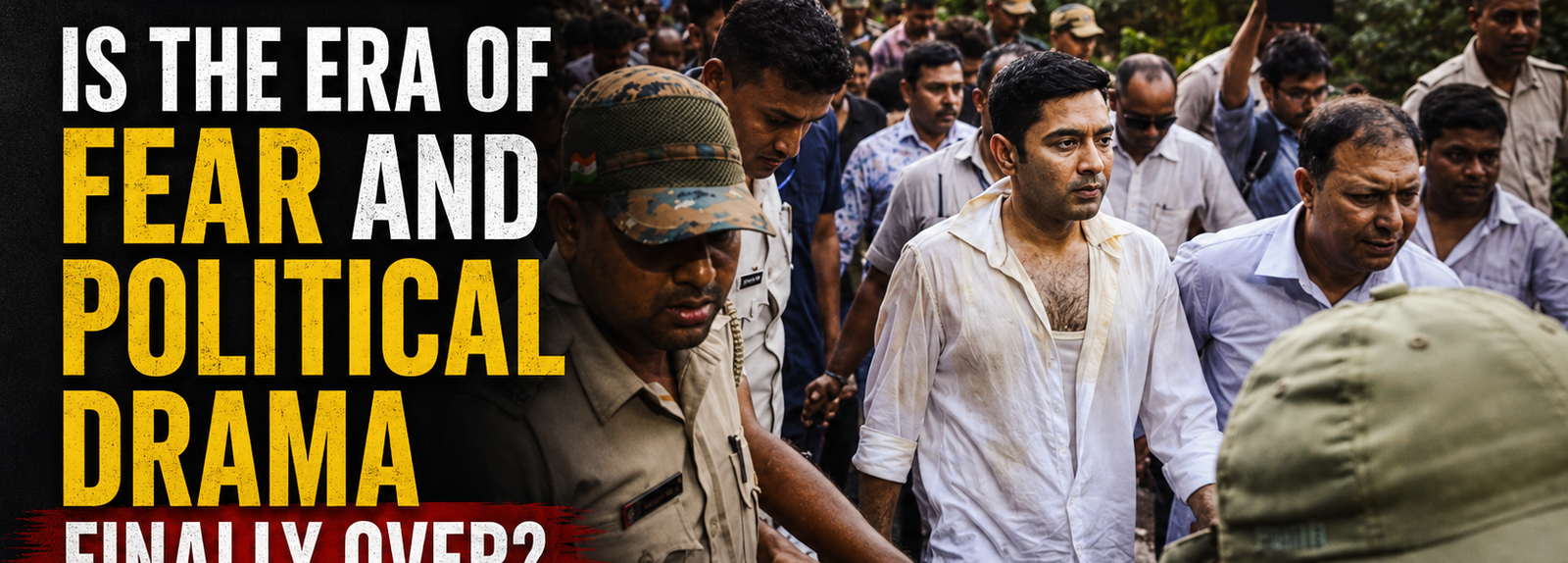
The images of Trinamool Congress national general secretary Abhishek Banerjee — wearing a police helmet, his shirt visibly tattered — circulating from Sonarpur in South 24 Parganas were striking in ways that went beyond political violence. Reports confirm that stones, shoes, and eggs were hurled at the TMC MP when he visited families affected by post-poll violence, and several persons have since been arrested. TMC leaders promptly framed the incident as a BJP-orchestrated “attack on democracy,” and Abhishek Banerjee himself alleged his security had been withdrawn on the day of the incident.
Yet the optics raise questions that even sympathetic observers have not been able to ignore. Here was a senior political leader — the Lok Sabha leader of the second-largest Opposition party, travelling with armed police escort — appearing live on national television wearing protective headgear and displaying a tattered garment. The public may reasonably ask: if security was present, how complete was the breakdown? If security was absent, was that absence known in advance, and if so, why proceed? Critics argue that seasoned political communicators are acutely aware of how images circulate, and that the choice to appear before cameras at that precise moment, in that precise condition, reflects a deliberate communication strategy rather than spontaneous distress.
“Drama and politics have always been companions in Bengal. The question is whether the audience has finally begun to distinguish between the performance and the performer.”
— News24Media EditorialThe BJP, now governing Bengal, has dismissed much of this as theatre. Senior party figures and newly inducted ministers have alleged that individuals close to a former TMC MLA from Sonarpur South were among those arrested — raising the uncomfortable suggestion, not yet proven, that the perpetrators may have had internal rather than purely external motivations. These claims are contested and investigation is ongoing. But the mere fact that they are being stated publicly, and not immediately laughed out of the room, speaks to how dramatically the political confidence of Bengal’s new ruling dispensation has changed.
The Chanditala Episode: When Videos Speak Differently
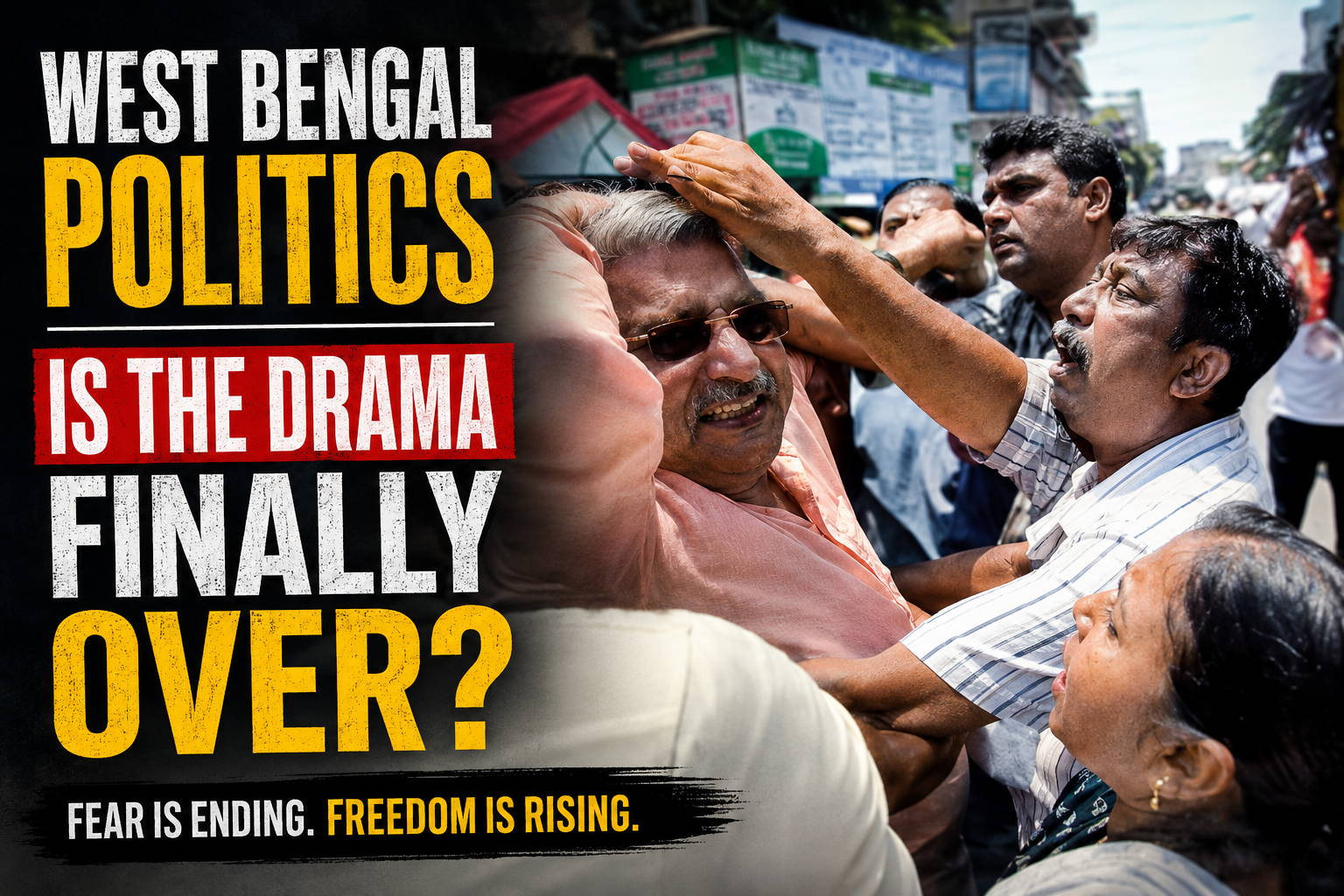
If the Sonarpur episode was contested, what followed with TMC MP Kalyan Banerjee was, for many observers, even more difficult to process. The Serampore MP, a senior figure and practicing lawyer, alleged he was attacked and injured near Chanditala Police Station in Hooghly district on May 31, characterising the incident as an “attempt to murder” by BJP workers. He pressed a handkerchief to his head and sat in protest outside the police station.
West Bengal minister Dilip Ghosh, reviewing the same incident, was categorical: “Everyone saw that no one pushed him nor attacked him.” More pointedly, videos from the scene — widely circulated on social media — appear to suggest that no clear projectile or physical contact is visible at the moment Kalyan Banerjee loses his balance. The BJP’s West Bengal social media unit dismissed the claims as “drama.” Critics argue that the visual gap between the alleged attack and the visible evidence demands explanation.
- May 31 — Abhishek Banerjee allegedly attacked with stones, shoes and eggs at Sonarpur, South 24 Parganas; five arrested.
- May 31 — Kalyan Banerjee alleges head injury outside Chanditala Police Station, Hooghly; BJP calls it “drama.”
- June 1 — Minister Dilip Ghosh states on record that “no one attacked” Kalyan Banerjee.
- June 1 — Mamata Banerjee alleges police are pressuring TMC MLAs to defect to BJP; BJP rejects the charge.
- June 2 — Opposition regrouping continues against the backdrop of BJP’s 206-seat mandate in the 294-seat House.
That Kalyan Banerjee is known for theatrical interventions is not new. His conduct in Parliament — from mimicking voices to delivering impassioned monologues — has made him a figure simultaneously admired and satirised. But theatrical capacity in a legislative chamber is one thing. Theatrical capacity at a police station, on video, in a political environment where every frame is scrutinised and archived, is quite another. The public may reasonably ask whether a senior lawyer and parliamentarian, fully aware of evidentiary standards, would not also be acutely aware of what cameras capture.
The Politics of Victimhood in a Post-Fear Bengal
To understand why these incidents matter, one must understand what they are designed to accomplish. Political victimhood — the art of making a leader appear persecuted — is among the most powerful emotional levers in democratic politics. It unifies a base. It generates media attention. It reframes electoral defeat as unjust suppression rather than democratic rejection. And in Bengal’s case, it carries an additional resonance: this is a state with genuine and documented post-poll violence, where the suffering of ordinary political workers is real and raw.
The TMC’s communication calculus, critics argue, has been to conflate the genuine suffering of its ground-level workers with the orchestrated imagery of its senior leadership. When Abhishek Banerjee appears in a police helmet before cameras, the intent — regardless of what actually transpired — is to associate his image with the vulnerability of every TMC worker who has genuinely faced violence. It is a sophisticated move. But it is also one that assumes the audience is still operating on its old emotional settings.
That assumption, more than anything else, may be the TMC’s most significant miscalculation in the post-2026 period. The public that voted in the 2026 Assembly election had already processed years of what critics describe as political arrogance: the casual dismissal of opposition voices, the language of intimidation that filtered down from leadership to local cadres, the weaponisation of administration, the culture of fear that silenced communities. Voters remember. And voter memory, unlike newsprint, does not fade with the next news cycle.
Public Memory and the Long Shadow of Political Arrogance
For any political leadership to successfully claim victimhood, it must first have established a prior image of vulnerability. The TMC, in its fifteen-year tenure, largely built the opposite image. It built an image of power — sometimes brazen, sometimes ruthless, and sometimes genuinely effective in its delivery of social welfare. The party brought electricity to villages, expanded the Kanyashree programme, and generated genuine goodwill in its early years. But the memory of that goodwill has been steadily eroded by what many voters experienced as a creeping culture of impunity.
Sympathy, ultimately, is a product of credibility. And credibility, once depleted, cannot be instantly replenished by a dramatic public appearance. The public may reasonably ask: when those in power spoke of teaching their opponents lessons they would “remember for life,” when syndicate politics ruled municipal contracts, when police were perceived as instruments of party discipline rather than public protection — were those the actions of a party now genuinely threatened by stones? Or is this something else?
“Bengal may now be entering a phase where the voter is less moved by the sight of a torn shirt and more interested in the state of a torn road.”
— News24Media EditorialBeyond Appeasement: The Grammar of West Bengal Politics Is Changing
The BJP’s 206-seat mandate in a 294-seat House is not merely a numerical fact. It is a civilisational statement from a state that has for decades been told its politics must pass through the prism of community mobilisation, identity arithmetic, and competitive appeasement. The verdict signals that a significant section of Bengal’s electorate has decided to recalibrate that calculus. They appear to have voted not for a specific ideology in every detail, but for the principle that governance — actual governance — must be placed at the centre.
This places the TMC in a genuinely difficult transition. The party must now function as an opposition without the administrative machinery it used to frame the rules of political engagement. It must find ways to articulate public grievances without the instruments of power it previously deployed. And it must do so before an electorate that, having experienced fifteen years of one political culture, is now calibrating what the next chapter should look like.
The resort to sympathy politics — attacks, injuries, dramatic press moments — is, in this reading, less a confident strategy than a reflex. It is what this political culture knows how to do when it cannot do what it previously did. But Bengal’s voters may have moved further than its leaders realise.
The New Administration: Promise, Pressure, and the Proof of Time
Chief Minister Suvendu Adhikari, sworn in on May 9, 2026 — coinciding with Rabindranath Tagore’s birth anniversary in a choice that carried obvious symbolic weight — has moved with visible energy in his administration’s opening weeks. The rollout of Ayushman Bharat, long withheld from Bengali citizens by the previous government, was among the first Cabinet announcements. Centrally funded schemes including PM SHRI, Vishwakarma, Beti Bachao Beti Padhao, and Ujjwala Yojana were also cleared for state implementation. These are meaningful early gestures.
The cabinet composition reflects political balances that will need to be navigated carefully. Dilip Ghosh at Panchayats and Rural Development places him at the heart of grassroots Bengal — both its potential and its complexities. Nisith Pramanik’s inclusion signals the value placed on political continuity and centre-state coordination. These are competent appointments on paper. Whether they translate into administrative transformation on the ground is a question only time — and sustained performance — can answer.
It would be neither accurate nor fair to judge a three-week government by the standards of a settled administration. What can be said is that the new government has created early symbolic capital. The more significant test — law and order restoration in violence-affected districts, administrative de-politicisation, employment generation, educational infrastructure, and the courage to act on corruption regardless of political affiliation — lies ahead. Bengal’s voters have demonstrated they are capable of making bold choices. They will be equally capable of reversing them if promises remain theatrical.
Can Bengal Move From Theatre to Administration?
The central question of this political moment is not about Abhishek Banerjee’s shirt or Kalyan Banerjee’s handkerchief. Those are symptoms. The central question is whether Bengal — a state of extraordinary intellectual and cultural richness, a state that gave India its finest literary tradition, its strongest labour movements, its sharpest political debates — can finally insist that its democratic conversation be about roads, schools, hospitals, jobs, justice, and the quality of a child’s morning in a government classroom.
The opposition must eventually ask itself whether sympathy dramas serve its long-term interests, or whether they accelerate its own marginalisation in a changed political environment. The ruling party must simultaneously resist the temptation to believe that winning a mandate is the same as earning sustained public trust. Trust is not granted by ballot; it is earned by performance.
Bengal has always had great drama. What it has historically lacked is great governance. The two have coexisted in a system where political theatre filled the vacuum that administrative competence should have occupied. The 2026 election may or may not have changed that equation permanently. But it has, at minimum, sent a clear signal: the stage has shifted, the audience has different expectations, and the actors — all of them — are on notice.
Bengal is not asking for perfect government. It is asking for honest government. The distance between those two phrases — honest and perfect — is precisely where the next chapter of this state’s politics will be written.
Discover more from
Subscribe to get the latest posts sent to your email.





2 COMMENTS