
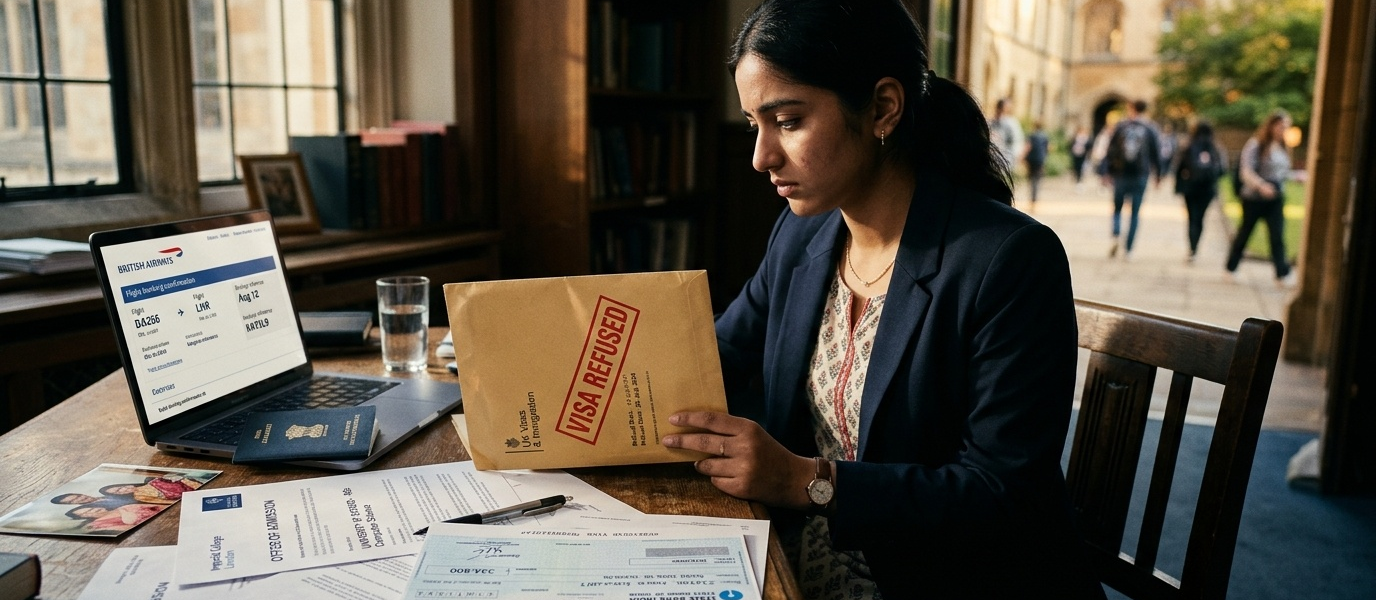
Student Visa Rejection Financial Loss: Why Indian Students Must Not Pay Fees Before Visa Approval


Pay First, Pray Later: student visa rejection
Why Indian Students Must Demand Visa Certainty Before Any Fee
Every year, hundreds of thousands of Indian families invest their dreams — and often their life savings — into a single ambition: securing a world-class degree from a university in the United States, the United Kingdom, Europe, or Singapore. The journey begins with months of painstaking preparation: entrance exams, statements of purpose, recommendation letters, and the electric joy of an acceptance email from a foreign institution. Then comes the moment no one adequately warned them about — the demand for money, far before any government has agreed to let their child into the country.
This is the study abroad visa trap. It is not a conspiracy. It is a system — and it is quietly devastating thousands of Indian families every year.
The Numbers Behind the Pain
In 2024, Indian travellers — students at the core of this figure — lost an estimated ₹664 crore to student visa rejections. The US denied 41 percent of all F-1 student visa applications in FY 2023–24, the highest rate in a decade. Indian approvals for that visa fell by a staggering 69 percent in the summer of 2025. Canada, once a reliable second destination, now rejects 74 to 80 percent of Indian study permit applications — up from 32 percent just two years ago. The UK has tightened its Graduate Route. Australia has raised its visa fee to AUD 2,000. Yet almost nobody is asking the question that should precede all of this: why are students paying significant sums of money before their visa is even applied for?
“The only condition under which a student should pay any significant fee to a foreign university is when the visa is approved — or when a written, unconditional refund guarantee in the event of visa refusal is already in hand.” News 24 Media Research
The Anatomy of the Trap
When a student receives an offer letter from a prestigious foreign university, euphoria overwhelms caution. Universities then typically issue a deadline — often just 14 days — to pay a tuition fee deposit, which can range from £2,000 to £5,500 for UK institutions and the equivalent in US, European, and Singapore cases. The deposit, in most published policies, is described as “non-refundable.” The fine print — buried in refund policy documents few students ever read — often does provide for a refund on visa refusal, but with conditions: tight claim deadlines, administrative deductions of up to £500, and categorical exclusions for anything deemed fraudulent. Meanwhile, the student has also rushed to book accommodation — another large advance — and has paid a consultant fee of ₹50,000 to ₹1.5 lakh that no one will ever return. By the time the visa refusal arrives, the family is not just heartbroken. They are ₹3 lakh to ₹10 lakh poorer, with nothing to show for it.
The Consultant Crisis Within the Crisis
Behind many such cases is an unregulated education consultant operating in a regulatory vacuum that India’s Ministry of Education has yet to close. With no mandatory licensing framework, no bonding requirements, and no national grievance portal, an entire industry of agents has flourished — collecting fees upfront, making guarantees no sovereign immigration authority can honour, and in the worst cases, submitting fabricated documents that not only cause a visa refusal but trigger multi-year bans that end a student’s study-abroad prospects entirely. The collapse of GrowPro — an international student placement company that collected fees before visa approvals and shut down in February 2025 after its 50 percent student visa rejection rate drained its refund reserves — is a cautionary tale that should have made international headlines. It barely made a footnote.
What Must Change — Now
The principle that should govern every international student’s financial decision is simple and non-negotiable: the visa must come before the payment. No deposit, no accommodation advance, no pre-sessional fee, no flight booking — until the student has an approved visa stamp or, at minimum, a written In-Principle Approval from the immigration authority. If a university’s deposit deadline falls before visa clearance is possible, students must write to the International Admissions Office and request a documented extension, citing the visa timeline. Many universities will grant this. Those that will not should be evaluated accordingly.
India’s Ministry of External Affairs must build a publicly accessible student financial protection portal — listing verified university refund policies, registered consultants, and a fast-track complaint mechanism. Bilateral education agreements with the US, UK, and Singapore should include visa-conditional refund clauses as a baseline standard. And every school, every parent, every guidance counsellor in this country must understand that an acceptance letter is not a visa — and a visa is the only document worth spending money on.
The Right Sequence, Stated Plainly
Apply for admission. Receive offer. Read the refund policy in full. Get any ambiguous terms confirmed in writing by the university. Apply for the visa. Receive visa approval. Then — and only then — pay the deposit, book the accommodation, and buy the flight. This sequence costs nothing extra. It protects everything. Reversing it has cost Indian families hundreds of crores of rupees and an incalculable weight of broken dreams. The time to reverse the reversal is now.
SEO Optimisation Pack
MAIN KEYWORD · TITLE · META DESCRIPTION · URL SLUG · KEYWORD STRATEGY · SERP PREVIEW
Yoast SEO / RankMath Configuration
WORDPRESS SETTINGS · JSON-LD SCHEMA · E-E-A-T SIGNALS · CANONICAL
| Field | Value to Enter |
|---|---|
| SEO Title | Student Visa Rejection Financial Loss: Why Indian Students Must Not Pay Fees Before Visa Approval |
| Meta Description | Indian students lost ₹664 crore to visa rejections in 2024. US F-1 denial rates hit a 10-year high. This editorial explains the pre-visa payment trap and the single rule that can protect your family’s money and your academic future. |
| Focus Keyword | student visa rejection financial loss India |
| Secondary Keywords | study abroad fees before visa, F1 visa rejection Indian students, student visa deposit refund, study abroad visa trap |
| Canonical URL | https://news24media.org/student-visa-rejection-financial-loss-india-study-abroad |
| OG Title | The Study Abroad Visa Trap: How Indian Students Lose Lakhs Before a Degree Begins |
| OG Description | ₹664 crore lost. F-1 rejections at a 10-year high. India’s study abroad visa trap is real — and entirely avoidable. Read before you pay any deposit. |
| OG Image | Upload feature image (16:9, min 1200×630px). ALT: “Indian student holding visa rejection letter with university fee receipts on desk” |
| Article Type | Article → Opinion / Editorial |
| Author | News24Media Education Desk (link to author bio page with E-E-A-T bio) |
| Date Published | 2026-05-04 |
| Date Modified | 2026-05-04 |
| Schema Type | Article (see JSON-LD below) |
| Breadcrumb | Home → Education → Study Abroad → Student Visa Rejection Financial Loss India |
| Index / Follow | index, follow |
| Cornerstone Content | Yes — Mark as cornerstone (links to the full 10-section Research Study) |
| Internal Link Target | Link to: Research Study page, EduPedia topic cluster, Career after Class 10 article |
| Reading Time | ~4 minutes (auto-calculated by Yoast/RankMath) |
{
  "@context": "https://schema.org",
  "@type": "NewsArticle",
  "headline": "Student Visa Rejection Financial Loss: Why Indian Students Must Not Pay Fees Before Visa Approval",
  "description": "Indian students lost ₹664 crore to visa rejections in 2024. This editorial explains the pre-visa payment trap and the rule that protects students' money.",
  "datePublished": "2026-05-04T09:00:00+05:30",
  "dateModified": "2026-05-04T09:00:00+05:30",
  "author": {
    "@type": "Organization",
    "name": "News24Media Education Desk",
    "url": "https://news24media.org/about/education-desk"
  },
  "publisher": {
    "@type": "Organization",
    "name": "News24Media",
    "url": "https://news24media.org",
    "logo": {
      "@type": "ImageObject",
      "url": "https://news24media.org/wp-content/uploads/news24media-logo.png"
    }
  },
  "mainEntityOfPage": {
    "@type": "WebPage",
    "@id": "https://news24media.org/student-visa-rejection-financial-loss-india-study-abroad"
  },
  "image": {
    "@type": "ImageObject",
    "url": "https://news24media.org/wp-content/uploads/study-abroad-visa-trap-cover.jpg",
    "width": 1200,
    "height": 630
  },
  "keywords": "student visa rejection India, study abroad fees visa, F1 visa denial Indian students, overseas education financial risk",
  "articleSection": "Education",
  "inLanguage": "en-IN",
  "about": {
    "@type": "Thing",
    "name": "International Student Visa Financial Risk"
  }
}
| Platform | Action | Canonical Setting |
|---|---|---|
| News24Media.org | Primary publication | Self-canonical (default) |
| EduPedia.site | Syndicate full editorial | rel=”canonical” → news24media.org URL |
| Medium | Teaser + link only | Medium canonical → news24media.org URL |
| Substack | Newsletter excerpt + link | No full duplication; link only |
| LinkedIn Articles | Adapted version + link | LinkedIn does not support canonical; publish as adapted, not copy |
study abroad fees before visa India, student visa rejected money refund, F1 visa rejection Indian students 2025, study abroad financial trap, UK student visa deposit refund,· Singapore student pass rejected, how to protect fees student visa denial,
Top Mistakes Students Make in Class 9 and 10: The Hidden Reasons Behind Poor Board Results
Discover more from
Subscribe to get the latest posts sent to your email.








3 COMMENTS