
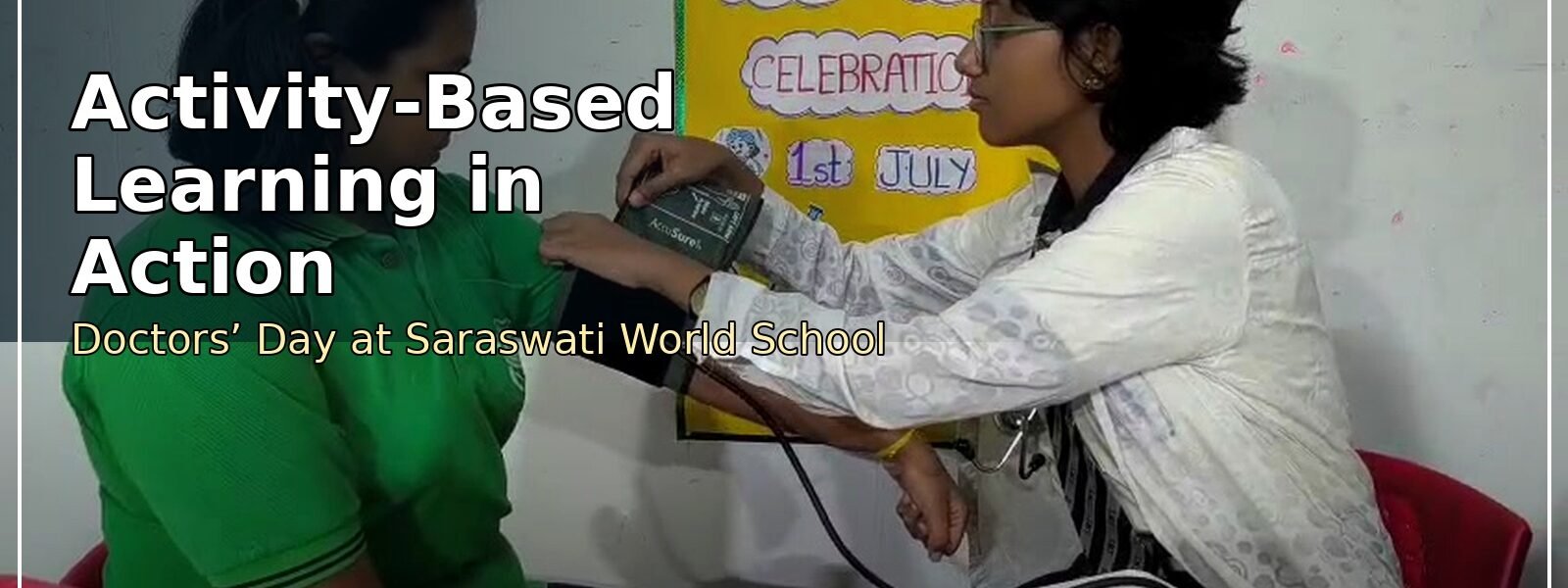
Activity Based Learning in Action: Saraswati World School Inspires Students on Doctors’ Day


Activity Based Learning: How Saraswati World School Turned National Doctors’ Day into a Living Classroom Experience
Speeches, role play, drawing, and theme-based dressing replaced rote learning as Saraswati World School showed how experiential education builds confident, compassionate, and aware young citizens.
Walk into any classroom today, and you will still find rows of desks, open notebooks, and children copying down definitions from the board. But ask those same children what a doctor actually does — beyond “give medicine” — and many will struggle to answer in their own words. This is the quiet gap that modern education is trying to close: the distance between knowing a fact and understanding it.
Textbooks can tell a child that doctors save lives. They cannot make a child feel what compassion looks like, or practise what it means to care for someone. That is where activity based learning steps in — and it is exactly what Saraswati World School demonstrated when it celebrated National Doctors’ Day with an assembly, speeches, role plays, and hands-on activities that turned a calendar event into a genuine activity based learning experience.
What Is Activity Based Learning?
Activity based learning is an educational approach where children learn by doing rather than merely listening. Instead of passively absorbing information, students participate — through speeches, drawing, role play, dressing up, demonstrations, and discussions — so that concepts are experienced, not just memorised.
This method rests on a simple but powerful idea: children retain what they engage with emotionally and physically far longer than what they read silently. A stethoscope drawn by a child’s own hand, or a doctor’s coat worn for even an hour, creates a memory anchor that a paragraph in a textbook rarely can.
Children retain what they engage with emotionally and physically far longer than what they read silently.
Why It Matters, Especially in the Early Years
For young children, abstract explanations often fail to land. A pre-primary student cannot fully grasp “medical responsibility” from a lecture — but they can understand it by dressing up as a doctor, holding a toy stethoscope, and pretending to check a friend’s heartbeat. Activity based learning matches how children naturally learn: through play, imitation, and sensory experience.
For older students, the benefits shift toward confidence, articulation, and civic awareness. Preparing and delivering a speech does more than convey historical facts — it builds public-speaking ability, research skills, and the courage to stand before an audience. Activity based learning, therefore, is not a single technique but a developmental ladder, offering different value at every age.
National Doctors’ Day at Saraswati World School: Activity based Learning in Action
Doctors’ Day at Saraswati World School: Powerful Activity Based Learning Beyond Textbooks pic.twitter.com/j6RN7wTwVi
— Saraswati Word Schoo (@saraswatiworld) July 2, 2026
This philosophy came alive recently when Saraswati World School organised a special assembly to mark National Doctors’ Day, observed every year in honour of the profession that stands at the frontline of human care.
The assembly opened with a speech by Class 12 student, who spoke on the life, legacy, and contribution of Dr. Bidhan Chandra Roy — the physician, freedom fighter, and former Chief Minister of West Bengal whose birth and death anniversary the day commemorates. Moupriya’s speech went beyond biography, exploring the vital role doctors play in society as healers, guides, and pillars of public trust.
The Principal followed with an informative address, reflecting on the deeper values the day represents: medical service, compassion, empathy, and social responsibility. Rather than treating the occasion as a formality, the school used it as a platform to instil real ethical understanding in students.
Bringing Concepts to Life: From Pre-Primary to UKG
What made the celebration truly memorable was how it was adapted for the youngest learners.
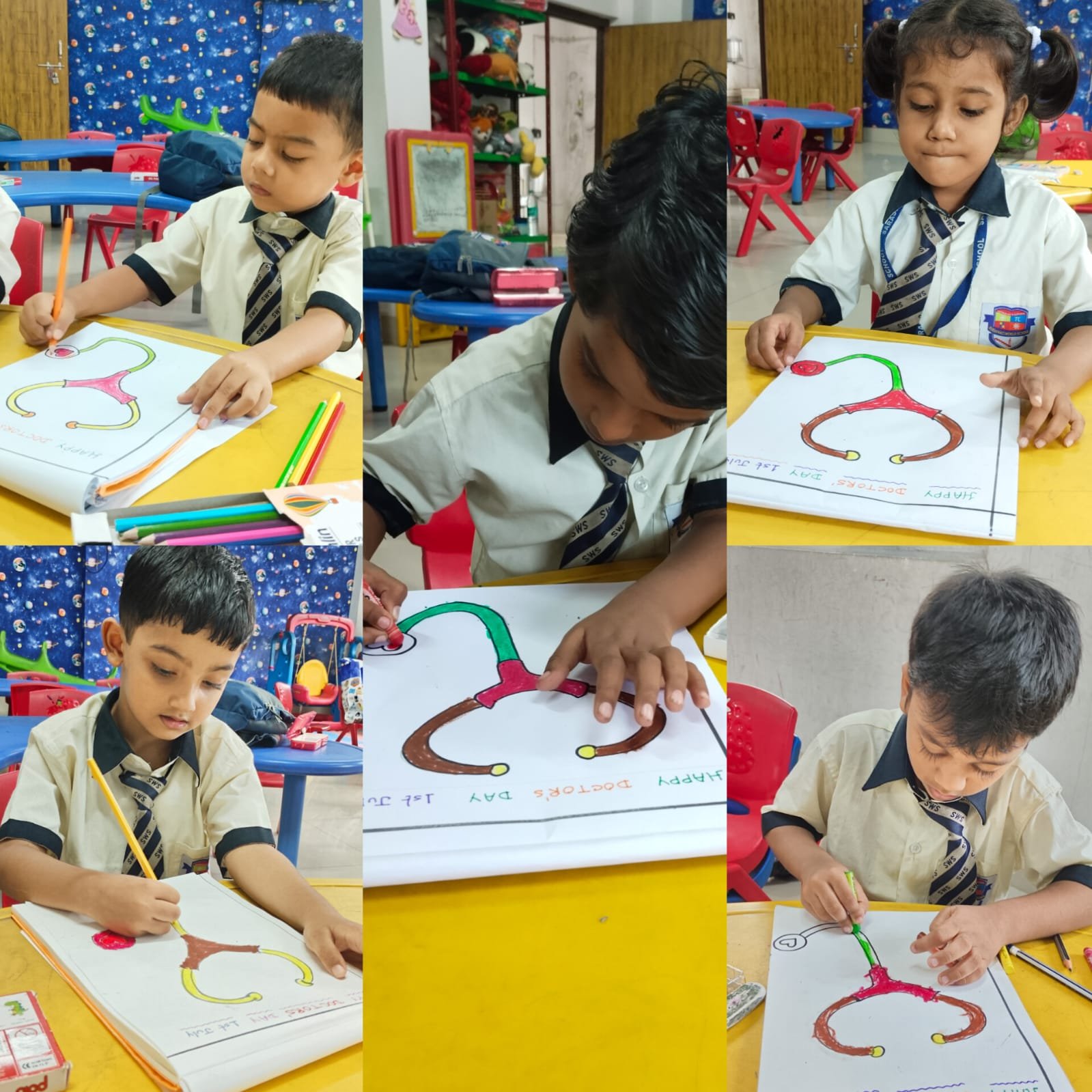
🎨 Pre-Primary Section
A stethoscope-themed drawing activity, along with theme-based doctor costumes, made the celebration visually engaging. Group photographs captured the moment as a lasting keepsake.
🩺 UKG Section
Pre-primary Coordinator introduced Dr. Bidhan Chandra Roy through pictures, explained real medical tools, and led a doctor-patient role play for hands-on understanding.
In the Pre-Primary Section
Children took part in a drawing activity centred on the stethoscope — one of medicine’s most recognisable symbols. Several students came dressed as doctors, complete with coats and toy instruments, making the celebration visually engaging and emotionally memorable.
In UKG
Priyanka Ma’am introduced Dr. Bidhan Chandra Roy through a picture-based session, helping children connect a name with a face and a story. She then explained real medical equipment — the thermometer, BP monitor, mask, and stethoscope — describing each tool’s purpose in simple, relatable language. The highlight was a doctor-patient role play, where children took turns “examining” one another, learning empathy and responsibility through direct participation rather than instruction.
What Each Activity Taught
- Speeches — research ability, structured thinking, public confidence
- Role play — empathy and responsibility, physically enacted and internalised
- Drawing — fine motor skills and visual memory of medical tools
- Theme-based dressing — emotional engagement that made the day feel personal
Together, these activities did what no single classroom lecture could: they made students feel the significance of the medical profession, not just recite facts about it.
Classrooms That Live and Breathe
Saraswati World School’s National Doctors’ Day celebration is a clear reminder that meaningful education happens when knowledge is lived, not just learned. Activities like speeches, role play, and creative expression transform ordinary classrooms into living learning spaces — places where children absorb values alongside vocabulary. By nurturing curiosity, confidence, communication, and compassion, activity based learning shapes something far more important than exam scores: it shapes aware, empathetic, and responsible citizens, ready to appreciate — and one day contribute to — the community around them.
Discover more from
Subscribe to get the latest posts sent to your email.








2 COMMENTS