China Real Population: The 130-Million Gap Nobody Wants to Admit
There is a number that quietly governs a staggering share of global trade decisions, investment strategies, and geopolitical calculations. That number is 1.4 billion — China’s official population. It is the figure that makes China the world’s most coveted consumer market, its most indispensable manufacturing base, and one of its two most powerful states. But what if it is, in substantial part, a carefully maintained fiction? A growing body of evidence — from peer-reviewed academic research to empty city streets, shuttered kindergartens, and suppressed COVID death counts — now suggests that China real population may be anywhere from 130 million to 300 million fewer than the number Beijing publishes.
China real population may be 130 million or more lower than officially stated — a gap equal to the entire population of Japan, hiding in plain sight.
News 24 Media Research
The Scientist Beijing Tried to Silence
The most systematic challenge to China’s demographic claims comes from Dr. Yi Fuxian, a demographer at the University of Wisconsin-Madison. In 2007, he published a book predicting that China’s population would begin declining around 2017 — a full sixteen years ahead of the official forecast. Beijing had the book banned within days. His methodology, however, could not be suppressed. Yi’s most powerful evidence comes not from disputed census data, but from China’s own mandatory tuberculosis vaccination programme. In 2018, the number of BCG vaccine doses administered to newborns implied at most 9.9 million births — yet China’s official figure claimed 15.23 million. That is over 5 million ghost babies, unaccounted for, every single year. Similar gaps appeared in 2019 and 2020. Vaccination records are compiled by public health agencies with no political incentive to falsify. They are, in effect, a second population register — and they tell a very different story.
The One-Child Policy Boomerang
To understand how China arrived here, the story begins in September 1980, when the Communist Party launched the one-child policy. Designed to prevent overpopulation and resource scarcity, it was enforced for 35 years through fines, forced sterilisations, and coercive abortions. China’s fertility rate — the average number of children per woman — had already fallen from 5.5 in 1970 to 2.7 by 1979. The one-child policy drove it below the replacement level of 2.1 by 1991. Yi argued the policy should have been abandoned that year. Instead, it continued for another 24 years. The cultural damage proved permanent. Today, China’s total fertility rate stands at 1.0 — matching nations like South Korea in an East Asian race toward demographic extinction. When the policy was finally scrapped in 2015 and families were allowed two, then three children, births never recovered. Raising a child had become too expensive, too difficult, too culturally alien for a generation shaped by the “little emperor” model of single-child households. The boomerang had already been thrown. It simply took decades to return.
Empty Streets, Shuttered Malls, Vanishing Children
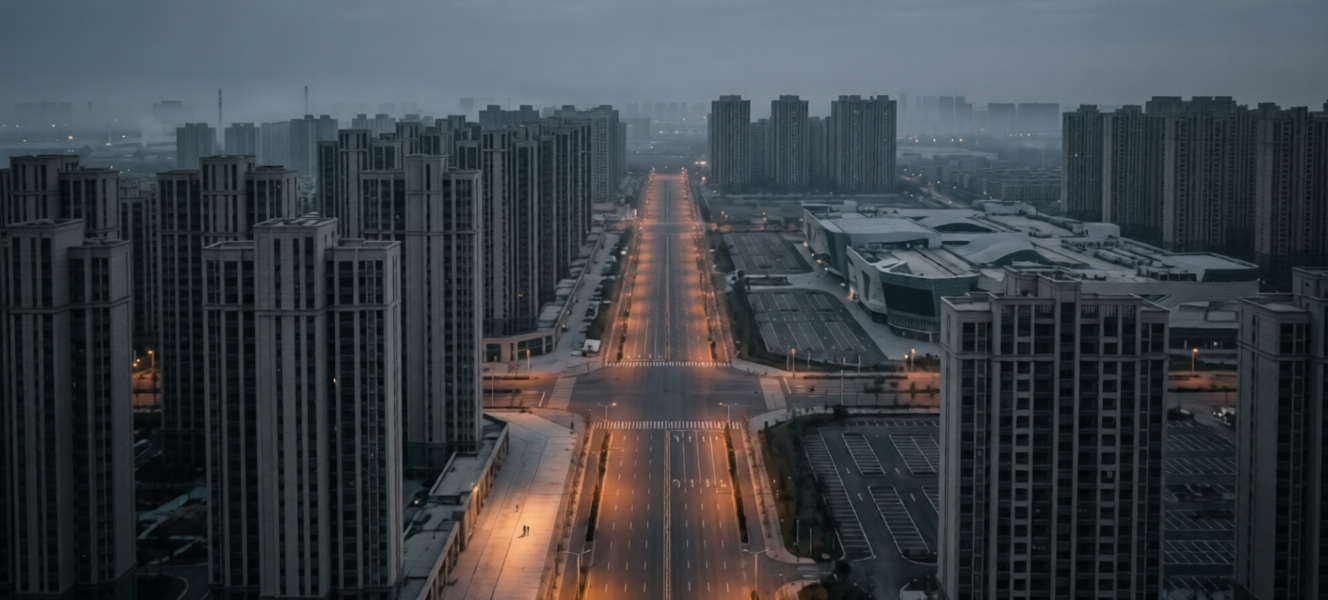
Statistics can be manipulated. Streets cannot. Across China — from Shanghai’s Lujiazui financial district to provincial towns in the interior — residents, delivery drivers, and shopkeepers have been describing the same phenomenon: the crowds are gone. Major shopping malls that served China’s middle class for decades — Shanghai Pacific Department Store, Guangzhou Tianhe City, Wuhan New World Department Store — have closed permanently. Delivery riders report sharp drops in orders. Even vegetable markets, once packed with elderly shoppers, are thinning. Shanghai’s migrant population dropped below 10 million in 2024. Meanwhile, over 35,000 kindergartens closed between 2020 and 2024 — a 25% reduction — because the children simply do not exist in the numbers required to fill them. Analysts estimate 65 to 80 million housing units stand empty across China — enough to house the entire population of a mid-sized European country — monuments to a real estate model built around population projections that may never have been real.
COVID and the Counting That Was Never Done
The COVID-19 pandemic briefly illuminated the depth of China’s data problem. When Beijing ended its zero-COVID policy in December 2022, the government reported approximately 60,000 deaths from the subsequent wave — a figure that would represent one of the most successful pandemic outcomes in recorded history. Peer-reviewed studies disagreed sharply. Research published in JAMA Network Open, using obituary databases and search engine mourning data, estimated approximately 1.87 million excess deaths among adults over 30 in just two months. A separate study in the US Centers for Disease Control’s Emerging Infectious Diseases journal put China’s true mortality rate at roughly twelve times the official count. Across the full 2020–2022 pandemic period, excess deaths exceeded an estimated 4 million. Each of these unreported deaths is a permanent subtraction from an already fragile population base.
Why the Number Must Stay Large
Understanding why China maintains inflated figures requires understanding the economic architecture the number supports. A market of 1.4 billion consumers attracts fundamentally different foreign investment than one of 1.1 billion. Local governments across China receive central government fiscal transfers in proportion to registered population — creating a systemic, decades-old financial incentive for every provincial official to overcount births. The distortion was not a single top-down command. It was the organic product of thousands of local bureaucratic calculations, each individually rational, collectively catastrophic. Meanwhile, international institutions including the United Nations continue to base their own demographic forecasts on China’s official data — laundering the fiction through institutional authority and spreading it into every global model that depends upon it.
The Reckoning Ahead
Even accepting Beijing’s official figures uncritically, China’s trajectory is unambiguously alarming. China real population has declined for four consecutive years. Births in 2025 hit 7.92 million — the lowest since the People’s Republic was founded in 1949. Deaths reached 11.31 million. The over-60 population now numbers 323 million — 23% of the total — and will reach an estimated 430 million by 2050. The country’s median age has already hit 40.6. With a fertility rate of 1.0, every generation is half the size of the one before. By century’s end, projections suggest China real population could fall to between 525 million and 767 million — a halving that no pension system, healthcare infrastructure, or economic strategy was designed to survive. The Phantom Billions are not an abstract statistical curiosity. They are the load-bearing fiction of the most consequential economy on earth — and the weight is beginning to show.
Sources: Dr. Yi Fuxian / University of Wisconsin-Madison; JAMA Network Open; US CDC Emerging Infectious Diseases; medRxiv; Vision Times; The Hill; Newsweek; Nature Scientific Reports; Trading Economics. Canonical publication: News24Media.org © 2026 All rights reserved.