
The Kharg Gambit: Is America Walking Into the Middle East’s Most Dangerous Trap?


Independent · Credible · Consequential
The Kharg Gambit: Is America Walking Into the Middle East’s Most Dangerous Trap?
As US Marines mass in the Persian Gulf and Trump’s 48-hour ultimatum ticks down, the world stands closer to a catastrophic miscalculation than at any point since the Cuban Missile Crisis.
Twenty-three days into the most consequential American military operation since the 2003 invasion of Iraq, the United States and Israel stand at a crossroads that no military planner, no presidential advisor, and no allied capital fully anticipated. What began as a series of targeted strikes against Iran’s nuclear and military infrastructure has, with breathtaking speed, evolved into something far larger, far more unpredictable, and far more dangerous than a “limited operation.” Today, the world is watching a great power push itself toward an island seizure in the Persian Gulf that could ignite a global economic crisis — or worse.
The facts on the ground are stark. In the first 72 hours of the conflict, the United States and Israel struck over 1,000 targets inside Iran. Supreme Leader Ali Khamenei was assassinated. Iran’s navy, air force, and radar network were effectively destroyed. By almost every conventional military metric, these were stunning opening moves. And yet, three weeks later, Iran continues to launch missiles. It has struck near Israel’s Dimona nuclear research site — a first in the history of the conflict. It has closed the Strait of Hormuz to enemy shipping. Oil has crossed $114 per barrel and is climbing. And a new Supreme Leader, Mojtaba Khamenei, has emerged more defiant, not less, from the ruins of the old order.
This is the paradox at the heart of the current campaign: air supremacy has not produced political submission. It never does, not in Vietnam, not in Serbia, not in Gaza, not in Yemen. And it will not in Iran — a nation of 85 million people with a deeply entrenched security state, mountainous terrain, and a revolutionary identity built entirely on resistance to foreign coercion.
“We can take out the island anytime we want. We left the pipes because to rebuild the pipes would take years.”
— President Donald Trump, on Kharg Island, March 2026
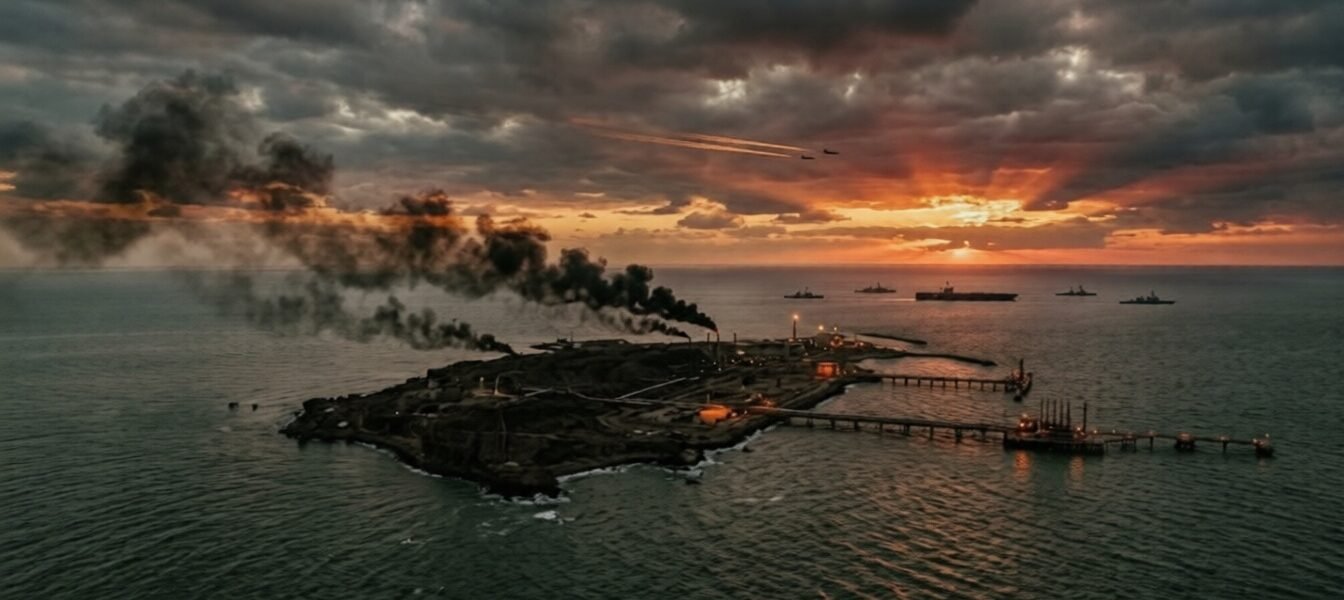
Which brings us to Kharg Island — a 20-square-mile coral outcrop fifteen miles off Iran’s southwest coast that handles ninety percent of the country’s crude oil exports. Trump has publicly acknowledged that the US has deliberately spared the island’s oil infrastructure. The implicit threat is unmistakable: the pipelines and loading terminals remain standing as a pressure instrument, not out of mercy. Senior administration officials have confirmed that plans to seize or blockade Kharg are under active review, with thousands of Marines and amphibious assault vessels already accelerating their deployment to US Central Command.
The strategic logic, on paper, is clean: seize the island, cut Iran’s oil revenue overnight, and force Tehran back to the negotiating table on Hormuz. It avoids troops on the Iranian mainland. The island is small. Deep waters allow close naval support. But clean logic on paper has a long and brutal history of collision with messy reality in the Persian Gulf region.
Consider what a Kharg seizure would actually mean. Oil markets — already at $114 per barrel — could spike toward $200 or beyond, triggering recession across Asia and Europe. For India, which imports over 85% of its crude, the consequences would be severe and immediate. Iran’s IRGC can still mine the Strait of Hormuz independently of whatever happens on Kharg. And there is zero guarantee that Tehran — now led by a new Supreme Leader with something to prove — would capitulate rather than escalate. History rewards our caution here. Holding even a small island under sustained Iranian drone and missile counterattack could trap thousands of American troops in an open-ended commitment with no clear exit.
There is a deeper strategic failure unfolding here that transcends the immediate military picture, and it deserves to be named plainly. As recently as February 27 — one day before the strikes began — Iran had reportedly agreed to never stockpile enriched uranium and to full IAEA verification. Talks were scheduled to resume on March 2. The war happened instead. Whatever the intelligence justifications, a diplomatic opening was available and was not taken. That fact will haunt the architects of this conflict for decades.
The regime in Tehran has not collapsed. It has hardened. The IRGC has consolidated power, not splintered. A population that might have welcomed relief from sanctions and nuclear brinkmanship has instead watched its cities be bombed. No foreign power in modern history has bombed its way to a population’s gratitude.
None of this means Israel’s security concerns were illegitimate — they were not. Iran’s nuclear ambitions represented a genuine and existential threat. But there is a vast and consequential distance between neutralising a nuclear program and launching what is effectively a war of regime change against one of the most complex states in the world’s most volatile region.
Tonight, a 48-hour ultimatum expires. Marines are at sea. Kharg Island sits uneasily under its spared pipelines. The next move is Washington’s. The world should hope, with great urgency, that whoever is in that room with the President in the coming hours has the wisdom to understand that the most powerful military on earth also carries the heaviest burden: the responsibility to know when not to strike.
#IranIsraelWar #KhargIsland #StraitOfHormuz #IranWar2026 #Geopolitics #MiddleEast #OilCrisis2026 #USMilitary #Trump #IRGC #PersianGulf #MojtabaKhamenei #WorldNews #BreakingNews #IranNews #IsraelNews #OilPrices #News24Media #Hormuz #IndiaOil #USIran #Editorial #WarAnalysis
Discover more from
Subscribe to get the latest posts sent to your email.








2 COMMENTS