
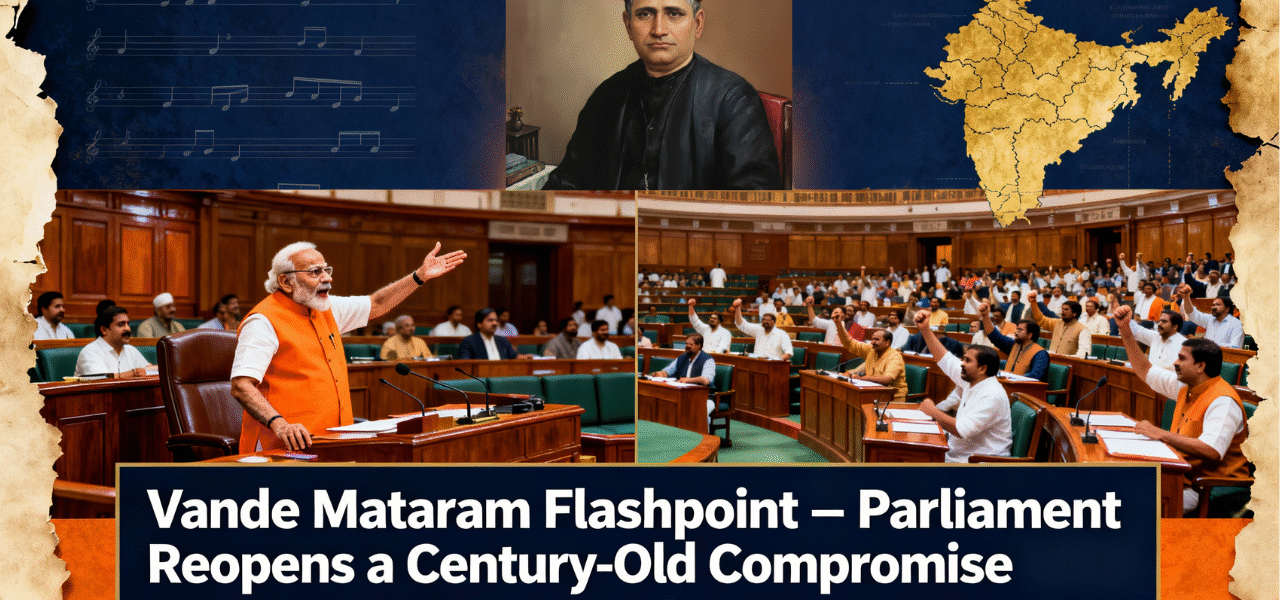
Vande Mataram Flashpoint: Why Parliament’s Emotional Showdown Is Forcing India to Reopen a 100-Year Compromise


Vande Mataram’s Unfinished Journey — Why India Is Reopening a Century-Old Wound
Introduction: A Parliament Session That Turned Emotional
For a brief but powerful stretch during the recent winter session of Parliament, the long-quiet debate over Vande Mataram became the emotional pivot of national politics. What began as routine legislative business in Lok Sabha and Rajya Sabha swiftly sharpened into a moment of collective introspection when Prime Minister Narendra Modi questioned why independent India officially adopted only two stanzas of Bankim Chandra Chattopadhyay’s iconic composition.
The Prime Minister’s remarks were not made in passing. He framed the decision — taken by the Congress leadership in the 1930s–40s — as a “historical compromise” shaped by the fear of antagonising sections of the Muslim leadership of that era. Other MPs echoed similar sentiments: that a nation struggling to assert its civilisational identity ended up diluting a song that embodied its cultural awakening.
In the Lok Sabha, BJP MPs thumped their desks in agreement; the Opposition benches appeared divided. Some Congress members defended the earlier approach as a gesture of accommodation necessary for national unity at the time. Others sat uneasily, signalling that the party itself recognises that the debate cannot be dismissed as mere politics.
In the Rajya Sabha, the debate grew sharper. Senior leaders asked whether India’s founding generation underestimated the long-term symbolic cost of limiting Vande Mataram to just two stanzas, effectively creating a precedent of negotiating national symbols to placate communal anxieties. The mood was electric: emotional, reflective, and at times confrontational. Few expected the discussion to carry such moral force — but it did, revealing unresolved tensions at the heart of India’s national imagination.
The Two-Stanza Compromise
To understand why Parliament erupted over a century-old issue, one must revisit the fraught history of Vande Mataram’s partial adoption.
When the Indian National Congress (INC) first popularised Vande Mataram in the late 19th and early 20th centuries, it became the rallying cry of the Swadeshi Movement. Its imagery of the motherland as divine, bountiful and worth defending resonated deeply across the subcontinent. British administrators openly feared its ability to mobilise people.
But by the 1920s and 1930s, Congress politics began shifting under the pressure of communal negotiations. Some prominent Muslim leaders, particularly those aligned with the Muslim League and other separatist voices, objected to the latter stanzas of the song, arguing that references to the motherland in symbolic, quasi-divine form conflicted with certain interpretations of monotheistic religious doctrine.
Historians such as Rafiq Zakaria, Bimal Prasad, and S. S. Sen have documented how Congress leaders, eager to maintain Hindu-Muslim unity and wary of accusations of majoritarianism, started limiting the public singing of the full song. By 1937, only the first two stanzas — considered more secular in tone — were used officially. This position was eventually endorsed by the Congress Working Committee and carried forward into the early years of independence.
What the parliamentary debate revived is the question: Was this compromise a genuine effort at inclusivity, or an early moral concession that signalled willingness to cede cultural ground for the sake of political expediency?
From Vande Mataram to Bharat Batwara: A Symbolic Link
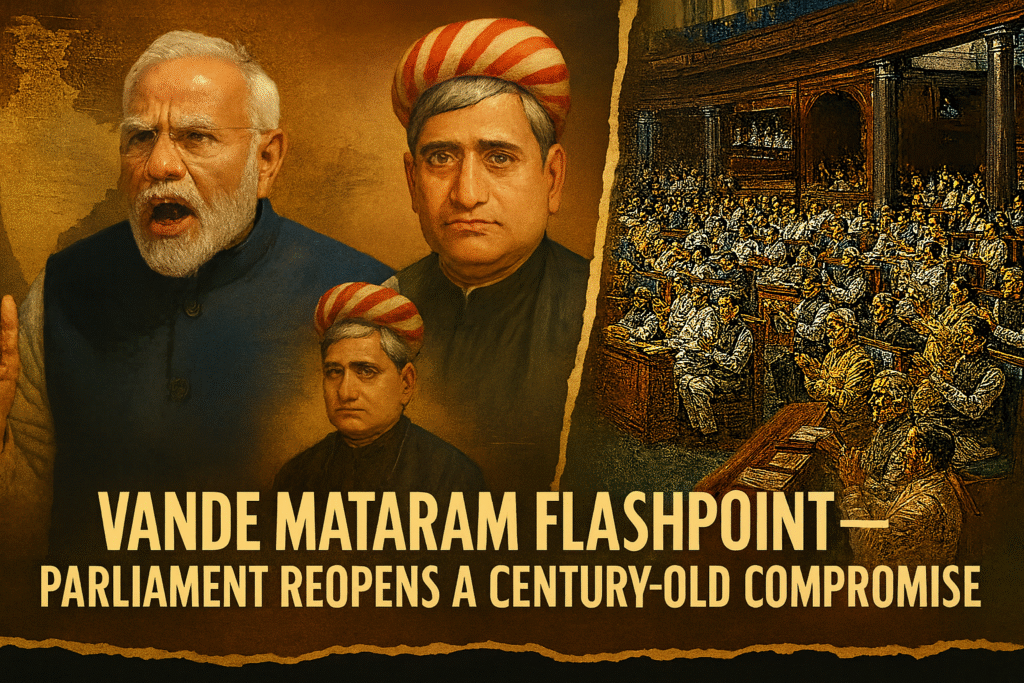
Many commentators in the present debate argue that the restriction on Vande Mataram reflects the broader political mindset that eventually accepted Partition.
The argument is not simplistic — it does not claim the compromise caused Partition. Instead, it suggests that the psychological readiness to dilute a unifying cultural symbol in the face of separatist pressure contributed to a political climate where conceding territory eventually seemed thinkable.
Partition was not a single event but a long process of cumulative concessions, anxieties, identity negotiations, and ultimately the collapse of trust. Scholars like Yasmin Khan, Urvashi Butalia, and Gyanendra Pandey have shown how the tensions of the 1930s and early 1940s — debates over representation, electorates, separate identity claims — shaped a fractured political imagination.
In this framing, Vande Mataram becomes a metaphor for that fragmentation. If the motherland could be divided symbolically in song, could it later be divided physically in geography?
The parliamentary debate evoked that memory. MPs spoke of the unimaginable human toll of Partition — nearly 10–15 million displaced, over a million killed in riots and reprisals, generations traumatised by the horrors of forced migration. Survivor accounts from Punjab, Bengal, and Sindh describe trains arriving full of corpses, homes abandoned overnight, and families uprooted by fear.
The editorial argument does not romanticise the past but interrogates its lessons: Did early efforts to “adjust” national symbols contribute to a culture of perpetual negotiation with communal hardliners? And is India still paying the moral price of those decisions?
Appeasement as a Political Habit
One of the most contested themes in the current debate is the claim that the “cancer of appeasement” — a term used by ideological commentators — still operates in Indian political life.
Proponents of this view argue that:
- objections to Vande Mataram today echo arguments once advanced by radical separatists and Islamist ideologues in pre-Partition India
- sections of the political establishment are hesitant to endorse culturally rooted patriotic symbols for fear of offending minority sensitivities
- “selective secularism” privileges religious objections over national-cultural traditions
They argue that this mindset leads to a distorted public discourse where the majority’s symbols must be constantly moderated, even when they are civilisational rather than explicitly religious.
Opponents push back firmly. They argue that:
- A secular republic must avoid imposing cultural expressions that some communities interpret as religious
- Inclusivity requires sensitivity to theological boundaries
- National identity should derive from constitutional values, not civilisational metaphors that may exclude some groups
This back-and-forth has intensified since the parliamentary discussion. Critics warn that expanding the official form of Vande Mataram might deepen communal divides. Supporters counter that no republic can build confidence by permanently outsourcing its cultural self-definition to fears of communal backlash.
The debate, then, is not just about a song — it is about competing visions of Indian secularism.
Bankim’s Forgotten Honour
Lost amid the political rhetoric is the towering legacy of Bankim Chandra Chattopadhyay — novelist, thinker, civil servant, and one of the most influential minds of the Bengal Renaissance.
Bankim wrote Vande Mataram not as a hymn to any deity but as a cultural-civilisational metaphor for Bharat Mata — the motherland whose rivers, fields, and forests nourish its children. His vision combined spirituality with patriotism, culture with compassion, and strength with self-respect.
Modern historians such as Sisir Kumar Das and Sankar Ghosh emphasise that Bankim’s writings played a crucial role in shaping political nationalism long before Gandhi or Nehru came to prominence.
Yet, as many scholars lament, India’s mainstream discourse often sidelines Bankim in favour of later political figures. His philosophical depth, his critique of colonialism, and his belief in cultural self-confidence receive far less attention today than they deserve.
The question raised in Parliament — whether India has truly honoured Bankim — is therefore not trivial. Full recognition of Vande Mataram may, for some, symbolise a long overdue restitution of Bankim’s place in India’s moral and cultural imagination.
Can a National Song Be Opposed on Religious Grounds?
This is the core tension at the heart of the debate.
View 1: The Cultural-Civilisational Argument
Supporters say that Vande Mataram transcends religion. Its imagery of the motherland is poetic, not theological. They argue that every nation uses symbols of profound emotional resonance — from flags to anthems — to cultivate unity. Rejecting such symbols on doctrinal grounds, they say, undermines national cohesion.
View 2: The Theological Objection
Some Muslim groups maintain that certain depictions in the later stanzas conflict with their monotheistic beliefs. They argue that secularism should protect religious minorities from symbolic impositions that appear devotional in tone.
View 3: The Plural Nationalism Perspective
This group argues that symbols must be inclusive but also historically honest. They call for dialogue rather than imposition, suggesting that India must evolve a model of nationalism that respects diversity while affirming shared heritage.
The editorial challenge is to ask: Is a secular republic strengthened by allowing religious sensitivities to veto national symbols? Or weakened?
The question has no easy answer — but it must be asked honestly.
Can the Song Unite Us Again?
The deeper issue behind the parliamentary firestorm is whether Vande Mataram — in its full form — can still serve as a unifying force in a polarised era.
The song once moved millions to confront colonial power, rebuild cultural pride, and imagine a free nation. Today, India stands at a very different crossroads: no longer fighting an external empire, but negotiating the internal conflicts of identity, memory, and ideological divides.
The debate forces us to ask:
- Can Vande Mataram be reclaimed as a symbol of shared belonging rather than partisan assertion?
- Can India transcend the inherited anxieties of the Partition era and revisit earlier compromises with maturity?
- Should future generations learn the full cultural depth of Bankim’s composition, even if not mandated in all contexts?
These questions go beyond politics. They speak to who Indians believe they are — and who they aspire to be.
Conclusion: Beyond Partisanship, Toward Self-Confidence
In the end, the debate over Vande Mataram is not merely about lyrics or stanzas. It is about India’s long struggle to reconcile its civilisational memory with its constitutional modernity.
The parliamentary discussions have reopened a wound — but perhaps also an opportunity. If the compromise of 1937 reflected a moment of national self-doubt, the question before 21st-century Bharat is whether it is time to heal that doubt.
Reclaiming Vande Mataram in full — whether formally adopted or socially honoured — may serve as a way for Indians to recover the cultural confidence their forebears were denied by the pressures of communal politics.
This is not a call for uniformity. It is a call for maturity. A call for historical honesty. A call to examine whether national symbols should remain hostage to century-old anxieties.
Bankim envisioned a nation that could stand proud in its cultural roots while embracing modern ideals. The debate now is whether India is ready to fulfil that vision — not for political gain, but for the sake of moral clarity.
As Parliament has rediscovered, the question is no longer about two stanzas or four. It is about whether Bharat, in all its diversity, is finally ready to sing of itself without fear.
Vande Mataram debate, Vande Mataram Parliament Modi, why only two stanzas of Vande Mataram, Bankim Chandra Chattopadhyay legacy, Vande Mataram controversy history, Vande Mataram Muslim objection, Vande Mataram Partition politics, appeasement politics India, nationalism secularism debate India, Lok Sabha Rajya Sabha Vande Mataram, cultural identity debate India, Vande Mataram full song demand, India national song controversy
Discover more from
Subscribe to get the latest posts sent to your email.








1 COMMENTS