Europe’s Closed Doors: How Schengen Visa Rejections Are Costing Indian Travellers Hundreds of Crores
For a growing segment of Indian travellers, Europe represents the ultimate travel aspiration — a symbol of global mobility, luxury, culture, and prestige. From Parisian boulevards and Swiss alpine railways to Italian art cities and Spanish coastlines, the Schengen region has long been marketed as the crown jewel of outbound tourism.
India today stands among the world’s top five outbound tourism markets, with more than three crore Indians travelling abroad annually, driven by rising incomes, a growing middle class, and an expanding appetite for global experiences. Yet, for thousands of Indian tourists each year, the European dream ends not at an airport gate — but at a Schengen Visa Rejections notice.
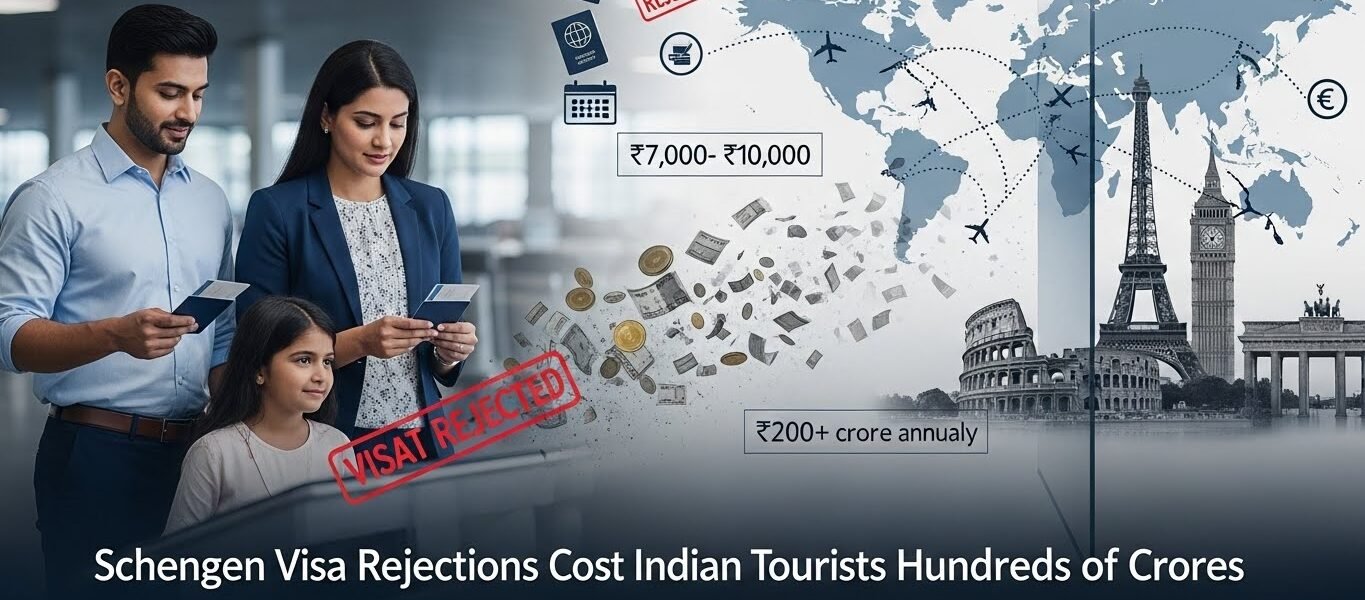
As Schengen nations quietly tighten visa scrutiny, Indian travellers are facing one of the highest Schengen Visa Rejections rates globally, resulting in not just disappointment, but substantial financial losses running into hundreds of crores of rupees.
A Rising Schengen Visa RejectionProblem
Schengen visa data over the past few years indicates a persistent and disproportionately high rejection rate for Indian applicants, particularly for short-term tourist visas.
According to compiled European Commission statistics and industry estimates:
France, Germany, Italy, and Spain — among the most popular destinations for Indian tourists — collectively account for a significant share of rejected applications.
Schengen Visa rejection rates for Indian applicants have hovered between 15% and 20% in recent years, markedly higher than for applicants from many other large outbound markets.
In contrast, Schengen Visa rejection rates for applicants from countries such as the US, UK, Japan, and South Korea often remain in the single digits.
Travel agents note that refusals frequently cite “insufficient justification,” “lack of travel intent clarity,” or “financial documentation concerns”, even for applicants with stable incomes, prior travel histories, and confirmed bookings.
What frustrates applicants most, industry insiders say, is the absence of clear, appeal-friendly reasoning — making reapplication both costly and uncertain.
The Hidden Cost: Visa Fees Without Travel
At the heart of the issue lies a lesser-discussed financial drain: non-refundable visa processing fees.
A Schengen tourist visa typically costs:
€80–€90 (₹7,000–₹10,000) per adult applicant
Additional service charges levied by outsourced visa centres
For families, couples, or group travellers, the upfront cost quickly multiplies.
Industry estimates suggest:
With over 1.5–2 lakh Indian Schengen applications rejected annually,
And an average fee of ₹8,500 per applicant,
The direct financial loss alone exceeds ₹150–₹200 crore every year, without accounting for ancillary costs such as documentation, travel agent fees, or funds blocked.
“Applicants pay for the right to be assessed, not the right to travel,” explains a senior executive at a Delhi-based travel consultancy. “But when Schengen Visa rejection rates remain high and opaque, it begins to feel punitive.”
Shifting Travel Behaviour: Asia Steps In
Schengen Visa Rejections
While Europe struggles with capacity, staffing shortages, and stricter migration controls, South and Southeast Asia are rapidly capitalising on the fallout.
Younger Indian travellers and middle-class families, in particular, are recalibrating priorities.
“Earlier, Europe was seen as a once-in-a-lifetime trip,” says a Mumbai-based travel blogger. “Now people prefer multiple shorter international trips where visas don’t feel like a gamble.”
Data from outbound booking platforms shows double-digit growth in Southeast Asia travel from India, while demand for Europe has flattened despite aggressive airline promotions.
Aspirations, Prestige, and EMIs
Despite the obstacles, Europe continues to hold deep aspirational value in India.
For many families and couples:
A European holiday is seen as a status milestone
Social media visibility and cultural prestige remain powerful motivators
Some travellers even finance trips through personal loans or EMIs
“When a visa gets rejected, it’s not just money lost — it’s an emotional setback,” notes a Bengaluru-based counsellor who works with young professionals. “People plan weddings, anniversaries, even proposals around these trips.”
This emotional toll, combined with financial loss, has made visa uncertainty a growing source of resentment among frequent travellers.
What the Industry Is Saying
Tourism bodies and travel associations have increasingly raised concerns.
Tourism industry stakeholders, including representatives from travel associations such as the Indian Association of Tour Operators (IATO), have highlighted growing challenges for Indian applicants navigating Schengen visa processes. These include concerns over documentation requirements and processing delays, which many applicants find opaque and inconsistent across different European consulates.
Travel agents argue that Europe risks alienating one of the fastest-growing outbound markets in the world.
“India is not a low-value tourism market anymore,” says an IATO office-bearer. “If barriers remain high, spending will shift elsewhere — and Asia is ready.”
Diplomatic Silence and Limited Redress
So far, official responses remain muted.
While European embassies have cited:
Capacity constraints
Security considerations
Migration management priorities
There has been little public acknowledgement of:
Disproportionate rejection rates
Financial burden on applicants
Lack of appeal clarity
On the Indian side, visa issues occasionally surface in bilateral discussions, but no formal mechanism exists to address rejection transparency for tourist visas.
A Market at a Crossroads
India’s outbound tourism market is projected to double over the next decade, driven by demographics, disposable income growth, and global connectivity.
The question is whether Europe will remain a central beneficiary.
If Schengen visa policies continue to feel restrictive, opaque, and financially punitive, industry experts believe a decisive shift toward Asia-Pacific destinations is inevitable.
As one veteran travel consultant puts it: “Tourism flows follow ease, not aspiration alone. Dreams survive — but bookings follow certainty.”
For now, Europe’s doors may not be fully closed — but for many Indian travellers, they are increasingly hard to open.
Schengen visa rejection, Indian tourists Europe, visa fee loss India, European travel restrictions, outbound tourism India, travel trends 2025, Southeast Asia tourism, Indian luxury travellers, Schengen Visa rejections
Discover more from
Subscribe to get the latest posts sent to your email.