

India’s Private CBSE Schools Under the Lens: What a New National Study Reveals


Why balance matters more than brand—and why rankings should always be read carefully
Looking Beyond Headlines: What This Study Set Out to Examine
India’s private CBSE schools ecosystem is often discussed through rankings, awards, and brand perception. However, these narratives rarely explain how private CBSE schools actually compare when evaluated through verifiable public evidence rather than marketing visibility.
A new national-level study by CCLP Worldwide, based exclusively on public-domain documentation, places private CBSE schools under the lens—not to declare winners, but to understand patterns, limits, and signals that emerge when evidence replaces hype.
This article summarises what the study reveals—and what it deliberately avoids claiming.
Key Finding 1: Balance Outperforms Brand
One of the strongest trends to emerge from the study is that institutional balance consistently matters more than brand reputation.
private CBSE schools that demonstrated:
- steady academic outcomes over time
- stable governance structures
- consistent regulatory compliance
- measured public communication
tended to score within a similar performance range, regardless of whether they were nationally famous or locally known.
By contrast, high-brand-visibility private CBSE schools did not automatically outperform quieter institutions when evaluated across governance, transparency, and consistency indicators.
Insight:
Visibility may attract attention, but balance sustains quality.
Key Finding 2: Governance Is the Quiet Backbone of Quality
Across the dataset, governance stability emerged as one of the strongest quality signals.
Public records showed that schools with:
- long-standing trusts or societies
- fewer administrative disruptions
- clear disclosure practices
were more resilient across academic cycles.
Governance does not appear on hoardings or brochures—but it shapes everything from academic planning to compliance discipline.
Important nuance:
Good governance does not guarantee excellence, but weak governance reliably predicts instability.
Key Finding 3: Performance Clusters Are Narrower Than Rankings Suggest
Contrary to popular “Top 10 / Top 50” narratives, the study found that most qualifying private CBSE schools fall within relatively narrow score bands when assessed using public evidence.
This means:
- differences between schools are often incremental, not dramatic
- Ordinal ranking positions can exaggerate minor gaps
- Small score variations are frequently over-interpreted
In practical terms, the difference between a school ranked 12th and one ranked 28th is often far smaller than headlines imply.
Takeaway for parents:
Rank numbers suggest distance; evidence suggests proximity.
Key Finding 4: Consistency Matters More Than Extremes
Another recurring pattern was the limited value of extremes—whether exceptionally high board scores or showcase infrastructure.
The study observed that:
- consistent, cohort-wide academic performance mattered more than isolated toppers
- stable compliance histories mattered more than occasional excellence
- Moderation correlated more strongly with long-term credibility than spikes
This challenges the assumption that standout achievements alone define institutional quality.
Why Rankings Should Always Be Read Carefully
The study does not argue that rankings are useless. It argues that they are often misunderstood.
Rankings tend to:
- compress complex realities into single numbers
- magnify marginal differences
- reward visibility over verification
When rankings are read as guides rather than verdicts, they can be helpful. When treated as absolute truth, they become misleading.
This is why the study deliberately avoids:
- “Top 10 best schools” claims
- sensational comparisons
- adversarial rank narratives
Such framing may attract clicks, but it obscures reality.
What This Study Does Not Claim
To maintain credibility and legal clarity, the study does not claim to:
- Identify the “best” school in India
- measure classroom-level teaching quality
- predict individual student outcomes
- replace parental judgment or school visits
Its role is narrower—but more reliable:
to identify documented institutional credibility using public evidence.
What Parents and Educators Can Take Away
For parents:
Look for signals of balance—not just fame. Stability, transparency, and consistency are safer indicators than rank positions alone.
For schools:
Long-term credibility is built through governance and discipline, not just awards or publicity.
For the education ecosystem:
There is space—and need—for evidence-first, low-noise research that resists sensationalism.
A Healthier Way to Read School Rankings
The most important outcome of this study may not be the list itself, but the way it reframes interpretation:
- Rankings are snapshots, not verdicts
- Differences are often narrower than portrayed
- Quality is institutional, not performative
When rankings are read with this perspective, they inform rather than distort.
Closing Reflection
In a competitive admissions environment, it is tempting to search for simple answers. But education rarely offers them.
This national study suggests that quiet consistency often outperforms loud branding, and that the strongest schools are not always the most visible ones—but the most balanced.
That insight alone makes the research worth attention.
Editorial Disclosure
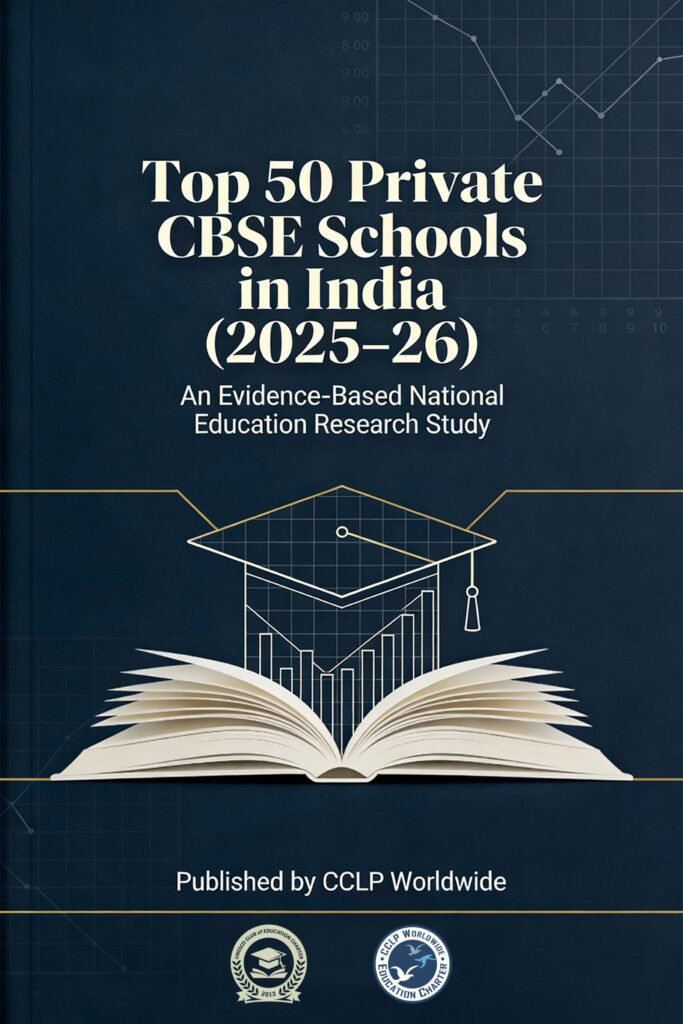
This article is based on an independent education research study by CCLP Worldwide, using only public-domain evidence. No schools were surveyed, charged, or promoted. The analysis avoids sensational ranking narratives in the interest of accuracy, responsibility, and public trust.
Top 25 International Schools in India Announced Under Good School Rating 2025–26
CBSE schools in India analysis, private CBSE schools research, CBSE school governance, education research India CBSE, CBSE school evaluation framework, evidence based school study India, India private CBSE schools study, private CBSE schools
Discover more from
Subscribe to get the latest posts sent to your email.







1 COMMENTS