
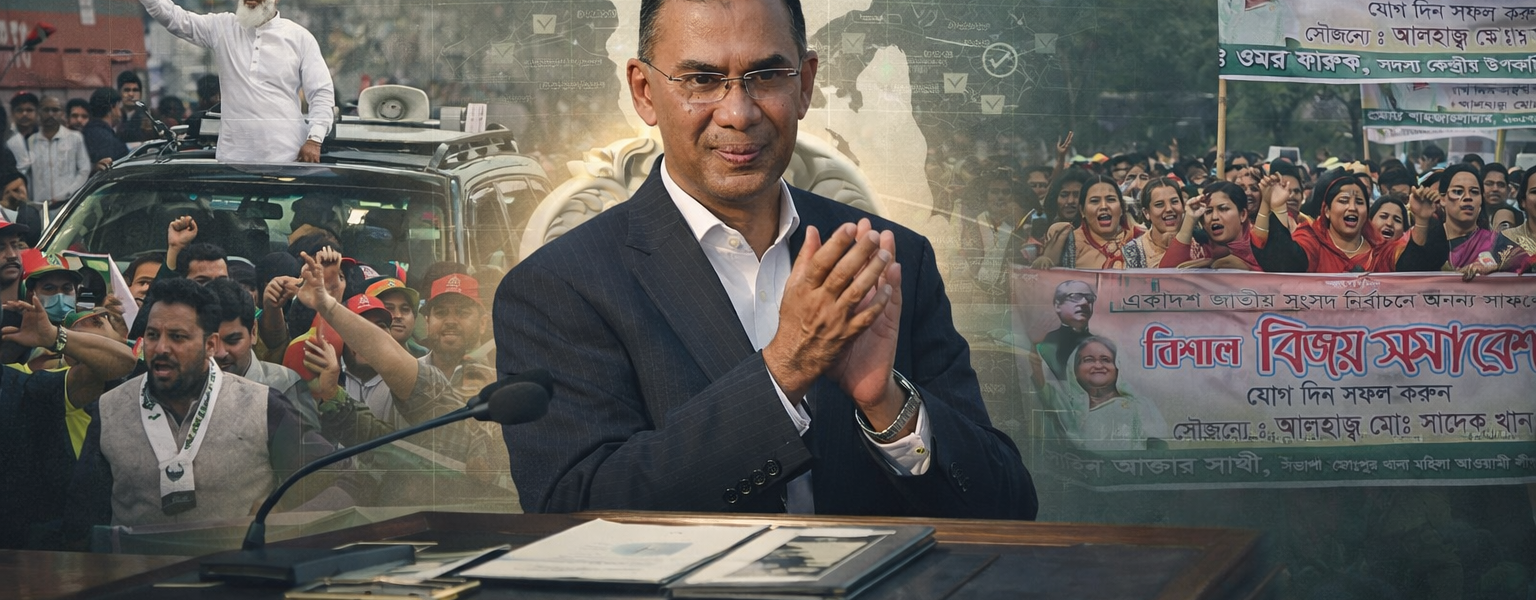
Bangladesh Political Transition 2026: After Yunus, Tarique Rahman Inherits a Fractured Republic


Bangladesh Political Transition 2026: After Yunus: Tarique Rahman’s Rise, Awami League’s Exclusion, and the Battle for the Republic’s Soul
Bangladesh has entered another decisive chapter in its turbulent political journey. With Tarique Rahman assuming office after elections that followed the unelected interim tenure of Muhammad Yunus, the country now stands at a political crossroads.
But this is not merely a routine transition of power. What unfolded over the past year has been described by many within Bangladesh as a profound political restructuring—others call it a democratic correction, while critics describe it as a strategic sidelining of the country’s largest traditional political force, the Bangladesh Awami League.
For observers across South Asia, the question is no longer just who governs Bangladesh, but how Bangladesh will now be governed.
The Year That Redefined Bangladesh Politics
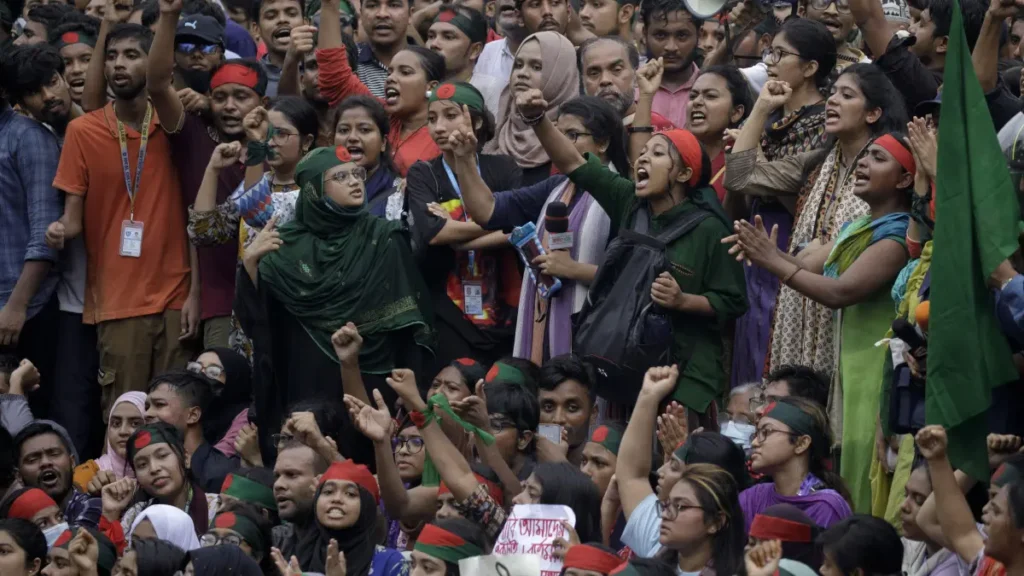
The unelected interim administration led by Muhammad Yunus took hold of governance during a period of upheaval and street mobilisation. What followed, according to many Awami League leaders and sympathisers, was a systematic shrinking of their political space:
- Party activities curtailed
- Offices shut amid protests and violence
- Organisational structures disrupted
- Electoral participation blocked
Supporters of the interim framework argue that this phase was necessary to “reset” institutions and restore credibility. Critics counter that excluding a historically mass-based political party from contesting elections reshapes the democratic field itself.
Bangladesh’s 2026 election, therefore, delivered a powerful mandate to Tarique Rahman—but within a political environment where one of the country’s most entrenched parties was absent from the ballot.
The Bangladesh Political Transition 2026 alone ensures that the legitimacy debate will not fade quickly.
A Familiar Pattern in an Unfamiliar Moment
Minority Security Watch: What to Track Now
Bangladesh’s transition phase often shifts local power balances. Minority confidence will depend less on speeches and more on enforcement consistency.
- Policing neutrality: Are threats/attacks investigated regardless of faction?
- Conviction rate: Do cases result in arrests and convictions, not only statements?
- Local office reopenings: Are political activities protected equally under law?
- Extremist deterrence: Are radical intimidation networks prosecuted without political shielding?
- Community reassurance: Are minority areas receiving visible protection during rallies and flashpoints?
Current signal: A minister in the new government has publicly stated commitment to minority safety and rejecting fundamentalism—this is a marker to measure against real-world outcomes.
Bangladesh Political Transition 2026- Bangladesh’s political history is marked by cycles:
- Extended military rule (1975–1990)
- Coalition instability
- Exile and political returns
- Street agitation as a parallel political instrument
The return of political actors once sidelined has been a recurring feature of Bangladesh’s democracy. That historical pattern suggests that the complete and permanent disappearance of the Awami League is improbable. Political forces deeply rooted in local networks rarely vanish—they reorganise.
Thus, the current phase may not be about elimination, but about repositioning.
The Reopening Question: Can Awami League Breathe Again?
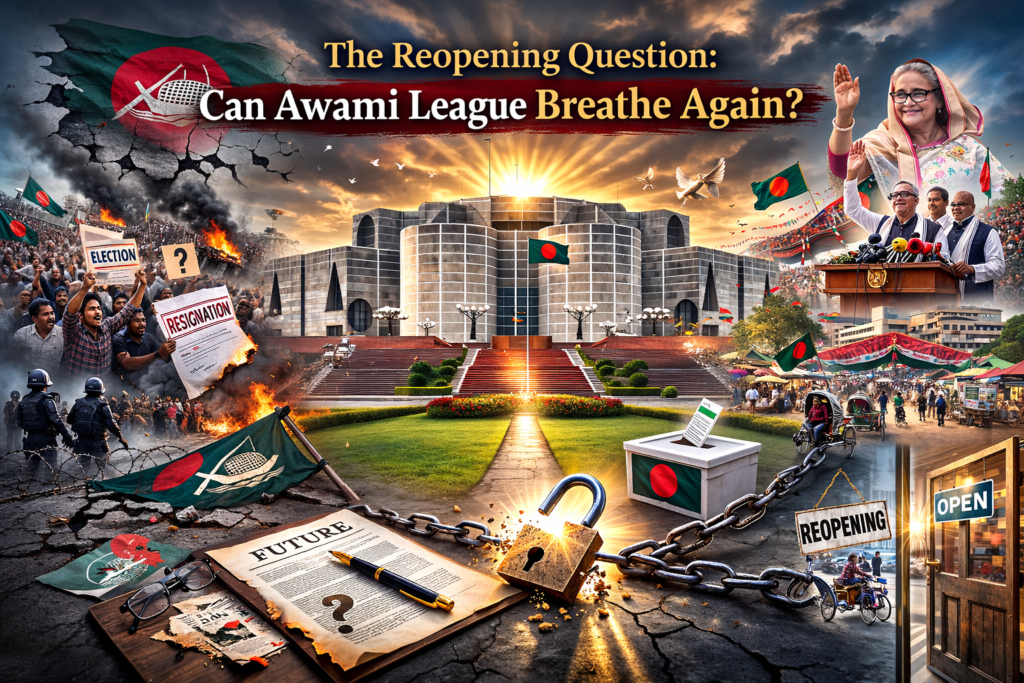
With Tarique Rahman now leading an elected government, a paradox emerges.
On the one hand, the new administration seeks stability—focusing on inflation control, market reforms, and efficient governance. Stability requires reduced street confrontation.
On the other hand, Awami League’s grassroots infrastructure—much of which was disrupted during last year’s unrest—may gradually attempt to re-emerge. Local offices that were shut down during protests are cautiously reopening in some regions.
But this reopening is not occurring in a neutral environment.
There remains a widely discussed concern about the operational freedom of hardline Islamist groups that gained visibility during the turbulence. While not all Islamist political actors are radicals, Bangladesh’s past shows that periods of political flux often provide space for fringe elements to assert influence.
Whether the state enforces neutrality—or allows selective pressures—will determine whether reopening becomes reconciliation or confrontation.
Islamist Influence: Parliamentary Presence vs Street Power
Islamist radical political forces have secured notable parliamentary strength in the post-election landscape. That reality brings strategic questions:
- Will policy drift toward socially conservative frameworks?
- How will minority confidence be maintained?
- Can extremist networks be contained without political shielding?
Government representatives have publicly reiterated commitments to minority safety and stability. But reassurance must be matched by enforcement.
The test is not rhetorical—it is whether law enforcement acts evenly across factions.
The Legitimacy Debate: Mandate vs Representation
Tarique Rahman’s victory was decisive. Yet legitimacy in democracies is not derived solely from numbers—it also rests on inclusion.
If Bangladesh moves toward a model in which electoral dominance justifies the prolonged exclusion of rivals, it risks deepening a two-tier political system: one visible, one underground.
But if the new government pursues calibrated reintegration—allowing opposition restructuring within constitutional bounds—it may reduce volatility and restore competitive politics.
The Next 12 Months: Decisive Variables
The coming year will shape Bangladesh’s trajectory. Several indicators will signal the direction:
1️⃣ Security Neutrality
Are arrests and prosecutions cross-party—or selective?
2️⃣ Political Space
Are opposition offices protected equally under the law?
3️⃣ Radical Containment
Are extremist networks prosecuted without hesitation?
4️⃣ Economic Stability
Inflation and price volatility remain public pressure points. Economic distress can rapidly translate into street agitation.
5️⃣ Institutional Reform
Judicial and election commission credibility will determine long-term trust.
Is Awami League’s Return Remote?
History suggests otherwise.
Bangladesh’s political DNA includes exile, suppression, regrouping, and return. From the post-1975 period to later democratic transitions, political actors have re-emerged when structural space reopened.
The question is not whether the Awami League can return.
The question is under what conditions it returns:
- As a legally rehabilitated parliamentary opposition?
- As a fragmented force?
- Or as a street-driven mobilisation movement?
Each path produces different outcomes for stability.
The Deeper Contest: Identity of the State
Beyond party politics lies a larger struggle:
- Is Bangladesh moving toward competitive pluralism?
- Toward ideological consolidation?
- Or toward a managed democracy shaped by convenience?
The past year has demonstrated that political engineering—whether justified as reform or criticised as exclusion—carries long-term consequences.
If inclusivity expands, Bangladesh may stabilise into a more predictable parliamentary system.
If exclusion persists, cyclical instability could return.
Final Assessment
Bangladesh today is neither collapsing nor fully consolidated. It is in a recalibration phase.
The interim unelected chapter under Muhammad Yunus has closed.
The elected chapter under Tarique Rahman has begun.
But the structural question remains unresolved:
Can Bangladesh transform political victory into political accommodation?
The next year will determine whether the republic moves toward reconciliation—or re-enters its familiar cycle of contestation and return.
For the Indian subcontinent and the wider geopolitical landscape, Bangladesh’s stability is not peripheral—it is strategic.
And for its citizens, it is existential.
Bangladesh, Tarique Rahman, Muhammad Yunus, Awami League, BNP, Jamaat-e-Islami, South Asia, Geopolitics, Democracy, Minority Security, Bangladesh Political Transition 2026
Discover more from
Subscribe to get the latest posts sent to your email.





1 COMMENTS