
Indo Bangladesh Border Crisis: From Liberation to Infiltration — The 50-Year Geopolitical Fault Line


The New Indo Bangladesh Border Crisis:
Radicalisation, Illegal Intrusion
& Eastern India’s Geopolitical Storm
How decades of ideological drift in Bangladesh, porous borders, demographic pressure, and a transformed Indian political landscape are converging into South Asia’s next major crisis.
Along India’s 4,156-kilometre eastern frontier, something has quietly changed. What was once a border shaped primarily by poverty and displacement has acquired new and dangerous dimensions — organised infiltration, forged identities, ideological networks, and a radically altered political landscape on both sides of the river. The tremors are already being felt. The earthquake may still be coming.
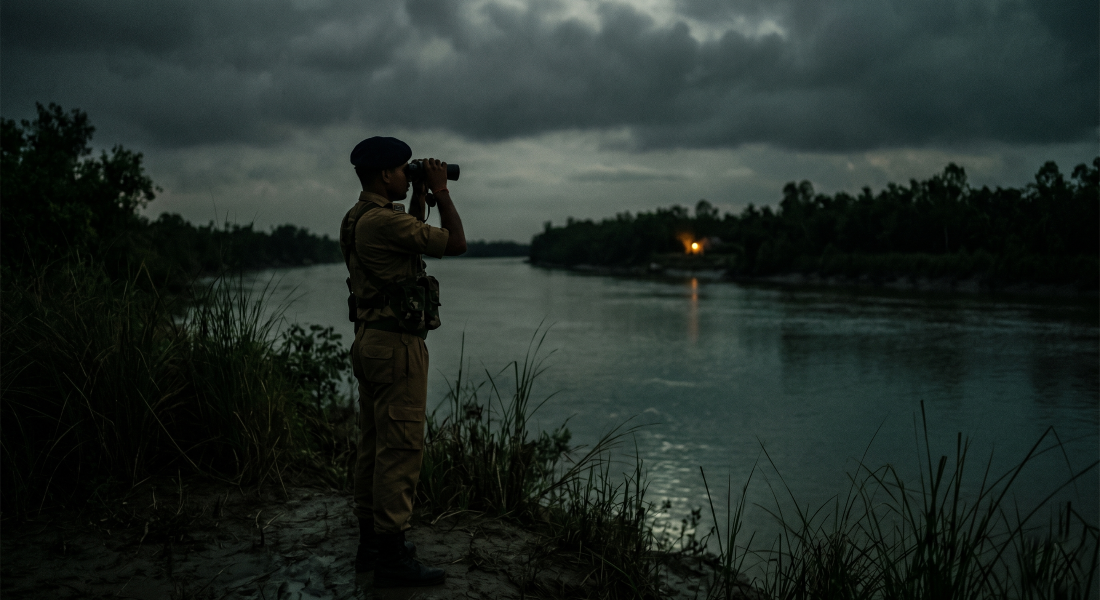
In the predawn darkness of Bengal’s border rivers — the Ichamati, the Padma’s braided arms, the tidal creeks threading through the Sundarbans — bamboo rafts still carry human silhouettes across the line that separates India from Bangladesh. Despite a partly fenced frontier, a sophisticated surveillance system, and one of the world’s largest border deployments, the eastern frontier remains porous in ways that keep intelligence officials awake at night. But the nature of the challenge has deepened far beyond what statistics on apprehensions can capture.
A Nation Built by India — and What It Became
Bangladesh was born in 1971 through India’s military intervention, diplomatic sacrifice, and the blood of ten million refugees. The founding compact was explicit: a secular, democratic Bangladesh, grounded in Bengali cultural identity rather than religious separatism — the explicit repudiation of the two-nation theory. India had, in a single war, redrew the subcontinent’s strategic map.
That compact has been progressively dismantled over fifty years. Following Sheikh Mujibur Rahman’s assassination in 1975, successive governments amended the constitution to remove secularism, rehabilitated the Bangladesh Nationalist Party’s alliance with Jamaat-e-Islami — whose leaders had collaborated with Pakistani atrocities in 1971 — and presided over the exponential expansion of madrasa education and Saudi-funded Islamist civil society. Even periodic Awami League governance could not reverse the structural ideological drift. The August 2024 fall of Sheikh Hasina, and the subsequent rehabilitation of Jamaat-e-Islami under the interim government, has now removed the last significant check on that drift.
India gave Bangladesh its existence. The erosion of secularism, the persecution of minorities — this is not merely Bangladesh’s internal affair. It is a direct and gathering threat to India’s eastern strategic environment.— News 24 Media Research
The Shrinking Minority and the Vanishing Secular Promise
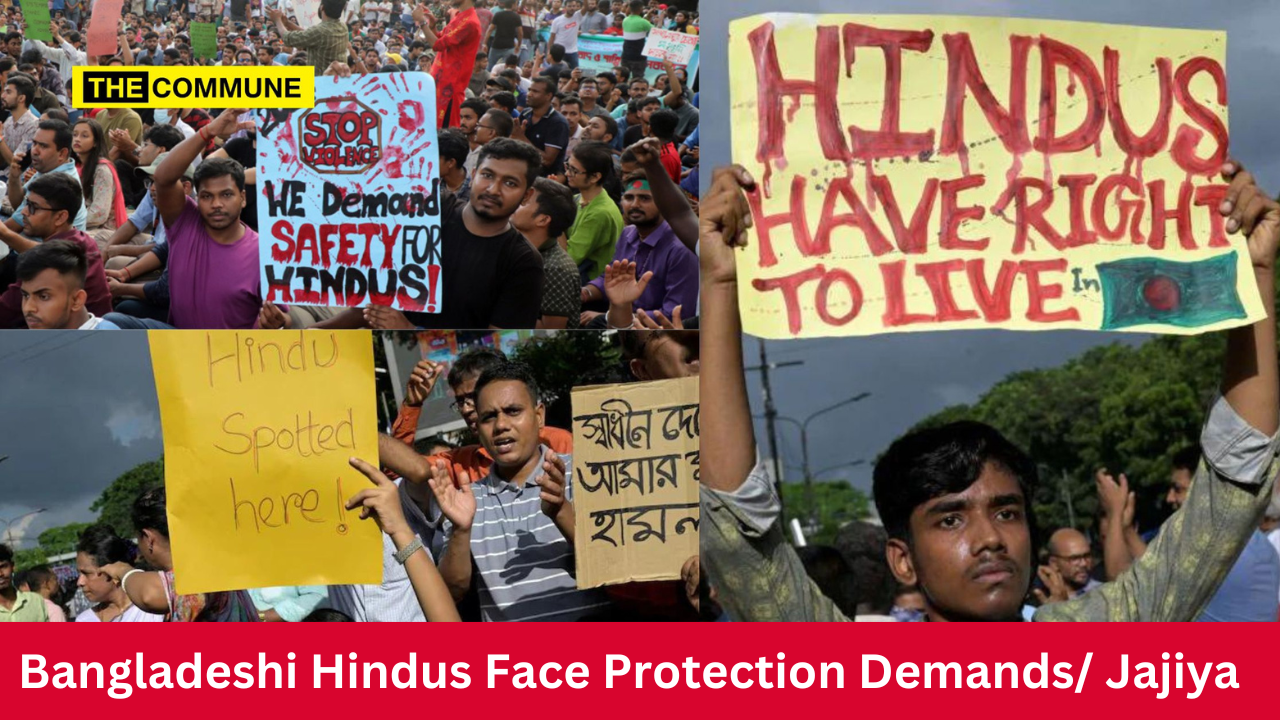
The numbers are stark. Hindus comprised 28 percent of East Pakistan’s population in 1947. By the last Bangladesh census, that figure had fallen to approximately 8 percent — and is projected to fall further. This is not natural demographic change. It is the accumulated outcome of the Enemy/Vested Property Act, periodic communal violence — including coordinated attacks across twenty-plus districts in October 2021 — and the steady social marginalisation of religious minorities in a state whose constitutional secularism exists now largely on paper. For many Hindu Bangladeshis, the choice has become binary: endure, or cross the river into India.
When Migration Becomes Infiltration — and Infiltration Becomes Influence
The overwhelming majority of undocumented migrants from Bangladesh are neither radicals nor security threats. They are desperate people fleeing poverty, floods, and displacement. But security analysts have long identified a distinct and dangerous minority embedded within that larger flow: individuals and networks connected to organisations like Jamaat-ul-Mujahideen Bangladesh, Harkat-ul-Jihad-al-Islami Bangladesh, and affiliated entities with documented links to regional and global radical movements.
More corrosive than the radical fringe, however, is the organised infrastructure of identity acquisition. Through a documented “document ecosystem” — panchayat-level intermediaries, fabricated address records, sequentially acquired ration cards, voter IDs, and Aadhaar enrollments — undocumented migrants have over decades achieved legal-seeming Indian identities. Parliamentary committees, the Election Commission, and multiple intelligence assessments have documented this pattern in border districts of West Bengal, particularly in Murshidabad, Malda, North 24 Parganas, and Nadia. The charge — contested but documented — is that political parties with electoral stakes in these communities actively facilitated, or at minimum deliberately ignored, this process.
The Electoral Earthquake and the New Security Posture
The BJP’s dramatic rise in West Bengal — from marginal presence to principal opposition force — has fundamentally restructured the political vocabulary of the border. The Citizenship Amendment Act offers a formal pathway for persecuted Hindu and Buddhist Bangladeshis. NRC discussions have been revived. BSF operations have intensified. The CIBMS surveillance infrastructure is expanding. And the political space that once shielded the infiltration infrastructure from serious scrutiny has narrowed considerably at the national level, even as state-level dynamics remain complex.
The diplomatic horizon is equally fraught. India cannot deport millions of undocumented migrants to a Bangladesh that will officially deny their nationality. No Bangladeshi government — interim or elected — could survive the domestic political cost of accepting mass repatriation. The result is a structural impasse in which the problem accumulates while the political will to resolve it remains episodically available at best.
International precedents — the EU’s offshore processing arrangements, Australia’s deterrence model, the US–Mexico enforcement framework — offer partial lessons but no clean templates. The India–Bangladesh frontier is longer, more culturally blurred, more politically volatile, and more geopolitically consequential than any of these comparisons can fully capture.
India’s eastern border is no longer merely a geographic boundary. It is becoming South Asia’s most consequential geopolitical fault line — where civilisational anxiety meets demographic pressure, where radical ideology meets porous geography, and where the accumulated failures of five decades of strategic drift are now arriving with compound interest.
The choices made in Dhaka, Delhi, and the border districts of Bengal and Assam over the next five years may determine whether this region evolves toward stability — or descends into a prolonged confrontation between nationalism, demographic transformation, radical ideology, and border sovereignty that neither country is fully prepared to manage.
History rarely announces itself. More often, it arrives in the night, across a dark river, on a bamboo raft — while the world is looking elsewhere.
Discover more from
Subscribe to get the latest posts sent to your email.






1 COMMENTS