
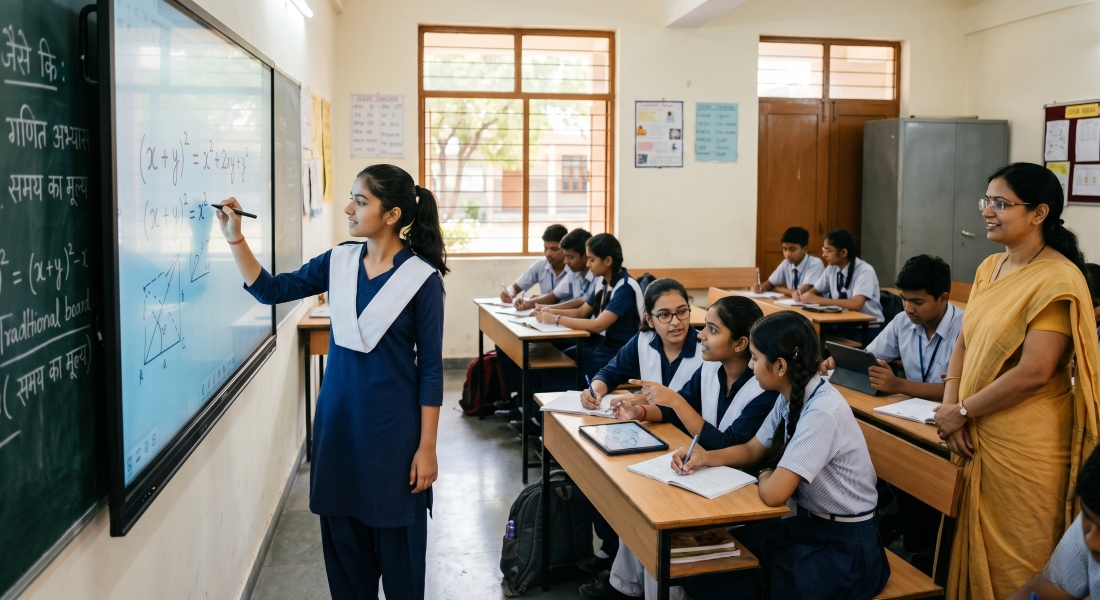
CBSE Skill-Based Learning Revolution: Why Traditional Studying Is Failing Today’s Students


Education Editorial | News24Media
CBSE’s Shift to Skill-Based Learning: Why Traditional Studying is No Longer Enough
As CBSE pushes schools toward hands-on, competency-based education, the classroom of tomorrow is moving beyond rote learning, marks, and memory.

T he Indian classroom is undergoing one of its most important transitions in decades. For years, success in school was often measured by how well a student could remember, reproduce, and score. But the Central Board of Secondary Education’s growing push toward skill-based learning and experiential learning signals a clear message: traditional studying alone is no longer enough.
CBSE has advised affiliated schools to implement Skill-Based Learning Education in Classes VI to VIII using NCERT’s Kaushal Bodh textbooks from the 2025–26 academic session, in alignment with the National Curriculum Framework for School Education 2023. The framework emphasizes project-based, practical, and competency-driven learning rather than textbook dependence alone.
The Big Shift
The question before schools is no longer whether a child can memorise a chapter. The real question is whether the child can understand, apply, communicate, create, and solve.
From Rote Memory to Real-World Readiness
Skill-based learning is not a decorative add-on to the curriculum. It is a structural change in the purpose of education. A student who learns only for exams may score well temporarily, but a student who develops problem-solving ability, communication skills, digital awareness, teamwork, and practical thinking becomes better prepared for the future.
This is also why CBSE’s recent focus on Composite Skill Labs is significant. Reports say CBSE has mandated affiliated schools to establish such labs to support hands-on and activity-based learning, aligned with NEP 2020 and NCF-SE 2023. Existing schools have been given time to comply, while new schools are expected to build such infrastructure from the beginning.
Why This Matters for Parents
For parents, this shift demands a change in mindset. The old question, “How much did my child score?” must now be accompanied by a deeper question: “What can my child actually do with what he or she has learned?”
In the age of artificial intelligence, automation, and fast-changing careers, marks remain important, but they cannot be the only measure of education. Students need confidence, curiosity, adaptability, and the ability to connect classroom learning with life situations.
CBSE’s Message is Clear: Schools Must Change
The reform is not only about students; it is also about schools. Schools must now rethink timetables, classroom delivery, teacher training, assessments, and infrastructure. Teachers will need to shift from simply completing syllabus to creating learning experiences.
CBSE has also been conducting capacity-building programmes for teachers to support skill education in Classes VI to VIII, with emphasis on practical classroom application, interdisciplinary teaching, critical thinking, and problem-solving.
Where New Age CBSE Schools Fit In
Institutions like Saraswati World School are now at a decisive moment. The school’s focus on structured lesson planning, regular classroom monitoring, student discipline, activity-based learning, English fluency, and continuous academic evaluation directly supports the direction in which Indian school education is moving.
As CBSE places greater emphasis on skills, schools that build disciplined academic systems today will be better positioned to prepare students not only for board examinations but also for higher education, future careers, and responsible citizenship.
The End of Passive Learning
Traditional studying often placed the student in a passive role: listen, memorise, write, repeat. Skill-based learning demands a more active learner: observe, question, discuss, build, present, reflect, and improve.
This does not mean textbooks are unimportant. It means textbooks must become starting points, not finishing lines. A chapter in science should lead to observation and experimentation. A lesson in mathematics should connect with logical thinking and problem solving. A language class should build confidence in speaking, writing, and expression.
AI, Digital Skills and the New Student Profile
The future student will not be judged only by memory power. The future student will be judged by the ability to learn continuously, use technology responsibly, communicate clearly, and solve unfamiliar problems.
This direction is already visible in CBSE’s wider academic reforms. In April 2026, Union Education Minister Dharmendra Pradhan launched a Computational Thinking and Artificial Intelligence curriculum for Classes III to VIII under the CBSE framework, aimed at building foundational digital skills, critical thinking, and problem-solving ability from an early stage.
The Challenge: Implementation, Not Intention
India has no shortage of policy ambition. The real test lies in implementation. Skill-based learning cannot succeed if it remains only on paper. It requires trained teachers, meaningful classroom activities, proper assessment, regular monitoring, and leadership commitment.
Schools must avoid reducing Skill-Based Learning to another notebook subject. The purpose is not to create one more burden for students. The purpose is to make education more useful, engaging, and life-connected.
Editorial View
The schools that will lead the next decade will not be those that merely produce marksheets. They will be those that produce confident, skilled, disciplined, and adaptable learners.
What Students Must Understand
For students, the message is equally important. Studying only before exams will not be enough. Students must develop daily learning habits, complete classwork and homework seriously, participate in activities, ask questions, practise communication, and learn to apply concepts.
The new education system will reward students who are active, curious, disciplined, and consistent. It will expose students who depend only on last-minute memorisation.
Conclusion: A Necessary Change
CBSE’s shift toward skill-based learning is not a temporary trend. It is a necessary response to a changing world. India’s students need more than marks. They need competence, confidence, creativity, and character.
For schools, the challenge is clear: build systems that make learning meaningful. For parents, the message is clear: support education beyond marks. For students, the path is clear: learn not only to pass exams, but to prepare for life.
News24Media Education Desk | CBSE Skill-Based Learning
Discover more from
Subscribe to get the latest posts sent to your email.







2 COMMENTS