
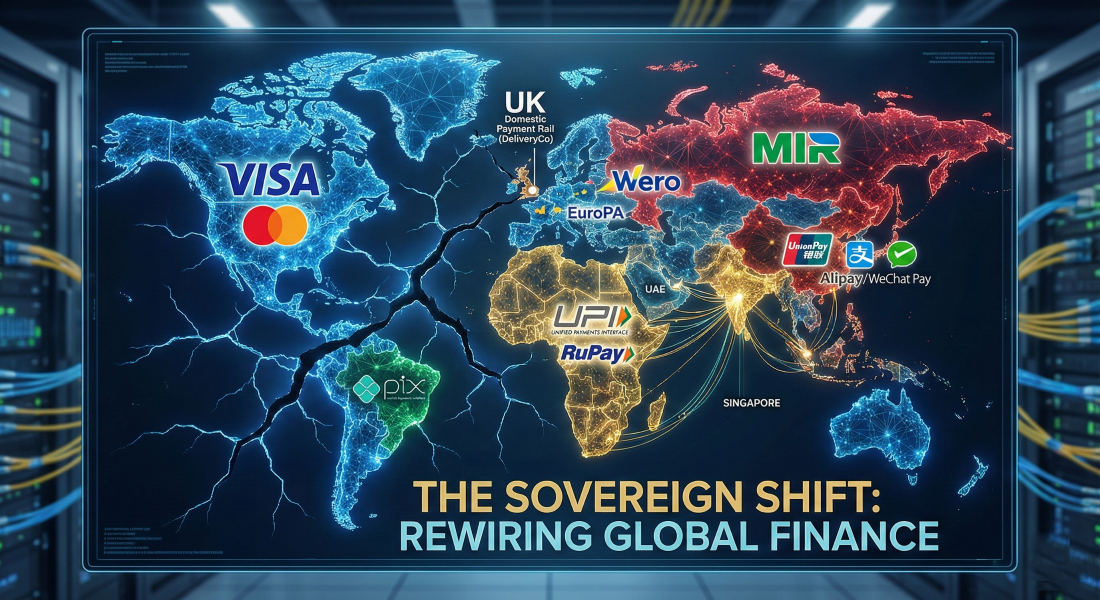
The $850 Billion Trap & Sovereign Payment Systems: Why the UK and the World Are Desperate to Ditch Visa and Mastercard


THE END OF THE DUOPOLY? HOW THE UK, INDIA, AND EUROPE ARE REWIRING THE SOVEREIGN PAYMENT SYSTEMS
For decades, the global flow of consumer capital has been quietly governed by two American giants: Visa and Mastercard. Controlling roughly 90% of the payment processing market outside of China, these two entities boast a combined market value of over $850 billion. But a seismic shift is underway.
From the banking halls of London to the tech hubs of Bengaluru and Brussels, nations are rushing to build their own sovereign payment systems gateways. The motivation is no longer just technological innovation; it is national security. The 2022 suspension of Visa and Mastercard operations in Russia following US sanctions proved that international payment rails could be weaponised overnight.
Today, countries are refusing to leave their domestic economies vulnerable to foreign policy shifts. Here is a factual look at how the world is dismantling the ultimate financial duopoly.
The UK’s “DeliveryCo” Initiative: A Shield Against Geopolitical Shocks
Britain is currently one of the most exposed major economies, with a staggering 95% of all UK card transactions processed by Visa and Mastercard. However, UK bank executives have recently initiated historic meetings to change this.
Under the working title “DeliveryCo,” a consortium of the UK’s largest financial institutions—including Barclays, Lloyds Banking Group, NatWest, Santander UK, and Nationwide—is collaborating to build a sovereign payment infrastructure.
- The Timeline: Supervised by the Bank of England and supported by the Treasury, the project aims to have a domestic account-to-account payment rail operational by 2030.
- The Catalyst: While framed publicly as a measure for operational resilience, financial insiders cite growing anxieties over US economic policies—particularly tariffs and the perceived unpredictability of the current US administration—as the driving force.
- The Goal: The UK is not banning Visa or Mastercard. Instead, DeliveryCo aims to provide a robust domestic fallback that can keep the British economy running if international networks are ever disrupted or “turned off.”
The Global Push for Financial Sovereignty
Britain is not acting alone. Across the globe, nations are deploying modern digital public infrastructure to reclaim control over their financial transactions.
1. India’s UPI: The Undisputed Global Heavyweight
India saw the strategic value of sovereign payment systems years before the rest of the world. Built as a digital public good, the Unified Payments Interface (UPI) has revolutionised global finance.
- The Volume: In the 2025-26 financial year (up to December), UPI hit a record transaction value of ₹230 lakh crore ($2.7 trillion). It processes an astonishing 18.4+ billion transactions in a single month.
- Global Dominance: Recognised by the International Monetary Fund (IMF) in 2025 as the world’s largest retail fast-payment system by volume, UPI now accounts for roughly 49% of all global real-time retail payments.
- International Reach: UPI has actively expanded beyond India’s borders and is now operational in countries including France, Singapore, the UAE, and Mauritius, linking with international fast-payment systems to bypass traditional Western routing.
2. Europe’s “Wero” Wallet: The Airbus of Payments
Determined to reduce reliance on US card networks, the European Payments Initiative (EPI)—a consortium of major European banks—has launched Wero- sovereign payment systems.
- Dubbed by EU politicians as the “European Airbus for payment systems,” Wero replaces fragmented national systems (like the Netherlands’ iDEAL or France’s Paylib) with a single, pan-European digital wallet.
- Running on the SEPA Instant Credit Transfer system, Wero moves money directly from bank account to bank account in under 10 seconds, entirely bypassing Visa and Mastercard rails.
3. The BRICS Innovators: China and Brazil for sovereign payment systems
- China: Daily commerce in China is entirely dominated by domestic apps like WeChat Pay and Alipay. Internationally, the state-backed UnionPay network operates as a massive counterweight to Western cards, handling an immense volume of global transactions driven by China’s sheer economic scale.
- Brazil: The central bank’s Pix system, launched in 2020, now manages over 37 billion transactions annually, aggressively digitising the Brazilian economy outside of the US credit card ecosystem.
The Technological and Economic Divide
Why are these new systems succeeding so rapidly? The answer lies in their fundamental architecture and economic models:
The Global Sovereign Payment Systems Shift
Traditional Duopoly vs. Emerging Sovereign Payment Systems Infrastructure
| Criteria | Legacy Duopoly (Visa, Mastercard) | Sovereign payment systems Gateways (UPI, Pix, Wero, UnionPay) |
|---|---|---|
| Architecture | Centralized Hub-and-Spoke: Private, closed-loop proprietary networks connecting issuing and acquiring banks. | Federated Account-to-Account: Often open-API digital public infrastructure (DPI) linking banks directly. |
| Transaction Scale | Massive global footprint, but losing the daily volume race. Visa processes roughly 639 million transactions daily. | Experiencing hyper-growth. India’s UPI alone has surpassed Visa, processing over 640-650 million transactions daily. |
| Settlement Speed | T+1 to T+2 Days Authorization is instant, but funds typically settle to the merchant in batches after 24-48 hours. |
Real-Time Money moves directly from the sender’s bank account to the receiver’s bank account instantly (24/7/365). |
| Merchant Fees | Charges a Merchant Discount Rate (MDR) typically ranging from 1.5% to 3% per transaction, cutting into retail margins. | Treated largely as public utilities. UPI charges Zero MDR for retail payments, while Pix charges a fraction of a cent. |
| Geopolitical Risk | Subject to US jurisdiction. Networks can be (and have been) switched off as a tool of Western sanctions. | Provides economic sovereignty. Insulates domestic economies and bilateral trade from foreign policy shocks. |
The Bottom Line for Global Trade
The rise of DeliveryCo, Wero, and UPI represents a fundamental rewiring of global trade. By establishing direct, interoperable domestic networks, countries are slashing cross-border remittance fees, empowering micro-businesses, and—crucially—paving the way for “de-dollarisation” by allowing direct currency settlements without routing through the US Dollar or the SWIFT system.
The era of a unipolar financial system is ending. The future of money is sovereign, instant, and multipolar.
sovereign payment systems
Discover more from
Subscribe to get the latest posts sent to your email.