
Kolkata Marathon Triggers Massive Traffic Chaos, Exposes Gaps in City Event Planning


Kolkata Marathon Morning: When a City Woke Up to Gridlock, Not Glory
By early Sunday morning, the promise of a city celebrating fitness had curdled into something far more familiar — frustration.
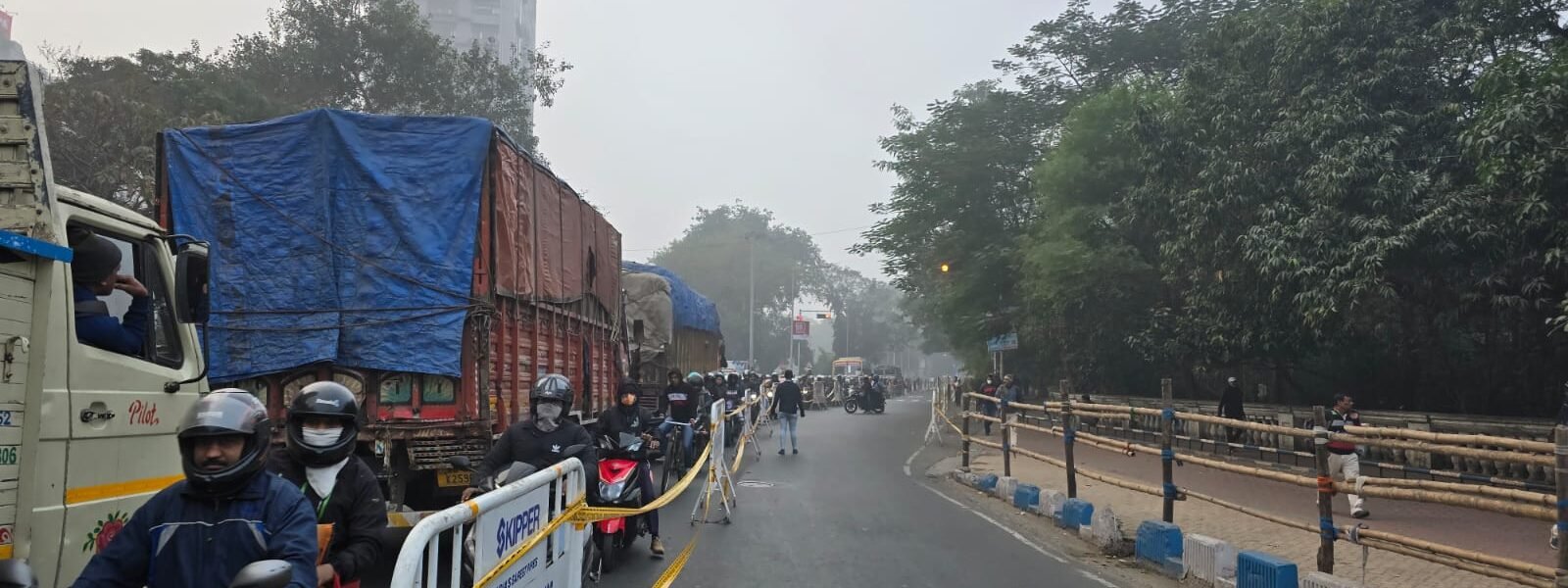
Just after dawn, around Victoria Memorial, the Maidan and Park Street, Kolkata was already honking awake. Cars stood bumper to bumper. Regular morning walkers and workers peered anxiously at their watches. Elderly walkers returning from their morning strolls found themselves trapped behind metal barricades, unsure which crossings were open. Families heading for their destinations, hospitals or railway stations sat immobile in vehicles for nearly an hour or more.
Kolkata Marathons are meant to celebrate health, discipline and community spirit. But for thousands of Kolkatans, today’s marathon turned into a torturous morning — one defined less by runners and ribbons, and more by stalled traffic, confused diversions and a city seemingly unprepared for the very event it had approved.
How the morning unravelled
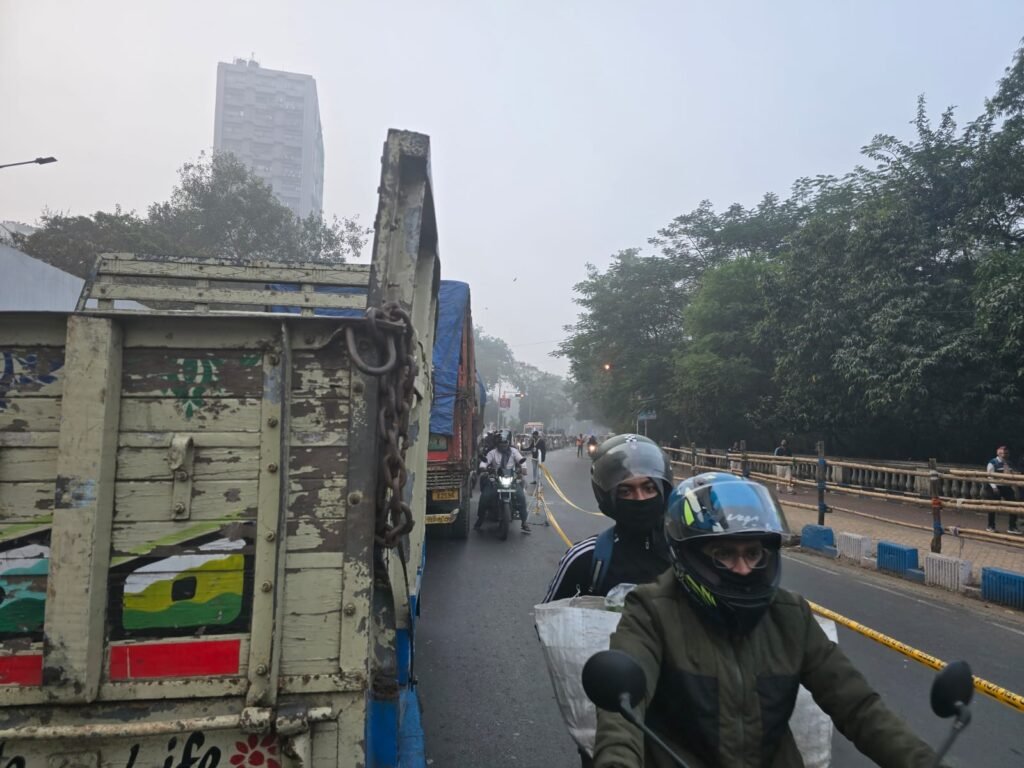
According to traffic advisories and on-ground reporting, the Kolkata Marathon route covered large stretches around Victoria Memorial, the Maidan, Park Street and connecting corridors along AJC Bose Road. Multiple arterial roads and link intersections were barricaded early, with movement restricted well beyond what many residents expected.
Between roughly 6:00 a.m. and 9:00 a.m. — based on reported estimates from commuters and drivers — vehicles barely moved through several key stretches. Park Street crossings were intermittently sealed. Access points near the Maidan were shut or opened without a clear indication. AJC Bose Road connectors saw traffic piling up as diverted vehicles merged into already narrow lanes.
Alternative routes, where mentioned, were poorly marked. Several commuters said diversions were not announced verbally at barricades. App-based navigation systems struggled to keep up with last-minute closures, leaving drivers circling the same blocks repeatedly.
Public buses crawled, auto-rickshaws stopped accepting passengers mid-route, and at least two app-cab drivers reported cancelling multiple rides because they could not reach pickup points. More worrying for many residents was the absence of clearly marked emergency corridors — a standard protocol in large-city events.
“It felt like the city was under siege”
For those caught in the gridlock, the impact was immediate and personal.
A daily walker in his late 60s near the Victoria Memorial said he waited nearly 40 minutes to cross a road he traverses every morning. “There was no volunteer who could tell us when it would open. Standing that long is not easy at this age,” he said.
An office-goer stuck near Park Street described being stranded in a cab for over an hour. “I support marathons. But no one told us the entire stretch would be blocked like this. I missed a critical morning meeting,” she said.
App-cab drivers spoke of rising tempers. “Passengers blame us, but we had no idea which roads were open. Barricades appeared suddenly,” said one driver who estimated losing half a day’s earnings.
The common refrain was not opposition to the Kolkata Marathon itself, but disbelief at the scale of disruption — and how little warning or guidance residents received.
Who was responsible — and what went wrong
The Kolkata Marathon was organised by private event organisers and sponsors, with permissions and traffic management handled by civic authorities and the Kolkata Police.
Officials had issued advisories, but many residents said these did not reach housing complexes, local clubs, or morning commuters in any meaningful way. Social media posts and press notes, they argue, are insufficient in a city where lakhs rely on routine morning movement.
Several gaps became evident on the ground:
- Inadequate prior notification: Many residents near the route said they learned of closures only after encountering barricades.
- Poor signage: Diversions were unclear, temporary, or missing entirely at key intersections.
- Last-minute barricading: Roads appeared to be sealed without staggered timing, amplifying congestion.
- Lack of real-time updates: No central, live traffic feed guided commuters through alternative corridors.
- Weak coordination: Event marshals and traffic police were often seen giving different instructions.
Not an isolated failure
Kolkata is no stranger to managing large events — from Durga Puja to political rallies to international matches. Past Kolkata Marathons and city runs have been conducted with fewer complaints, aided by better route planning and clearer communication.
The contrast makes today’s disruption more glaring. It also comes close on the heels of a recent crowd-management mess at a major event at Salt Lake Stadium, where poor coordination led to confusion and safety concerns. Together, these episodes raise uncomfortable questions.
Is there a widening gap between the ambition to host mega-events and the capacity to manage basic city logistics? Are permissions being granted without enforceable planning benchmarks?
The larger civic question
At its heart, this is not an argument against Kolkata Marathons or public celebrations. It is about balance.
How many truly benefit from such events, and how many suffer quietly in traffic jams, missed shifts, delayed medical visits and physical discomfort? Could the same Kolkata Marathon have been routed through fewer residential corridors, or scheduled at a time that spared peak city movement?
Urban planners and traffic experts often point to best practices from other global cities: staggered road closures, night-time or ultra-early starts with rapid reopening, compulsory emergency lanes, and aggressive, multi-platform public communication days in advance.
Civic activists argue that repeated mismanagement sends a troubling message — that citizens’ time and dignity are secondary to spectacle.
Lessons Kolkata cannot afford to ignore
The solutions are neither radical nor expensive:
- Transparent route planning with public consultation
- Early, wide notification through local councils, housing associations and public transport networks
- Clear, physical signage at every diversion point
- Real-time traffic dashboards integrated with navigation apps
- Dedicated emergency corridors monitored continuously
- A clear accountability framework for organisers and approving authorities
The goal is not to stop Kolkata Marathons, festivals or public events. It is to ensure that the joy of a few does not become the suffering of lakhs.
A city at a crossroads
This morning’s gridlock will fade from memory for many. But the lesson should not.
Kolkata must decide what kind of city it wants to be — one that celebrates ambition while planning meticulously for its people, or one that keeps learning the same lessons the hard way, at the cost of its citizens’ patience.
A marathon tests endurance. So does city living. Only one of these should be unnecessary.
Kolkata marathon traffic chaos, Kolkata marathon mismanagement, Kolkata traffic disruption today, Kolkata city news marathon
Recent Posts
- Bangladesh Sees Surge in Islamist Violence as Hindu Minority Faces Rising Attacks Amid Political Instability
- Top 25 International Schools in India Announced Under Good School Rating 2025–26
Discover more from
Subscribe to get the latest posts sent to your email.








1 COMMENTS