
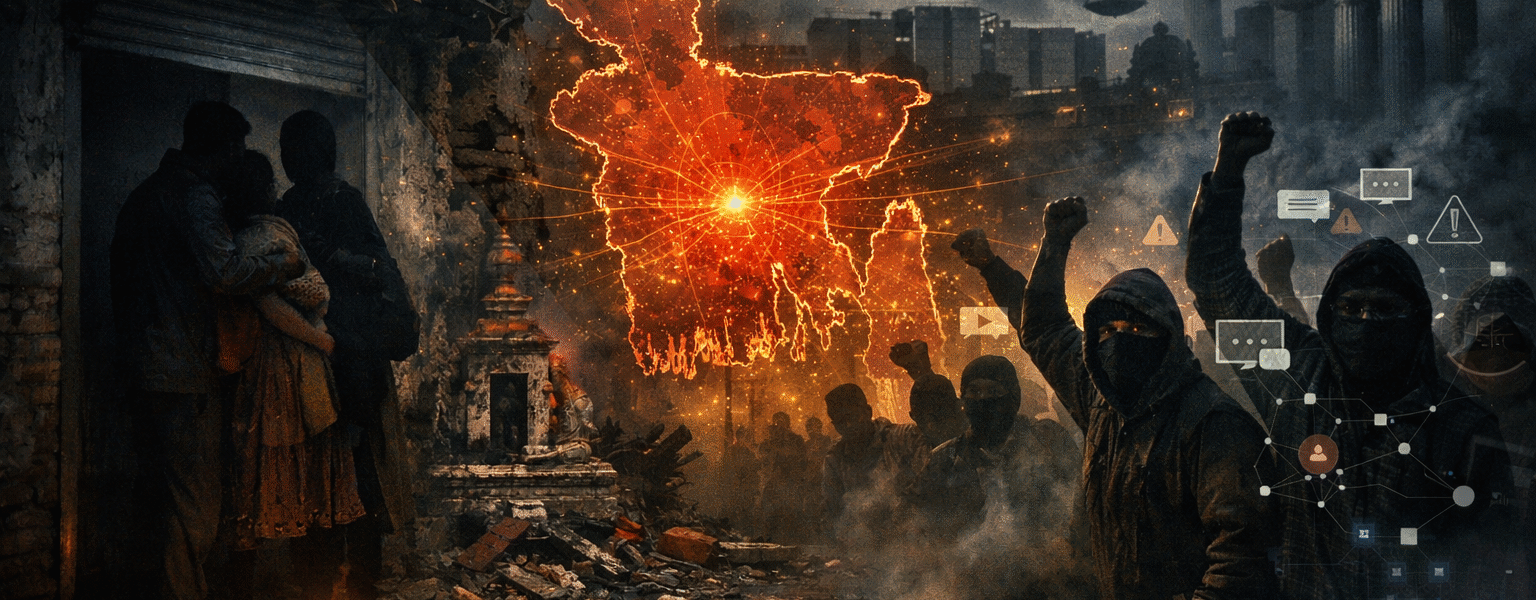
Bangladesh Sees Surge in Islamist Violence as Hindu Minority Faces Rising Attacks Amid Political Instability


Radicalisation, Power Vacuums, and Fear: Bangladesh’s Growing Crisis of Islamist Violence
Dhaka | International Desk
Bangladesh is confronting one of its most unsettling internal crises in years, as a wave of radicalised Islamist violence has followed the death of a radicalised youth preacher named Hadi, triggering unrest that has disproportionately targeted the country’s Hindu minority. What began as localised anger after Hadi’s killing has rapidly evolved into a broader pattern of mob Islamist Violence, public lynchings, arson attacks, and intimidation — exposing deep vulnerabilities in Bangladesh’s political and social fabric during a period of post–Sheikh Hasina uncertainty.
Human rights groups, regional security analysts, and local journalists warn that the Islamist Violence is not an isolated episode, but rather the outcome of years of growing radicalisation, weakened governance, and the expanding influence of Islamist populism — both on the streets and across digital platforms.
A Timeline of Escalation: From a Death to a Nationwide Shock
The unrest erupted following the death of Hadi, a young preacher known for incendiary online sermons that blended religious rhetoric with anti-minority narratives. While the exact circumstances of his death remain disputed, extremist groups rapidly framed it as a “martyrdom,” mobilising supporters through encrypted messaging apps and social media platforms.
Within days:
- Protest marches turned into Islamist Violence in multiple districts
- Hindu-owned shops and homes were vandalised or torched
- A Hindu man was publicly lynched and burned, an incident that sent shockwaves across the country
- Local police units, overstretched and under-resourced, struggled to regain control
According to verified reports compiled from local media and international observers, more than two dozen serious communal incidents were recorded in a matter of weeks — a sharp spike compared to previous years.
Targeted Islamist Violence Against the Hindu Minority
Bangladesh’s Hindu community, roughly 7–8% of the population, has long faced episodic discrimination, but the current wave marks a disturbing escalation in brutality and visibility.
Human Rights Watch and Amnesty International have documented:
- Coordinated mob attacks on Hindu neighbourhoods
- Desecration of temples and religious symbols
- Forced displacement of families fearing reprisal
- Patterns of violence timed with inflammatory online campaigns
A senior researcher at a regional rights watchdog noted that “the speed at which rumours turn into mobs suggests organised radical networks exploiting local grievances rather than spontaneous unrest.”
Voices From the Ground: Lives Caught in the Crossfire
To protect identities, the accounts of survivors have been anonymised.
“They came shouting slogans just before sunset,” recalled R, a middle-aged shopkeeper from a semi-urban district. “I hid my children inside and watched from a crack in the wall as they broke the idol in our small shrine. The police came hours later.”
Another witness, S, described fleeing her village after threats circulated on WhatsApp groups naming Hindu households:
“We have lived here for generations. Overnight, we were told we no longer belonged.”
Such testimonies underline the human cost behind the statistics — fear, displacement, and a growing sense of abandonment among minority communities.
Political Instability and the Rise of Islamist Populism
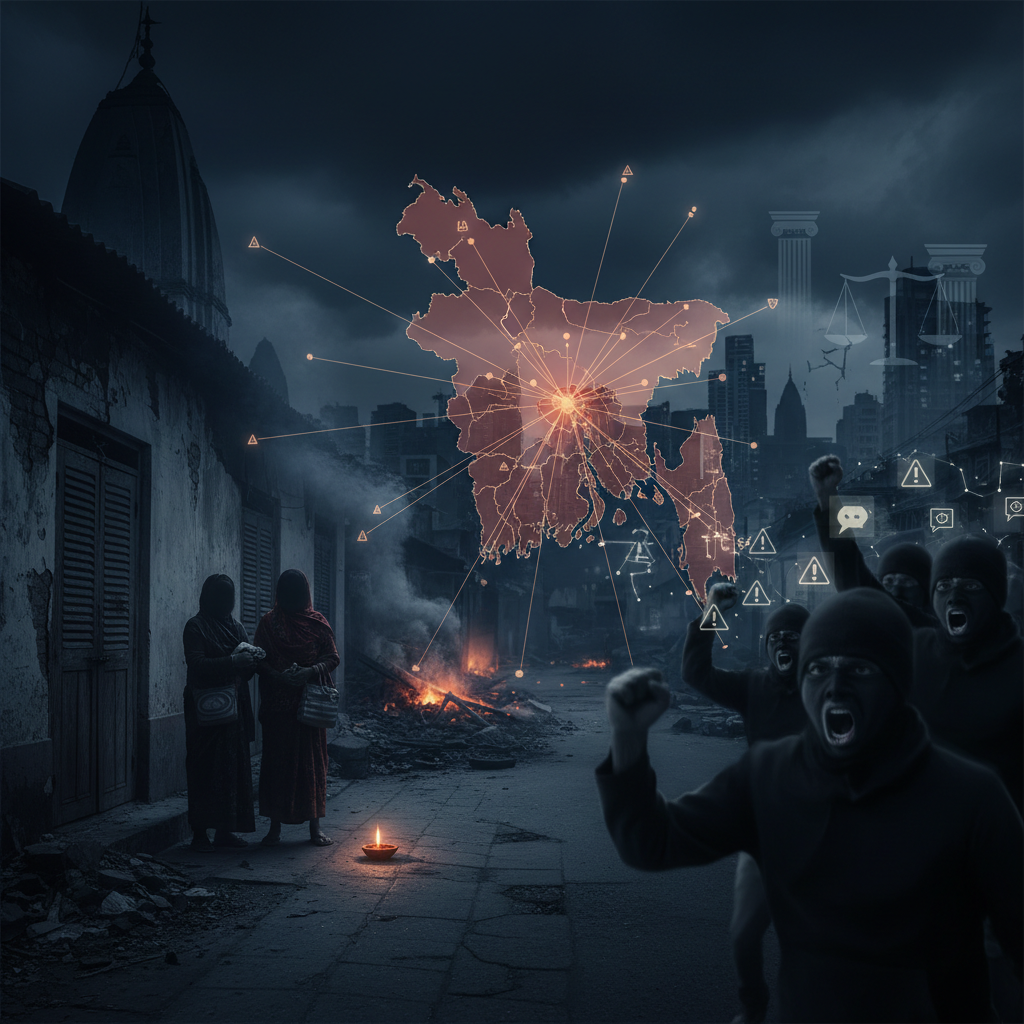
Analysts argue that Bangladesh’s current vulnerability is inextricably linked to its ongoing political transition. The weakening of centralised authority in the post–Sheikh Hasina period has created space for Islamist factions to reassert themselves — both politically and socially.
Key factors include:
- A power vacuum at the local administrative level
- Fragmented law enforcement, hesitant to confront large religious mobs
- Islamic populist narratives portraying minorities as political proxies or cultural threats
- Digital radicalisation, amplified by foreign extremist content and local influencers
A South Asia security expert explained:
“When governance weakens, identity politics hardens. Islamic Extremist groups thrive by presenting themselves as defenders of faith during moments of uncertainty.”
The Online Ecosystem of Radicalisation
Counterterrorism specialists point to encrypted platforms, short-video apps, and fringe Facebook groups as accelerators of violence. Hadi’s sermons, widely circulated even after his death, reportedly framed Islamist Violence as a religious duty — a narrative quickly adopted by more extreme actors.
This pattern mirrors trends seen elsewhere in South Asia, where leaderless radicalisation allows Islamist Violence to erupt without direct organisational commands.
Government Response and International Concern
Bangladesh’s interim authorities have condemned the Islamist Violence and announced arrests, but critics say responses remain reactive rather than preventive. Curfews and internet restrictions have slowed unrest in some areas, yet human rights groups caution that heavy-handed measures may further alienate communities.
Internationally, diplomatic missions and the United Nations have urged Dhaka to:
- Ensure protection for religious minorities
- Hold perpetrators accountable regardless of affiliation
- Counter extremist propaganda through transparent governance
Regional Implications: A South Asian Warning Signal
Bangladesh’s growing radicalisation carries consequences beyond its borders. Analysts warn of:
- Cross-border extremist spillover into India and Myanmar
- Heightened refugee pressures if minority displacement accelerates
- Increased strain on regional counterterrorism cooperation
- A shift in South Asia’s internal security balance if Islamist networks consolidate power
As one regional policy expert summarised:
“Bangladesh’s stability has long been a pillar of eastern South Asia. If Islamic radicalisation becomes normalised, the ripple effects will be profound.”
A Fragile Moment
The violence following Hadi’s death is not merely a law-and-order crisis; it is a test of Bangladesh’s pluralistic identity and institutional resilience. Whether the country can reverse this trajectory depends on restoring trust in governance, confronting extremist ecosystems, and ensuring that minority safety is treated not as a concession but as a constitutional obligation.
For now, fear lingers in many neighbourhoods, and the world is watching closely.
Bangladesh Islamist violence, Hindu minority attacks in Bangladesh, Bangladesh radicalisation crisis, Post Sheikh Hasina Bangladesh unrest, Religious violence in Bangladesh, Islamist extremism South Asia, Bangladesh mob lynching minorities, Political instability Bangladesh, Bangladesh human rights crisis
Discover more from
Subscribe to get the latest posts sent to your email.







3 COMMENTS