
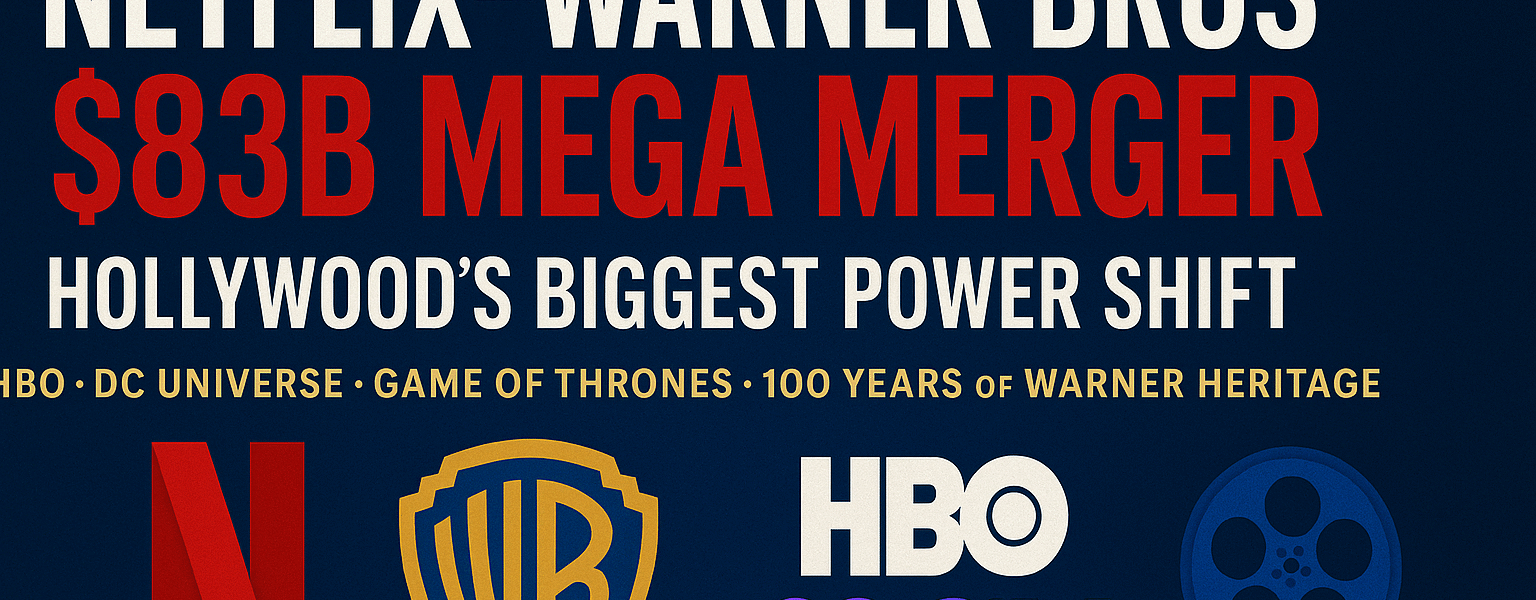
Netflix Warner Bros Acquisition 2025: The $83 Billion Power Shift Reshaping Hollywood, HBO Max & Global Streaming


The $83 B Netflix Warner Bros Power Play: What Netflix’s Acquisition of Warner Bros Means for Hollywood
On December 5, 2025, Netflix stunned Hollywood and Wall Street by announcing a definitive agreement to acquire Warner Bros. Discovery’s film and television studios, streaming operations, and premium-content assets — including HBO, HBO Max and the storied Warner Bros. film and TV library — in a blockbuster deal valued at US$82.7 billion in enterprise value (US$72.0 billion equity value at US$27.75 per share).
The announcement of Netflix Warner Bros triggered a sharp market reaction. Shares of Warner Bros. Discovery jumped, while those of several competing media firms slipped as investors digested the dramatic shift in competitive dynamics. Netflix emerged victorious from a fierce bidding war that included rival suitors such as Paramount, Skydance and Comcast — underlining how high the stakes had become for control over Hollywood’s most valuable franchises.
Century of Stories Meets Streaming Dominance
Warner Bros. isn’t just a brand name — it is one of the founding institutions of Hollywood, with nearly a 100-year legacy of storytelling across genres, media and generations. Founded in 1923, the studio grew to dominate American film and TV, fostering landmarks from early classics to global-scale franchises.
Over the decades, Warner Bros. built — or acquired — a treasure trove of intellectual property (IP): from timeless films and cartoons to television hits and modern blockbuster sagas. Its library is vast: by 2022, the studio boasted more than 145,000 hours of programming, including 12,500 feature films and 2,400 TV programs spanning over 150,000 individual episodes.
Franchises like the DC Universe (with iconic superheroes such as Batman, Superman and Wonder Woman), wizarding worlds like Harry Potter, cinematic phenomena such as The Wizard of Oz, and cult hits like Game of Thrones (via HBO) have shaped decades of pop culture. On top of that, smash television series such as The Big Bang Theory, plus countless classic films, animated features, and award-winning dramas, make Warner’s vault among the richest in entertainment history.
Yet in recent years, the merged Warner Bros. Discovery (WBD) — itself a product of the 2022 union of legacy WarnerMedia with Discovery, Inc. — has faced headwinds. Shifting consumer habits, restructuring efforts, and declining linear-TV revenues placed growing pressure on the studio’s vast but costly operation.
The $83 B Netflix Warner Bros Power Play
What Netflix Gets
Under the terms of the Netflix Warner Bros deal, Netflix acquires more than just a brand name — it inherits:
- Warner Bros. film and TV production assets, including studios, lots, future pipelines and classic libraries;
- HBO and HBO Max are premium streaming brands and subscription services, along with their original content libraries spanning a decade.
- DC Entertainment/DC Studios is giving Netflix direct control of a massive superhero IP universe.
- Ancillary assets, including licensing, distribution, consumer products, and gaming, are broadening Netflix’s footprint beyond pure streaming.
WBD’s remaining linear cable and lifestyle networks — such as CNN, HGTV, TNT and others — are excluded from the deal and will be spun off into a separate public company, Discovery Global, expected to launch in Q3 2026.
Why Netflix Won
Netflix’s bid of US$27.75 per WBD share (mix of cash and stock) translated into US$72 billion in equity — enough to outbid Paramount Skydance and Comcast after months of aggressive competition.
The Netflix Warner Bros bid’s structure played a pivotal role: by targeting only the studios and streaming arm — avoiding the legacy cable networks — Netflix presented a cleaner, more focused offer, aligning with its global streaming ambitions.
The boards of both companies approved the sale unanimously — signalling that stakeholders believed the offer maximised value and offered a viable path forward amid a rapidly shifting media landscape.
Strategic Synergies: Content, Scale & Global Reach
For Netflix, the acquisition offers more than just a content upgrade — it represents a strategic leap that could reshape its global competitive positioning and business model.
1. From Streaming Platform to Entertainment Powerhouse
By absorbing Warner Bros. Studios, Netflix gains theatrical production and distribution capabilities — a realm it has tiptoed into but never fully owned. This opens the door to producing blockbuster films, leveraging theatrical releases alongside streaming-first content, and reclaiming prestige in cinema.
Moreover, adding premium pay-TV content from HBO and HBO Max complements Netflix’s breadth with depth — offering award-driven prestige series, cinematic films, and high-quality storytelling that resonates globally.
2. Global Subscriber Upside & Cost Efficiency
Combining Netflix’s global OTT scale with Warner’s franchises and IP vault opens massive cross-selling and bundle opportunities. Analysts suggest this could translate into lower per-subscriber content costs, improved retention, and accelerated growth — especially in international markets where HBO’s penetration has lagged.
Cost synergies are another draw: early estimates from observers point to potential savings of US$2–3 billion by the third year post-integration, thanks to consolidated operations, reduced duplication in content acquisition/licensing, and streamlined production/distribution channels.
3. Diversified Revenue Streams — Licensing, Games, Merchandising
Beyond streaming, Warner’s assets include video games, licensing, merchandising and global distribution — business lines that Netflix, till now, largely outsourced or bypassed. Control over these verticals unlocks new monetisation opportunities, from international licensing deals to gaming adaptations and consumer products tied to iconic franchises.
Hollywood’s New Monolith? Industry Disruption & Backlash
This Netflix Warner Bros acquisition isn’t just big — it’s potentially transformational. By aggregating two of the most powerful catalogues and platforms in entertainment, Netflix risks remaking the industry’s competitive, creative, and regulatory landscape.
Consolidation — and Monopoly Concerns
Regulators and critics have already raised red flags. With Netflix absorbing both its own streaming scale and HBO Max’s content — including franchises like DC, Harry Potter, Game of Thrones — the deal may create a near-monopoly in Western streaming and content distribution.
In the U.S., Europe and elsewhere, antitrust authorities are expected to examine whether the merger suppresses competition, reduces consumers’ options, or gives Netflix unfair bargaining power — especially in licensing, theatrical distribution, and global content deals.
As one op-ed bluntly put it: consolidating two major players into one “winner-take-most” powerhouse could spell the end of the “Golden Age” of streaming for many content creators and smaller players.
Jobs, Creative Output, and Theatrical Risk
Industry insiders and unions have warned that the merger could mean job cuts, particularly in production, distribution, and legacy cable operations. The fear: with fewer content buyers, there may be less demand for original content, fewer theatrical releases, and a shrinking marketplace for creators.
Cinema owners, too, are anxious. With Netflix now controlling both streaming and theatrical pipelines, there’s concern that theatrical-first releases could give way to streaming-focused launches — reducing box-office revenue and undermining the economics of movie theatres worldwide.
Creative Opportunity — or Homogenization?
On one hand, the Netflix Warner Bros consolidation may offer creators unprecedented access to resources, global distribution and franchise-building potential. A smaller number of “big players” might invest heavily in fewer, higher-quality projects rather than scatter resources across many.
On the other hand, creative diversity could suffer. With fewer commissioning platforms and more centralised decision-making, there’s a risk that content becomes more formulaic, risk-averse, and driven by franchise potential rather than originality.
What This Means for the Future — Consumers, Creators, Rivals
Regulatory Road Ahead
The Netflix Warner Bros deal is expected to close only after the spin-off of Discovery Global, slated for the third quarter of 2026, and it will likely require approval from multiple antitrust authorities worldwide, including U.S. regulators.
Regulators will closely examine whether the merger stifles competition, reduces consumer choice, or consolidates excessive power in the hands of one corporate entity. Given recent global scrutiny of Big Tech and media consolidation, Netflix may face tough bargaining, possible mandated divestitures, or structural remedies before final approval.
For Shareholders — Windfall and Risk
For WBD shareholders, the deal represents a substantial premium and a clean exit from a challenging post-merger environment. For Netflix shareholders, the acquisition offers a path to dominant scale, diversified revenue streams and long-term growth — but also raises the company’s leverage significantly given the debt and financing required (see below).
Netflix reportedly secured a massive bridge loan to finance the deal (widely reported in financial news coverage). The gamble: success depends on Netflix’s ability to integrate smoothly, retain subscriber growth, and unlock the promised synergies without alienating creators or regulators.
For Creators, Employees and Consumers
If managed well, the combined entity could provide creators with deeper pockets, global distribution, and more opportunities to build ambitious universes across film, TV, gaming and merchandise — potentially ushering in a new era of blockbuster creativity.
But the Netflix Warner Bros consolidation also raises red flags around creative diversity, job security, and gatekeeping. With fewer major players controlling green-lighting, there’s a risk that many voices — especially niche, arthouse or low-budget creators — may find it harder to secure funding or exposure.
For consumers, the deal could mean a richer, more unified library — but also less choice, potential subscription-price increases, and fewer independent streaming alternatives.
What This Means for Rivals — and the Broader Industry
With Netflix now owning arguably the deepest IP and content library in Hollywood, rivals like The Walt Disney Company, Amazon, MGM Studios, and other major streamers face a tougher uphill battle. Disney in particular — which has long relied on breadth (Disney, Marvel, Star Wars) rather than acquired studio libraries — may now find itself competing not just on new content but on legacy catalogue strength.
Smaller streaming services, independent studios, and niche content platforms may struggle to compete — leading to further consolidation or an increased focus on regional/local markets, indie content, and differentiated offerings.
Table: Key Assets and Franchises Acquired by Netflix
| Asset / Division | Notable Franchises / Content | Strategic Value |
|---|---|---|
| Warner Bros. Studios (film & TV) | Films & TV library: 12,500 films, 2,400 TV shows, 145,000+ hours | Massive content vault; theatrical and streaming output |
| DC Entertainment / DC Universe | Batman, Superman, Wonder Woman, etc. | Superhero IP — global appeal, merchandising, cinematic universe potential |
| HBO / HBO Max | Originals & prestige series (Game of Thrones, The Sopranos, etc.), broad TV catalogue | High-quality series and films — bolsters prestige and subscriber retention |
| Video games / Licensing / Merchandising divisions | Gaming IP (e.g., Hogwarts Legacy), global licensing | New revenue streams beyond streaming — games, merchandise, global licensing |
What Lies Ahead — Netflix’s Gamble to Reshape Entertainment
As the dust settles, several critical questions remain about how Netflix will manage the transition, and whether the entertainment industry will be stronger — or more vulnerable — under the weight of such consolidation.
- Regulatory scrutiny and potential remedies may reshape or limit the scale of integration. Even after approval, Netflix may face forced divestitures or conditions to protect competition.
- Integration challenges — aligning corporate culture, production pipelines, legacy contracts, and global distribution — could stall cost synergies or delay new content output.
- Creative balance and diversity — with fewer major studios, the risk is that content becomes driven by franchise potential and profitability metrics, at the expense of creative experimentation and smaller-scale, edgy storytelling.
- Impact on theatrical release models — with Netflix now owning a powerful studio system, the role of cinemas may be diminished if streaming-first or hybrid release strategies become dominant. Theatre owners and global distributors may resist or feel squeezed.
- Consumer experience and pricing — Netflix might leverage its expanded catalogue and platforms to justify higher subscription prices, or bundle HBO content — potentially reducing choice or increasing costs for subscribers.
For rivals, the bar has been raised: competing platforms must find ways to differentiate through unique content, regional focus, or new delivery models. For independent creators, the landscape becomes riskier but also potentially rewarding — if they land a green light from this newly consolidated powerhouse.
Final Word: A New Era of Hollywood — But at What Cost?
The acquisition of Warner Bros. by Netflix marks a seismic turning point in entertainment history — a collision of streaming ambition with century-old Hollywood prestige. The combined entity promises content depth, scale and global reach like never before.
Yet with great power comes great scrutiny. As consolidation tightens, the risks of reduced competition, creative homogenization, and diminished opportunities for smaller players grow. For the industry — from creators to consumers to regulators — the next 18 months will be critical.
Will this deal usher in a new golden age of global storytelling under a unified roof? Or will it signal the end of diversity, competition and cinematic plurality? For now, Netflix has bet big. The world of entertainment is watching — and holding its breath.
Dhurandhar Trailer Review: Ranveer Singh’s Bold Spy Makeover Ignites Buzz Online
Netflix Warner Bros acquisition 2025, Netflix buys Warner Bros Discovery, HBO Max merger news, Warner Bros Discovery sale, Netflix $82.7B takeover, Entertainment industry consolidation, Streaming wars 2025, Hollywood merger news, Netflix HBO deal explained, DC Universe Netflix, Warner Bros acquisition analysis, Netflix Warner Bros merger impact, Global streaming competition 2025
Discover more from
Subscribe to get the latest posts sent to your email.