Vedamurti Devavrat Mahesh Rekhe: The Young Prodigy Behind India’s Historic Vedic Triumph


The 19-Year-Old Who Revived a 200-Year-Old Vedic Feat: The Extraordinary Journey of Vedamurti Devavrat Mahesh Rekhe
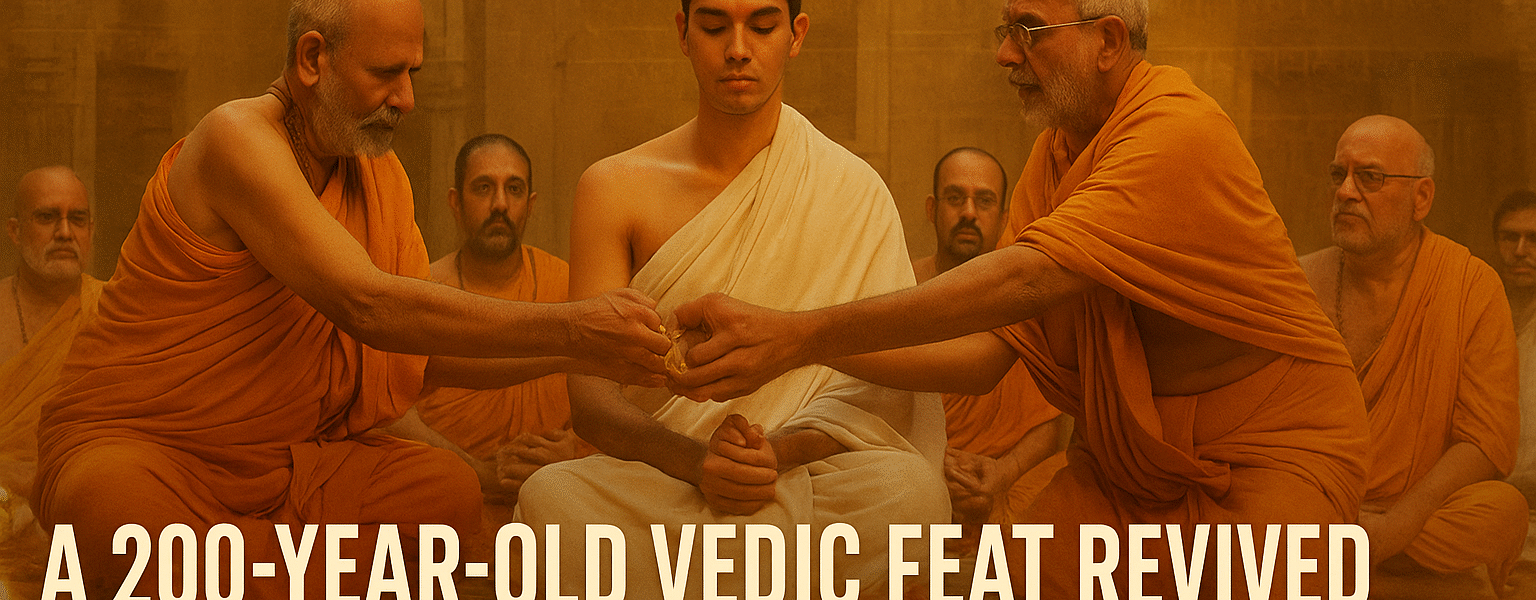
On a crisp late-autumn morning in Kashi, the inner courtyard of the Vallabharam Shaligram Sangved Vidyalaya glowed with lamps as priests, scholars, and students gathered around a young man draped in a simple white angavastram. At the centre stood 19-year-old Devavrat Mahesh (Devavrat) Rekhe, his palms folded, eyes lowered, as senior acharyas of the Sringeri Sharada Peetham placed a gold bracelet on his wrist and offered their blessings.
The felicitation was more than ceremonial. Just days earlier, the teenager had completed the Dandakrama Parayanam — an extraordinarily rare, technically demanding recitation of nearly 2,000 mantras from the Shukla Yajurveda (Madhyandina branch) — performed from memory for 50 consecutive days, for several hours each day, without a single textual reference.
For Vedic scholars gathered in Varanasi, the moment was historic. They described this recital as “classically pure in a way that has not been recorded in nearly 200 years,” a level of precision and endurance seen only in a handful of instances in documented Vedic oral history.
It might have remained a niche spiritual achievement — until Prime Minister Narendra Modi amplified it on X, praising Devavrat’s “extraordinary dedication” and expressing “deep pride” that a teenager had mastered a parayanam considered nearly impossible. Overnight, the young scholar from Maharashtra became a national conversation.
Who Is Vedamurti Devavrat Mahesh Rekhe? The Journey From Ahilyanagar to Kashi
Vedamurti Devavrat Mahesh Rekhe hails from Ahilyanagar (Ahmednagar district) in Maharashtra, born into a family where Vedic learning is not just a discipline but a way of life. His father and primary guru, Vedabrahmasri Mahesh Chandrakant Rekhe, is a respected examiner of the Shukla Yajurveda Madhyandina Shakha, affiliated with Vedic bodies aligned with the Sringeri Peetham.
From childhood, Devavrat was trained in the traditional guru–shishya parampara — long hours of memorisation, tonal practice, breath control, and ritual discipline. He moved to Varanasi for advanced training, where his teachers soon recognised an unusually sharp memory and rare capacity to retain complex svara patterns.
In 2025, after completing multiple internal assessments and parikshas, Devavrat was formally conferred the title “Vedamurti” — a prestigious designation customarily reserved for those who display mastery over core Vedic recitation systems and maintain classical purity in delivery. In Vedic circles, the title signals not just scholastic achievement but admission into a lineage of oral custodians who uphold the Vedas through disciplined practice.
What Exactly Did He Achieve? Understanding the Dandakrama Parayanam
For most Indians — and even many who study Sanskrit — the term Dandakrama Parayanam is unfamiliar. Scholars describe it as a “crown-jewel style of Vedic chanting,” involving:
- extremely intricate svara (tonal) patterns,
- interwoven phonetic permutations,
- around 2,000 mantras from the Shukla Yajurveda,
- approximately 2.5 lakh syllables recited daily,
- performed in a fixed, uninterrupted sequence.
This style belongs to the advanced family of Vedic recitation modes, including padapatha, krama, jata, and ghana, but extends far beyond them in structural complexity. Its purpose is the same as those ancient systems: to preserve every syllable, intonation and sound value with absolute fidelity.
What makes Vedamurti Devavrat Mahesh Rekhe’s recital extraordinary is that:
- He performed it entirely from memory,
- for 50 continuous days (early October to end-November 2025),
- maintaining classical precision despite the enormous volume of daily chanting,
- and achieved what scholars say is the first fully documented performance of its kind in ~200 years.
As organisers from the pathshala noted, such feats require not only a prodigious memory but also meditative stamina, vocal durability, emotional composure and deep ritual grounding.
A Felicitation Rooted in Tradition
After the recital concluded, senior priests from Sringeri Sharada Peetham travelled to Varanasi to honour him — a rare gesture that underscored the gravity of the accomplishment.
Vedamurti Devavrat Mahesh Rekhe received:
- a golden bracelet (kankanam) symbolising divine protection and scholarly merit,
- monetary blessings,
- and formal recognition from Vedic institutions that seldom confer honours on such young scholars.
This felicitation effectively placed him within a living oral lineage, affirming him as a bearer of the Madhyandina tradition in the 21st century.
How PM Modi’s Tweet Turned a Traditional Event Into a National Moment
On X, Prime Minister Modi wrote (paraphrased):
- that he felt “immense joy and pride” watching a 19-year-old complete such an arduous recital,
- that every Indian who values culture would feel proud,
- and that Vedamurti Devavrat Mahesh Rekhe’s feat would “inspire future generations” to embrace India’s civilisational heritage.
Other leaders — including Uttar Pradesh Chief Minister Yogi Adityanath, central ministers, and state officials — followed with congratulatory posts.
Temple authorities and Vedic scholars echoed this sentiment in public statements, saying the achievement reflects the living continuity of Sanatana Dharma, not merely its past glory.
Almost immediately, hundreds of thousands of Indians encountered Devavrat’s name for the first time, transforming what would have remained a local scholastic event into a national story of cultural continuity and youthful dedication.
What ‘Devavrat’ and ‘Vedamurti’ Really Mean in the Guru–Shishya World
In dharmic tradition, the name “Devavrat” signifies one who has “undertaken a sacred resolve dedicated to the divine.” The title is conferred only upon disciples who demonstrate absolute sincerity in their tapasya (discipline) and adherence to their guru’s teachings.
Similarly, “Vedamurti” is not a modern award or scholastic label. It signifies:
- mastery of Vedic memorisation,
- command over Vedic phonetics and intonation,
- commitment to lifelong preservation of oral tradition,
- acceptance into an unbroken guru–shishya parampara.
In Vedamurti Devavrat Mahesh Rekhe’s case, the titles mark the culmination of years of immersion under his father–guru, Mahesh Rekhe, whose own reputation as an examiner and scholar provided the institutional and pedagogic foundation for such an achievement.
Scholars interviewed by Vedic institutions noted that no recitation of this scale is possible without a living oral tradition — a reminder that personal brilliance in Vedic learning is inseparable from familial dedication and guru-led transmission.
Why Vedic Mantras Matter: Memory, Sound and a Shared Consciousness
To non-specialists, the emphasis on perfect syllables and tonal accuracy may seem excessive. But in Vedic philosophy:
- sound is considered a form of consciousness,
- mantra is a bridge between the individual and the cosmic,
- And precise recitation is thought to align the chanter with a larger universal order.
The elaborate oral systems — padapatha (word by word), krama (stepwise), jata (twisted braid), ghana (dense weave), and rarer sequences like dandakrama — are not ornamental; they are architectures of preservation, ensuring that no syllable drifts over millennia.
This oral fidelity is a key reason the Vedas are considered among humanity’s oldest continuously preserved knowledge systems.
Scholars observing Devavrat’s recital framed it as a reminder that Bharat’s cultural unity is built on shared reverence for mantra, dharma and parampara, even across regions, languages and sects.
A Gen-Z Scholar Who Challenges Assumptions About Tradition
In an age when Vedic scholarship is often perceived as declining among youth, Vedamurti Devavrat Mahesh Rekhe’s achievement stands out.
Organisers and scholars said :
- that this is not just the brilliance of one teenager,
- but a sign of revival within endangered branches of Vedic transmission,
- and proof that traditional disciplines can survive the pressures of modern life.
They noted that social media — especially after the PM’s post — turned what was once an esoteric recitation into a global cultural story, with diaspora communities sharing clips, photos and explanations.
For many young Indians, Vedamurti Devavrat Mahesh Rekhe’s feat became a symbol that tradition is not fading — it is adapting, regenerating, and finding new relevance.
A Critical, Forward-Looking Lens: What Comes Next for India’s Vedic Ecosystem?
While Vedamurti Devavrat Mahesh Rekhe’s recital is widely celebrated, scholars also offered a reflective perspective.
They note that:
- Pathshalas require stronger institutional support,
- Scholarships and residential facilities are essential to attract young learners,
- Digitisation projects must record rare oral traditions before they disappear,
- And Vedic students should have pathways to pursue modern education without abandoning their training.
For young scholars like Vedamurti Devavrat Mahesh Rekhe, the challenge will be balancing:
- continuing Vedic mastery,
- academic or professional aspirations,
- and contributing to the preservation of their shakha.
Policy experts also argue that India’s civilisational heritage can thrive only when oral traditions and modern institutions work together rather than in parallel lines.
A Symbol of Bharat’s Living Civilisation
As the sun set over the ghats of Varanasi on the day of his felicitation, Vedamurti Devavrat Mahesh Rekhe bowed before his gurus and quietly left the stage — no grand speech, no overt celebration.
For observers, this humility mirrored the essence of the tradition he represents: a culture where knowledge is preserved not through monuments but through memory, discipline and devotion, passed from one generation to the next.
In the journey of this 19-year-old scholar Vedamurti Devavrat Mahesh Rekhe, many see a metaphor for Bharat today — a nation attempting to braid together its ancient mantra-sadhana, living guru parampara, and contemporary aspirations into one shared consciousness.
If Devavrat’s achievement is any indication, that braid may be stronger than anyone imagined.
Vedamurti Devavrat Mahesh Rekhe, Devavrat Rekhe, Vedamurti Devavrat, Dandakrama Parayanam, PM Modi Vedic scholar, Shukla Yajurveda Madhyandina, Vedic recitation 200 years, Varanasi Vedic tradition, Sringeri Peetham scholar, Vedic chanting systems, Veda preservation India, Guru shishya parampara, Vedic revival among youth, Maharashtra Vedic scholars history, What is Dandakrama Parayanam, Prime Minister Modi praises Vedic scholar, Rare Vedic recitations in India, Young Vedic scholars in 2025, Shukla Yajurveda recitation difficulty, How Vedic mantras are preserved orally
Discover more from
Subscribe to get the latest posts sent to your email.